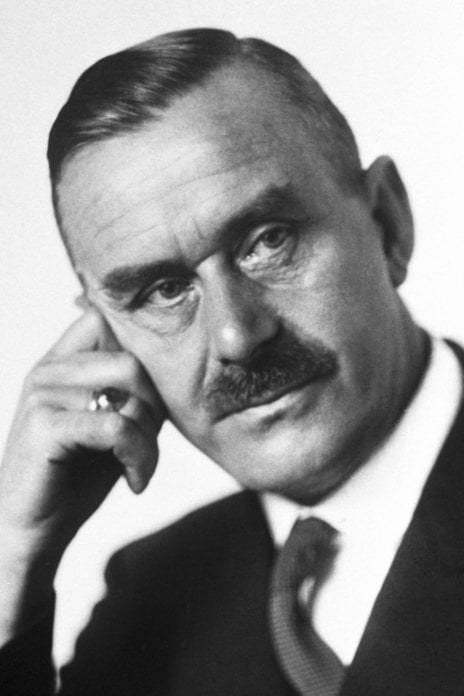
Contents — explore this biography
Lübeck and the family as a historical lensThe artist and the demands of ordinary lifeThe Magic Mountain and a continent in debateNobel recognition, exile and public responsibilityLate fiction and a difficult cultural inheritanceLübeck and the family as a historical lens
Born in Lübeck in 1875, Mann grew up in a merchant family whose background helped shape his first major novel. Buddenbrooks, published in 1901, follows a family across generations and studies the decline of a commercial world. Economic success, social obligation and private temperament become connected parts of the novel’s account of historical change.
The artist and the demands of ordinary life
Mann repeatedly explored the uneasy relationship between artistic vocation and conventional social identity. Tonio Kröger and Death in Venice place questions of desire, discipline and aesthetic distance at the centre of fiction. Their protagonists should not be treated as straightforward autobiographical substitutes: Mann’s narrative irony creates distance between a character’s convictions and the larger meaning of the work.
The Magic Mountain and a continent in debate
Published in 1924, The Magic Mountain sets an extended intellectual drama within a Swiss sanatorium. Conversations about politics, illness, time and death transform a seemingly enclosed environment into a way of examining European culture before the First World War. The novel’s scale allows competing ideas to develop without making any one speaker a simple authorial spokesman.
Nobel recognition, exile and public responsibility
Mann received the 1929 Nobel Prize in Literature, with particular recognition of Buddenbrooks. After the Nazi seizure of power, he remained abroad and later lived in the United States. His public opposition to Nazism included broadcasts to German listeners. The development of his political views is an important part of his biography, not an unchanging position projected backwards.
Late fiction and a difficult cultural inheritance
Doctor Faustus appeared in 1947, connecting a composer’s fictional career with questions about German culture and catastrophe. Mann’s later years included a return to Europe; he died in Switzerland in 1955. His work endures through its layered narration and its examination of how cultivated societies, distinguished artists and respectable families can become implicated in destructive historical forces.
Career timeline
Born in Lübeck.
Published Buddenbrooks.
Published The Magic Mountain.
Awarded the Nobel Prize in Literature.
Published Doctor Faustus.
Selected works & milestones
Buddenbrooks
A multigenerational study of a merchant family.
Death in Venice
A novella about art, desire and discipline.
The Magic Mountain
A sanatorium novel examining time and European ideas.
Doctor Faustus
A fictional composer’s life intertwined with German cultural history.
- United States Holocaust Memorial Museum — Thomas Mann
- Nobel Prize — biographical record
- Nobel Prize — award and facts
- Biographical references and further reading
Published 2026-11-02. Sources reviewed for this edition. Independent coverage of public professional activity.