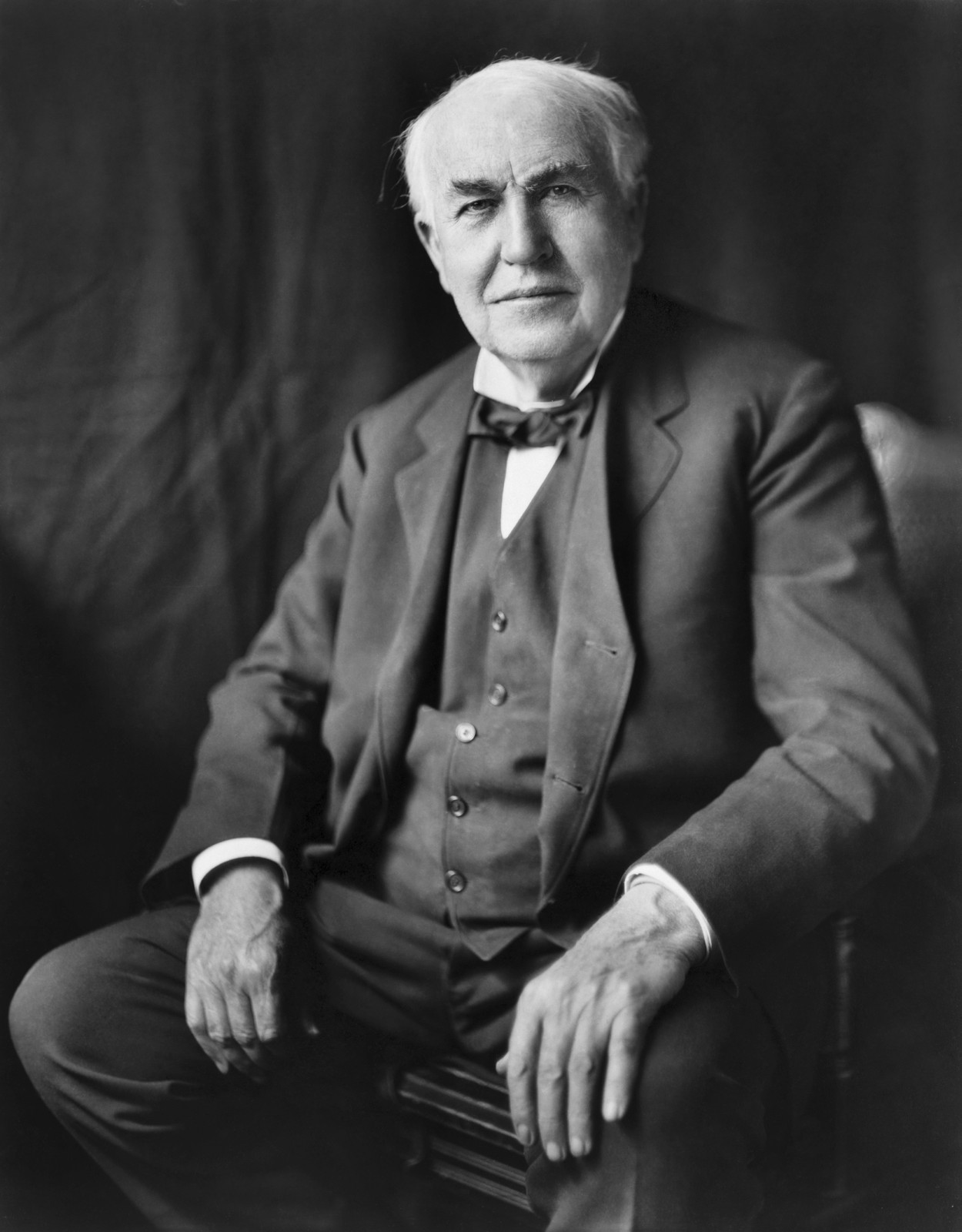
Contents — explore this biography
Telegraphy and a practical educationMenlo Park and organized experimentationThe phonograph and the possibility of recorded soundElectric lighting as a complete systemWest Orange, failures and an industrial legacyTelegraphy and a practical education
Thomas Alva Edison was born in Milan, Ohio, in 1847 and grew up largely in Port Huron, Michigan. His formal schooling was limited, but reading, technical curiosity and work provided other forms of education. Employment on the railway introduced him to commercial routines, while telegraphy gave him practical experience with electrical communication. He worked in several cities before concentrating on invention. This background helps explain the character of his later research: an instrument had to operate reliably in a real setting, and an improvement mattered when it solved a problem that someone would pay to overcome.
Menlo Park and organized experimentation
In 1876 Edison established his laboratory at Menlo Park, New Jersey. Its importance lay partly in the organization of research, with tools, materials and skilled assistants brought together for sustained experimentation. The laboratory did not make invention effortless or remove the contribution of individual collaborators. It made repeated trials and the movement between design and manufacture easier to coordinate. Edison became the public identity of this collective enterprise, but a careful history also recognizes the technicians and researchers whose work supported it. The laboratory model became as consequential as several of the products associated with his name.
The phonograph and the possibility of recorded sound
The tinfoil phonograph of 1877 established Edison’s international reputation by recording sound and reproducing it mechanically. Turning that striking demonstration into a dependable product took considerably longer. Materials, recording surfaces, playback mechanisms and manufacturing all required further development. Edison returned to the phonograph after devoting attention to electric lighting, and his companies participated in the emerging recording business. This history illustrates a recurring feature of his career: the first public sensation was only one stage. A useful commercial system needed equipment for producing recordings as well as machines that customers could operate.
Electric lighting as a complete system
Edison did not originate the general idea of incandescent lighting. His contribution involved developing a workable lamp within a broader system of generation, distribution and electrical equipment. Menlo Park’s public demonstration in 1879 and the opening of the Pearl Street power station in 1882 were major milestones in that process. The practical relationship between a filament, a power supply and a paying customer was central. Lighting therefore depended on engineering and capital as well as laboratory tests. Describing this achievement accurately means recognizing prior inventors and collaborators while explaining how the connected system advanced commercial electrification.
West Orange, failures and an industrial legacy
Edison opened a larger laboratory complex in West Orange in 1887. His later work ranged across motion pictures, improved sound recording, ore processing and alkaline storage batteries. Not every investment succeeded: his sustained effort to make low-grade iron-ore processing commercially viable consumed substantial resources. Other projects developed useful applications beyond their original intended market. He died in 1931, leaving an extensive archive of notebooks, patents and business records. His legacy is best understood through this combination of experimentation, organization, manufacturing and financial risk. The familiar image of solitary genius explains less than the working institutions preserved in those records.
Career timeline
Born in Milan, Ohio.
Established the Menlo Park laboratory.
Developed the tinfoil phonograph.
Pearl Street’s electric-power station began operating.
Died at Glenmont in New Jersey.
Selected works & milestones
Tinfoil phonograph
An early machine for recording and reproducing sound.
Incandescent-lighting demonstration
A public presentation of an integrated electric-lighting system.
Pearl Street power station
A major step in commercial electrical distribution.
West Orange laboratory
An expanded centre for research and industrial development.
- National Park Service — Edison biography
- Rutgers University — Thomas Edison Papers biography
- Library of Congress — Edison timeline
- MIT Lemelson — Thomas Edison
Published 2026-11-09. Sources reviewed for this edition. Independent coverage of public professional activity.