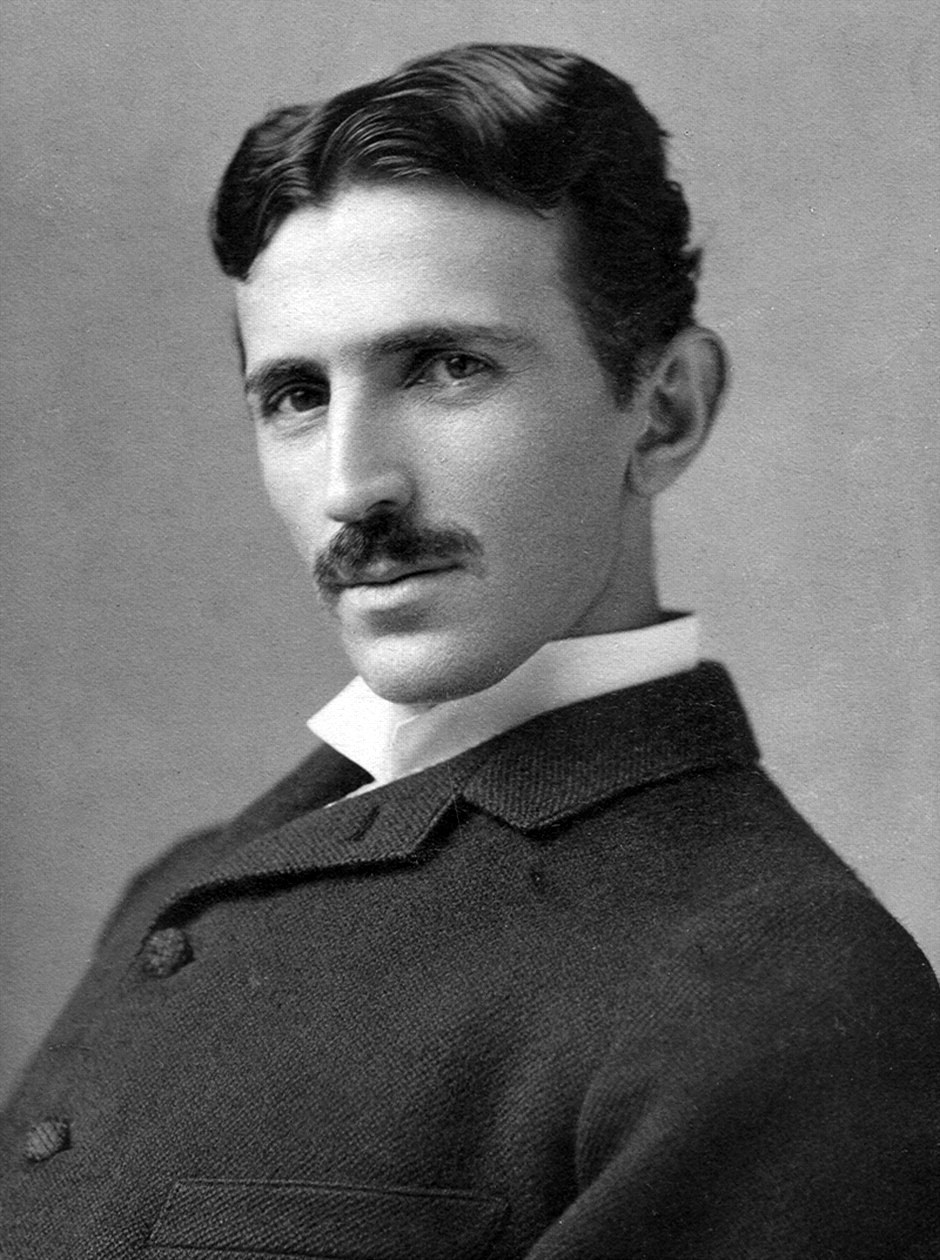
Contents — explore this biography
Origins and technical formationAlternating current and patentsWorking with WestinghouseHigh-frequency experimentsWireless ambitions and setbacksA documented engineering legacyOrigins and technical formation
Tesla was born in Smiljan in 1856 to a Serbian family in the Austrian Empire. He studied technical subjects in Graz without completing a degree, then worked in European telecommunications and electrical businesses. These practical experiences preceded his move to the United States in 1884. His biography crosses several modern national boundaries, making a simple present-day nationality label an incomplete description of his origins.
Alternating current and patents
After a short period with Edison’s organization, Tesla developed patents for polyphase alternating-current equipment. His induction-motor work used a rotating magnetic field to produce motion without the same arrangement of brushes and commutators found in many earlier motors. The patents and the engineering system are documented achievements; calling him the inventor of electricity would replace a specific contribution with an historically meaningless claim.
Working with Westinghouse
George Westinghouse licensed Tesla’s alternating-current patents in 1888, connecting the inventor’s designs with industrial manufacture and power distribution. The resulting commercial development involved other engineers, financiers and organizations. Tesla’s contribution was important within that larger system. The history of electrification consequently includes competing designs and infrastructure decisions rather than a contest won by a single person acting alone.
High-frequency experiments
In the 1890s he investigated high-voltage, high-frequency electricity, developing the resonant apparatus commonly called the Tesla coil. Public demonstrations helped make him famous, while laboratory work explored lighting, oscillation and wireless effects. These experiments should be described according to their actual operation. Electrical resonance does not establish later claims about unlimited energy, medical cures or technologies that were never demonstrated.
Wireless ambitions and setbacks
Tesla conducted experiments at Colorado Springs in 1899 and later pursued the Wardenclyffe project on Long Island. He hoped to develop large-scale wireless communication and power transmission, but the project did not reach its intended commercial form. The distinction between an ambitious proposal and a completed system is central to an accurate account of this phase of his career.
A documented engineering legacy
He died in New York in 1943, after a career combining successful patents with projects that failed to secure lasting support. His papers and apparatus are preserved by the Nikola Tesla Museum in Belgrade. The SI unit of magnetic flux density bears his name. That scientific recognition honours a real engineering record; it should not be used to validate every story subsequently attached to his reputation.
Career timeline
Moves to the United States after technical employment in Europe.
His alternating-current motor patents enter a licensing arrangement with Westinghouse.
Develops the resonant transformer associated with the Tesla coil.
Conducts a period of high-voltage electrical experimentation.
Dies in New York; his archive later becomes a major museum collection.
Selected works & milestones
Polyphase patents
His alternating-current motor patents enter a licensing arrangement with Westinghouse.
High-frequency apparatus
Develops the resonant transformer associated with the Tesla coil.
Colorado Springs
Conducts a period of high-voltage electrical experimentation.
Completed career
Dies in New York; his archive later becomes a major museum collection.
- Smithsonian — Tesla motor of 1888
- Nikola Tesla Museum — life and collections
- Nikola Tesla — biographical reference and bibliography
Published 2026-10-31. Sources reviewed for this edition. Independent coverage of public professional activity.