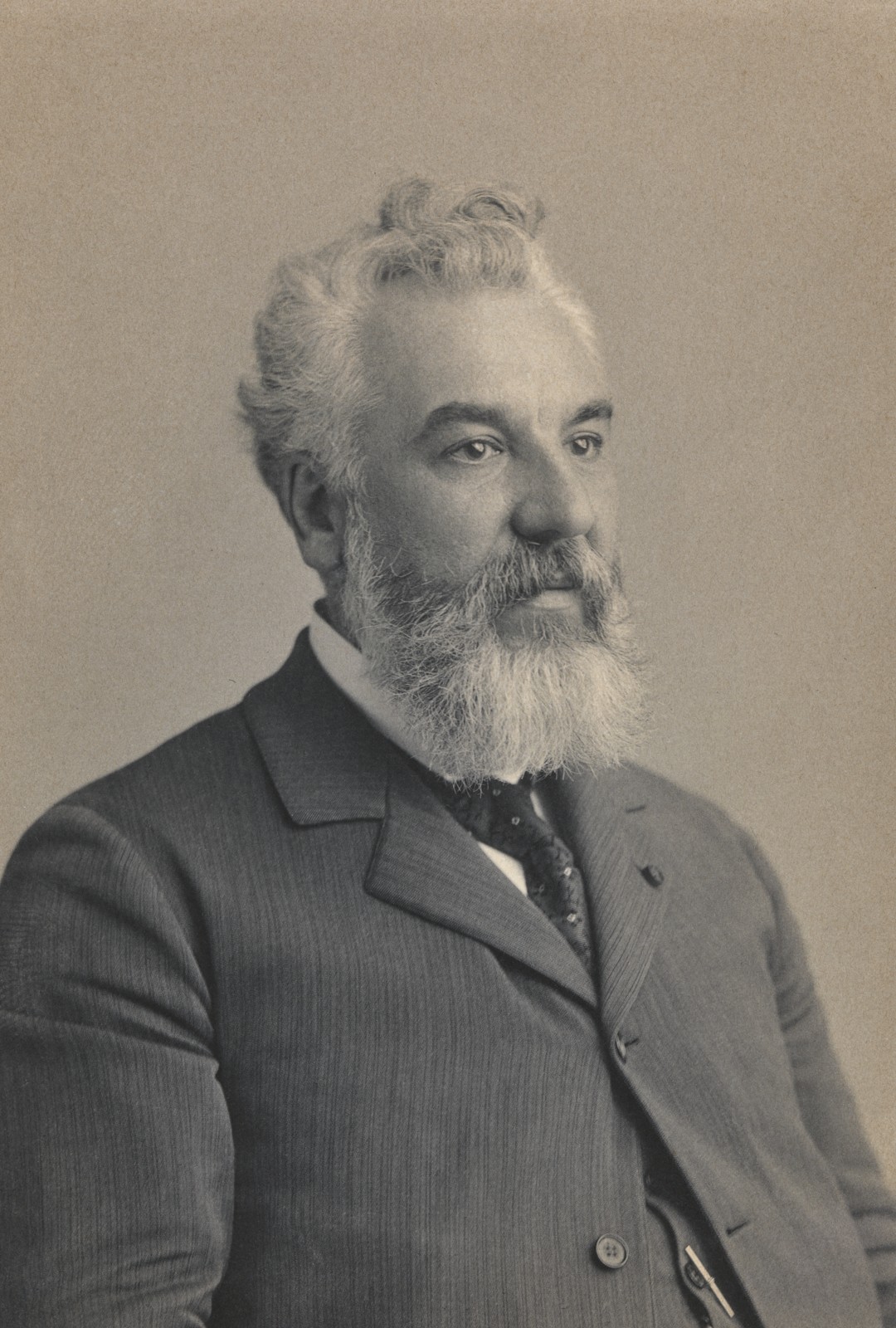
Contents — explore this biography
Speech, teaching and the study of soundThe telephone patent and an experimental breakthroughFrom demonstration to a communications networkLight, recorded sound and later experimentsEducation, contested ideas and historical legacySpeech, teaching and the study of sound
Alexander Graham Bell was born in Edinburgh in 1847 into a family deeply involved in speech and its teaching. His father’s work on visible speech and his mother’s deafness helped shape an enduring interest in communication. After moving to Canada with his family in 1870, Bell developed a teaching career in the United States. These experiences connected practical educational questions with experiments in acoustics. His route into invention therefore began with problems of speaking, hearing and representation, rather than with a ready-made plan to establish a telecommunications industry. Teaching and experimental work continued to overlap throughout his career.
The telephone patent and an experimental breakthrough
In 1876 Bell received a United States patent central to the development of the telephone. His experiments with Thomas Watson helped demonstrate the electrical transmission of intelligible speech. The achievement emerged within a crowded field of investigation into telegraphy and sound, and its history includes competing claims, patents and litigation. Bell’s importance can be described precisely without presenting invention as an isolated moment that erased all other contributors. The experimental task was to translate the changing character of a voice into an electrical signal and then reproduce an audible version at another point.
From demonstration to a communications network
Public demonstrations and the organization of telephone enterprises transformed the laboratory achievement into a commercial undertaking. That transformation required instruments, lines, exchanges, financing and users willing to adopt an unfamiliar medium. Bell’s name became closely associated with a business system much larger than his own experimental practice. The distinction matters because a successful prototype and a widely usable service are different accomplishments. His biography connects both, while recognizing the engineers, operators and commercial organizations that developed the network. The telephone’s significance grew as communication became possible between increasing numbers of connected subscribers.
Light, recorded sound and later experiments
France awarded Bell the Volta Prize in 1880, supporting the research associated with his Washington laboratory. With collaborators he explored sound recording and the photophone, which transmitted speech using light. His later interests extended to aviation and marine engineering, including work connected with the Aerial Experiment Association and hydrofoil craft. These projects reveal a wider experimental identity than the familiar telephone story suggests. Some were commercially influential, while others were exploratory or dependent on later technical developments. They should be evaluated according to what was demonstrated and built, rather than retrospectively treating every experiment as a finished modern technology.
Education, contested ideas and historical legacy
Bell died in 1922 at his home in Nova Scotia. His educational work and support for scientific institutions form important parts of his legacy, alongside his inventions. A complete account also considers his promotion of oral education for deaf students and his involvement with eugenic thinking. Those commitments are historically consequential and cannot simply be absorbed into a celebratory account of communication. His archive preserves a figure whose technical curiosity, educational ambitions and social assumptions developed together. Studying that complexity makes it possible to understand both his scientific influence and the disagreements that continue to shape interpretations of his work.
Career timeline
Born in Edinburgh.
Moved with his family to Canada.
Received the foundational United States telephone patent.
Received France’s Volta Prize and demonstrated the photophone.
Died in Nova Scotia.
Selected works & milestones
Telephone patent
Patent protection central to the electrical transmission of speech.
Photophone
Speech transmission using a beam of light, developed with collaborators.
Volta Laboratory research
Collaborative experiments in sound recording and communication.
Aerial Experiment Association
A collaborative organization investigating powered flight.
- Library of Congress — Bell family papers
- Library of Congress — inventor and scientist
- Smithsonian — Studying Sound
- Dictionary of Canadian Biography — Bell
Published 2026-11-09. Sources reviewed for this edition. Independent coverage of public professional activity.