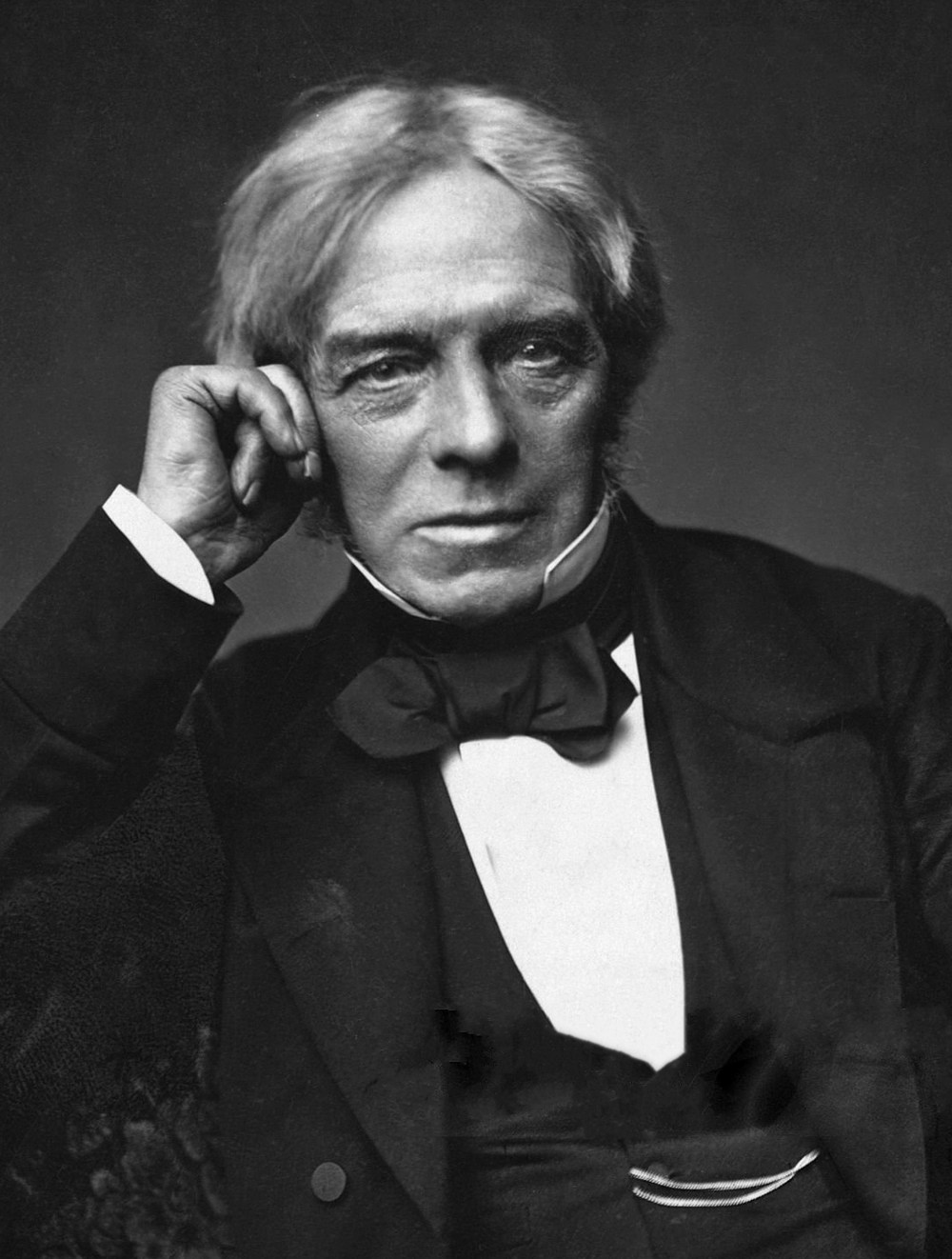
Contents — explore this biography
From bookbinding to a laboratoryElectricity producing motionInduction and changing fieldsChemistry and electrolysisFields, light and public explanationLaboratory discovery and later systemsFrom bookbinding to a laboratory
Faraday was born in 1791 and apprenticed to a London bookbinder, where reading helped develop his interest in science. After attending Humphry Davy’s lectures, he sent Davy notes and was eventually appointed at the Royal Institution in 1813. His route differed from a university education, but it involved disciplined study and apprenticeship rather than scientific work without training or institutional support.
Electricity producing motion
In 1821 he demonstrated electromagnetic rotation, showing a sustained relationship between electric current and mechanical motion. The apparatus was a laboratory demonstration, not a fully developed industrial motor. Faraday’s experiments helped reveal a principle on which later engineers would build practical devices. Distinguishing an experimental discovery from its later commercial forms gives appropriate credit both to the scientist and to subsequent engineering development.
Induction and changing fields
His 1831 experiments demonstrated electromagnetic induction: changing magnetic conditions could produce an electrical effect in a conductor. Investigations with coils and magnets helped clarify relationships later used in generators and transformers. The crucial condition was change, not the simple presence of a stationary magnet. His surviving notebooks document a sequence of experiments rather than a single moment of unexplained inspiration.
Chemistry and electrolysis
Faraday also identified benzene in 1825 and investigated electrochemical processes. His laws of electrolysis connected the quantities of material transformed at electrodes with the electrical charge passing through a system. Chemistry was therefore a central component of his career, not an incidental activity before electricity. Working across these subjects helped make quantitative relationships visible where earlier descriptions had often remained qualitative.
Fields, light and public explanation
He developed a physical picture of lines of force and in 1845 demonstrated a connection between magnetism and the polarization of light. Maxwell later gave related ideas a mathematical form. Faraday also became a celebrated lecturer, including presentations for younger audiences. Demonstration and public communication were connected with his experimental practice, while his theoretical language differed from the equations that eventually became standard.
Laboratory discovery and later systems
Faraday died in 1867. The electrical systems associated with his work were developed by many later scientists and engineers using materials, manufacturing and mathematical analysis unavailable to him. His importance is not that he personally built the modern power grid, but that his experiments established reproducible relationships. The record shows how careful apparatus, controlled change and an increasingly coherent field concept can reshape technology over generations.
Career timeline
Joins the institution as a chemical assistant to Humphry Davy.
Demonstrates a relationship between electric current and continuous motion.
Identifies the substance later known as benzene.
Establishes induction through experiments with coils and magnets.
Demonstrates magnetic rotation of the plane of polarization.
Selected works & milestones
Electromagnetic rotation
Demonstrates a relationship between electric current and continuous motion.
Benzene
Identifies the substance later known as benzene.
Electromagnetic induction
Establishes induction through experiments with coils and magnets.
Magnetism and light
Demonstrates magnetic rotation of the plane of polarization.
- Royal Institution — Faraday’s research and work
- Royal Institution — historical biography
- Institution of Engineering and Technology — archival biography
- Michael Faraday — biographical reference and bibliography
Published 2026-10-31. Sources reviewed for this edition. Independent coverage of public professional activity.