Contents — explore this biography
From India to mathematical astrophysicsThe mass limit and the argument about stellar endingsChicago and an exceptionally broad research careerBooks, teaching and the stewardship of researchNobel recognition and the observatory bearing his nameFrom India to mathematical astrophysics
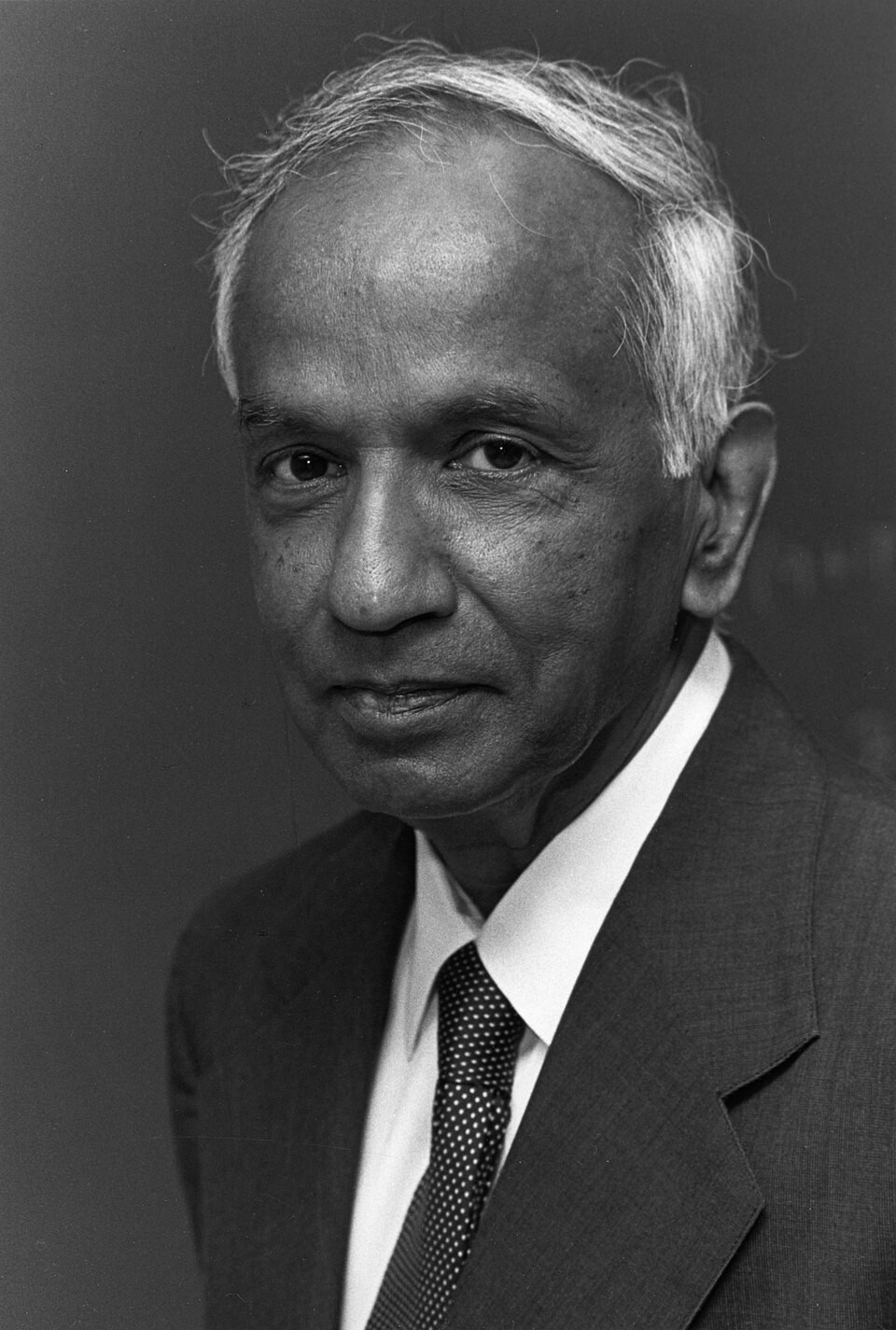
Subrahmanyan Chandrasekhar was born in Lahore in 1910 and educated in India before going to Cambridge in 1930. His early development combined advanced mathematics with the rapidly changing physics of matter and radiation. Astronomy offered questions that required both: how stars maintain equilibrium, where their energy goes and what happens as they evolve. He approached those questions through explicit physical assumptions and mathematical analysis. This was more than an interest in observing distant objects. It was an attempt to understand which stellar configurations could exist, and where the available theory placed limits on their stability and eventual fate.
The mass limit and the argument about stellar endings
Chandrasekhar’s best-known early result concerned white dwarfs, compact stellar remnants supported by electron degeneracy pressure. Incorporating relativity into the analysis led to an upper mass beyond which that form of support cannot maintain an ordinary white dwarf. The result challenged assumptions about the final condition of sufficiently massive stars and encountered prominent resistance, particularly from Arthur Eddington. The scientific significance is the existence of a limit under specified conditions, rather than a rule that independently predicts every individual star’s history. Composition, mass loss and other physical processes matter when applying stellar theory to real astronomical systems.
Chicago and an exceptionally broad research career
In 1937 Chandrasekhar joined the University of Chicago, initially working at Yerkes Observatory, and remained associated with the university until his death. Over successive periods he investigated stellar dynamics, radiative transfer, hydrodynamic stability, magnetic effects and general relativity. His working pattern often involved mastering a field, publishing a body of research and organizing it into a substantial monograph before moving to another subject. This breadth is easily obscured by the fame of the white-dwarf limit. It shows a researcher interested in the mathematical organization of physical knowledge as well as the solution of one celebrated astronomical problem.
Books, teaching and the stewardship of research
Chandrasekhar’s books gave detailed form to areas that could otherwise remain scattered across specialist papers. An Introduction to the Study of Stellar Structure appeared in 1939, followed by studies of stellar dynamics, radiation and stability. His long service as editor of The Astrophysical Journal also placed him within the everyday institutions of scientific communication. Editing and teaching do not carry the dramatic simplicity of a discovery story, but they influence how results are checked, presented and transmitted. His career joined independent theoretical work with responsibilities that helped other researchers contribute to astronomy and made a growing discipline more coherent.
Nobel recognition and the observatory bearing his name
Chandrasekhar shared the 1983 Nobel Prize in Physics with William A. Fowler; his award recognized theoretical studies relevant to stellar structure and evolution. He died in Chicago in 1995. NASA’s Chandra X-ray Observatory, launched in 1999, was named in his honour, extending public recognition beyond the community that used his equations and books. The name should not imply that he designed the spacecraft or personally conducted its later observations. It commemorates a scientific legacy. His archives, oral histories and monographs reveal a much larger contribution than a single numerical threshold: a sustained effort to make difficult physical questions mathematically intelligible.
Career timeline
Born in Lahore.
Travelled to Cambridge for advanced study.
Joined the University of Chicago.
Shared the Nobel Prize in Physics.
Died in Chicago.
Selected works & milestones
White-dwarf mass limit
A relativistic analysis of the limits of electron-degeneracy support.
An Introduction to the Study of Stellar Structure
A foundational monograph on stellar physics.
Radiative Transfer
A detailed mathematical treatment of the transport of radiation.
The Mathematical Theory of Black Holes
A major synthesis of black-hole theory.
- NASA Chandra — the man behind the name
- University of Chicago Library — Chandrasekhar papers
- American Institute of Physics — oral history
- Institute for Advanced Study — Chandrasekhar
Published 2026-11-09. Sources reviewed for this edition. Independent coverage of public professional activity.