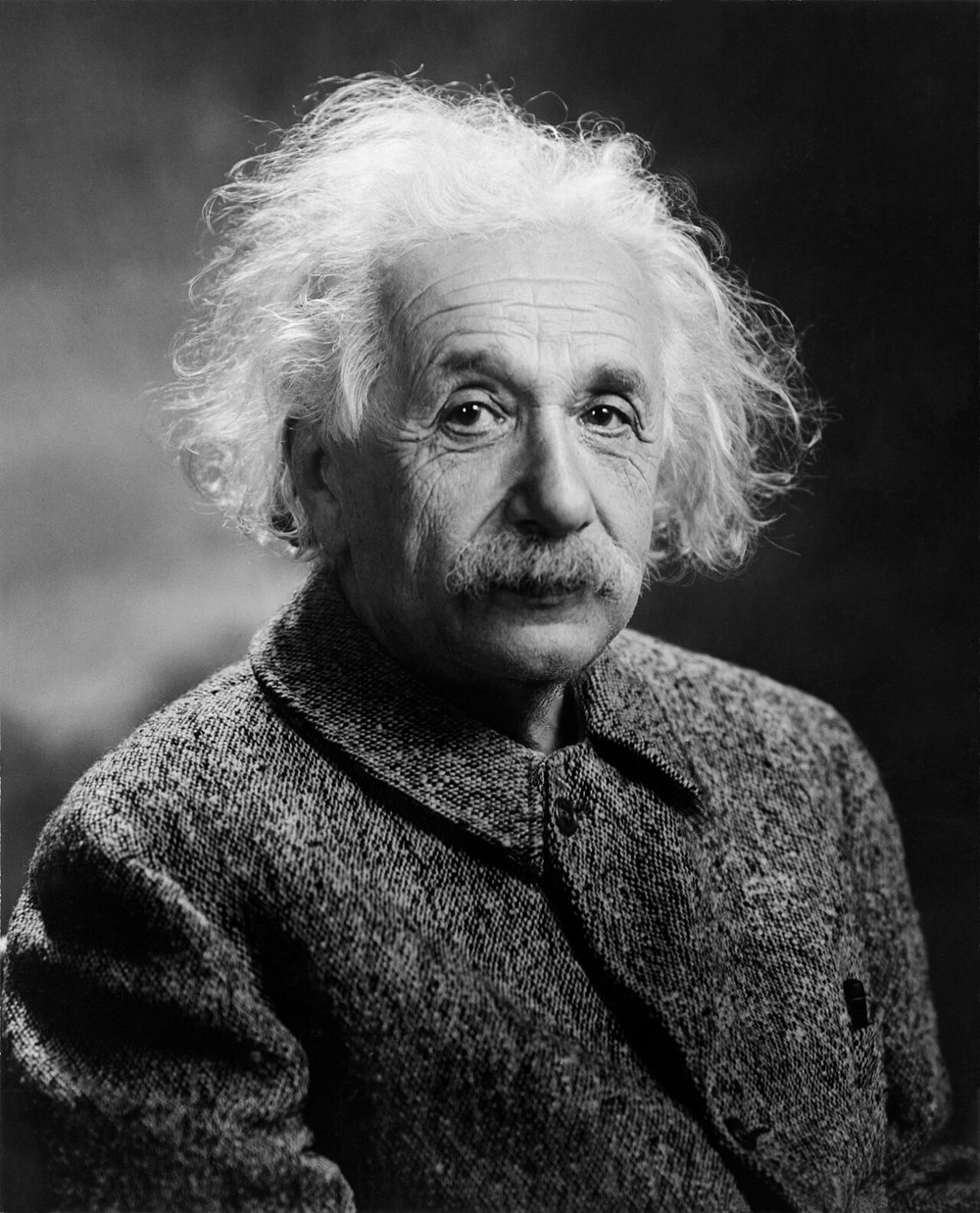
Contents — explore this biography
Education and the Bern patent officeThe papers of 1905General relativity and gravitationThe Nobel Prize and quantum theoryLeaving Germany and work in PrincetonPublic responsibility and a scientific legacyEducation and the Bern patent office
Albert Einstein studied in Switzerland and completed his teaching diploma at the federal polytechnic in Zurich in 1900. He later worked at the patent office in Bern while developing his scientific ideas. The setting has become part of a popular story about genius outside institutions, but it should not conceal his mathematical training, engagement with existing research or exchange of ideas with other people. His work addressed precise problems already troubling physics.
The papers of 1905
In 1905 Einstein published important papers on light quanta, Brownian motion, special relativity and the relationship between mass and energy. These were distinct contributions rather than one single theory. The Brownian-motion work connected the movement of suspended particles with molecular processes, while the light-quantum proposal addressed aspects of light’s interaction with matter. Special relativity reconsidered the relationship between measurements of space and time when observers move relative to one another.
General relativity and gravitation
Einstein developed general relativity over the following decade, presenting its central field equations in 1915. The theory describes gravitation through the geometry of spacetime, changing the framework used to understand gravity. Its significance rests on a mathematical structure and testable consequences, not the vague idea that everything is relative. Observations of light deflection during the 1919 eclipse helped bring public attention to the theory and turned Einstein into an unusually recognizable scientist.
The Nobel Prize and quantum theory
The Nobel Prize in Physics for 1921, awarded to Einstein in 1922, particularly recognized his law of the photoelectric effect. It was not awarded specifically for relativity. His contribution helped establish the importance of light quanta in modern physics, even though he later challenged aspects of the developing interpretation of quantum mechanics. The history is therefore more complex than a simple opposition between Einstein and quantum theory: he helped create questions whose answers he continued to debate.
Leaving Germany and work in Princeton
Einstein did not return to Germany after the Nazis came to power in 1933 and became associated with the Institute for Advanced Study in Princeton. He acquired United States citizenship in 1940 while retaining Swiss citizenship. His later work pursued a unified description of physical fields, without achieving the intended final theory. The public image of a scientist who had already transformed physics coexisted with an ongoing research programme whose ambitions were not fully realized.
Public responsibility and a scientific legacy
Einstein’s public life included statements on war, persecution and civil rights. He signed the 1939 letter warning President Franklin Roosevelt about the possibility of nuclear weapons, but did not work on the Manhattan Project. He died in Princeton in 1955. His legacy includes foundational scientific results and a complicated public role; evaluating either requires keeping documented contributions separate from inspirational quotations and claims later attached to his famous name.
Career timeline
Completes his diploma at the federal polytechnic in Zurich.
Publishes major papers on light quanta, Brownian motion and relativity.
Presents the central field equations of general relativity.
Receives the Nobel Prize in Physics designated for 1921.
Settles in the United States after the Nazi rise to power in Germany.
Selected works & milestones
Light-quantum paper
A foundational contribution to understanding light’s interaction with matter.
Special relativity
Reframes measurements of space and time for observers in relative motion.
General relativity
A new account of gravitation through the geometry of spacetime.
Nobel Prize in Physics
The prize year recognizing theoretical physics, especially the law of the photoelectric effect.
- Albert Einstein — biographical reference and cited sources
- Nobel Prize — scientific and award record
- Max Planck Society — historical profile
- United States National Park Service — historical biography
Published 2026-10-31. Sources reviewed for this edition. Independent coverage of public professional activity.