Contents — explore this biography
Oxford, Cambridge and early researchSingularities and the limits of a theoryBlack holes and quantum effectsA Cambridge career and collaborationA Brief History of Time and communicationDisability, technology and a scientific legacyOxford, Cambridge and early research
Stephen Hawking studied physics at Oxford before moving to Cambridge for doctoral work in cosmology. He completed his PhD in 1966. His early scientific questions concerned the large-scale structure of the universe and the conditions described by general relativity. The later public image of a solitary genius can conceal the training, mathematical frameworks and conversations through which this work developed within an active research community.
Singularities and the limits of a theory
Hawking worked with Roger Penrose on results concerning singularities in general relativity. A singularity in this context signals a limit in the classical description under particular conditions, rather than a directly observed object with every property already explained. The work helped sharpen questions about gravitational collapse and the universe’s early history. Its significance comes from mathematical reasoning with stated assumptions, not from simply attaching a dramatic image to the word beginning.
Black holes and quantum effects
In the 1970s Hawking showed that combining quantum-field effects with a black-hole background leads to a prediction of thermal radiation, now called Hawking radiation. The result connected gravitation, quantum theory and thermodynamics in a new way. It remains important to distinguish a theoretical prediction from a routine direct observation of radiation from astrophysical black holes. The research also contributed to continuing debates about information and what a complete theory of quantum gravity must explain.
A Cambridge career and collaboration
Hawking held the Lucasian chair of mathematics at Cambridge from 1979 to 2009. His work included further research with collaborators, among them James Hartle on a proposal concerning the universe’s quantum state. Scientific institutions, students and colleagues formed part of the career behind the famous name. New proposals were subject to argument and revision, and the public visibility of an idea did not remove the need to distinguish established results from open theoretical questions.
A Brief History of Time and communication
A Brief History of Time, published in 1988, brought questions about time, black holes and the universe to a broad readership. The achievement involved explaining difficult material without expecting readers to follow every mathematical derivation. Popular communication is a different task from a research paper, with its own compromises in analogy and detail. Hawking’s later books and public appearances extended that role, making a working theoretical physicist an unusually familiar cultural figure.
Disability, technology and a scientific legacy
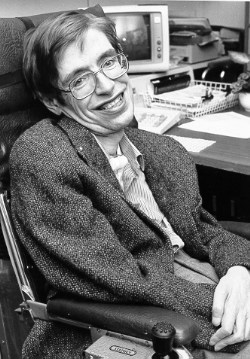
Hawking lived for decades with motor neurone disease and used assistive technology for communication. Those conditions shaped daily work and public presentation, but they do not replace the scientific content of his career. He died in Cambridge in 2018. His legacy combines research that changed the questions asked about black holes with an example of science communicated across a large audience, supported by collaborators, care and technologies that made continued participation possible.
Career timeline
Completes his doctoral degree at Cambridge.
Develops the prediction of thermal radiation from black holes.
Becomes Lucasian Professor of Mathematics at Cambridge.
Publishes A Brief History of Time.
Dies in Cambridge after a long research and public-communication career.
Selected works & milestones
Singularity research with Roger Penrose
Mathematical work addressing gravitational collapse and limits within general relativity.
Hawking radiation
A theoretical result linking black-hole physics with quantum effects and temperature.
No-boundary proposal with James Hartle
A research proposal concerning the quantum state and initial conditions of the universe.
A Brief History of Time
A widely read introduction to questions in cosmology and fundamental physics.
- Stephen Hawking — biographical reference and cited sources
- University of Cambridge — scientific biography
- Cambridge Faculty of Mathematics — research record
- Institute of Physics — professional obituary
- Hartle and Hawking — Wave function of the Universe, 1983
Published 2026-10-31. Sources reviewed for this edition. Independent coverage of public professional activity.