Contents — explore this biography
An independent mathematical educationCorrespondence that crossed institutional boundariesNumbers, partitions and surprising connectionsRecognition and the final period of workThe notebooks as a continuing research programmeAn independent mathematical education
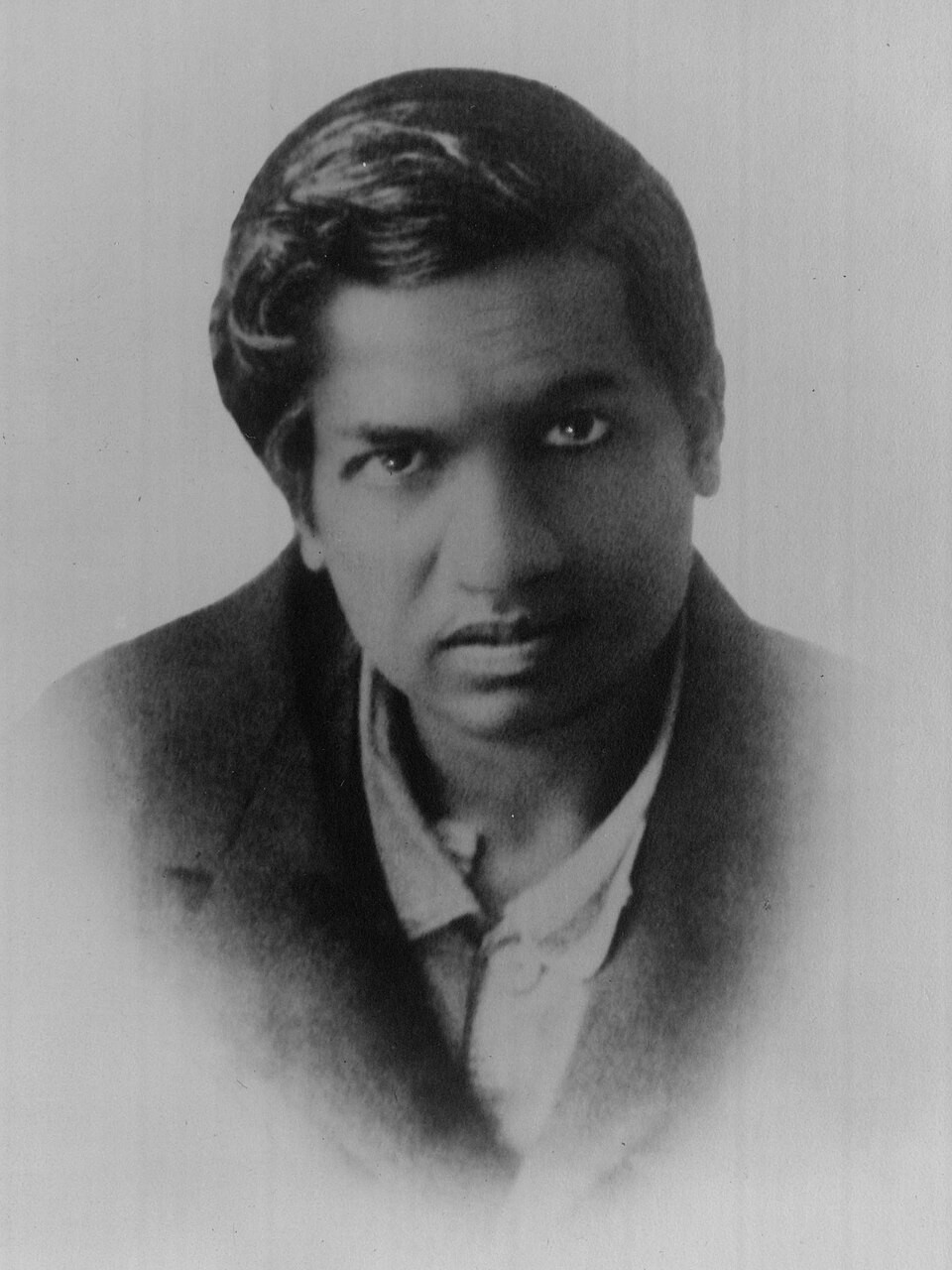
Srinivasa Ramanujan was born in Erode in 1887 and grew up in southern India. His exceptional interest in mathematics developed through school, borrowed books and an increasingly independent programme of calculation. A scholarship did not provide a straightforward university career: his concentration on mathematics came at the expense of other subjects required for examinations. This background is important because the later story is sometimes reduced to effortless intuition. His notebooks instead show sustained work, extensive experimentation and a distinctive way of recognizing relationships among expressions. The lack of conventional credentials also created practical difficulties in securing time and financial support for research.
Correspondence that crossed institutional boundaries
While working in Madras, Ramanujan sought mathematical contacts who could assess results that did not fit a familiar academic presentation. His 1913 letter to G. H. Hardy at Cambridge proved decisive. Hardy and J. E. Littlewood recognized that the formulas deserved serious attention, and arrangements followed for Ramanujan to travel to England in 1914. Their encounter joined different habits of thought: Ramanujan brought a vast stock of original identities and conjectures, while Cambridge offered colleagues, libraries and established standards of proof. The collaboration developed through discussion and argument, rather than simply converting an unknown outsider into a conventional European mathematician.
Numbers, partitions and surprising connections
Ramanujan’s research ranged across infinite series, continued fractions, modular equations and properties of integers. With Hardy he developed influential work on the partition function, which counts ways of expressing an integer as a sum of positive integers without treating order as significant. The resulting asymptotic approach showed how an apparently elementary counting question could connect with sophisticated analysis. His separate investigations included highly composite numbers and rapidly converging expressions involving pi. The value of these contributions lies in their precise mathematical structures, not in the popular suggestion that every striking numerical coincidence represents a discovery. Some results required later correction or substantial additional proof.
Recognition and the final period of work
In 1918 Ramanujan was elected a Fellow of the Royal Society and a Fellow of Trinity College. These honours recognized research produced during a remarkably short career, but they did not remove the serious illness that affected his years in Britain. He returned to India in 1919 and continued mathematical work, including the ideas he described as mock theta functions. He died in 1920, aged thirty-two. The chronology matters: the final discoveries were part of active research under difficult circumstances, not a retrospective label invented to explain his reputation. His correspondence and manuscripts preserve the development of questions that remained productive long after his death.
The notebooks as a continuing research programme
Ramanujan’s notebooks became a lasting resource for mathematicians who worked to establish proofs, interpret notation and connect individual entries with wider theories. Their importance is therefore both historical and contemporary. They document a particular researcher’s methods while continuing to generate new mathematical questions. Archives at Trinity and the Royal Society also make it possible to examine the institutional support, correspondence and evaluation behind the famous story. His legacy resists a simple opposition between inspiration and discipline: unexpected insight, long calculation, collaborative criticism and rigorous demonstration all have roles. The continuing effort to understand his work is itself evidence of its depth and unusual range.
Career timeline
Born in Erode.
Sent his influential letter to G. H. Hardy.
Arrived at Cambridge to pursue research.
Elected to the Royal Society and a Trinity College fellowship.
Died in India after returning the previous year.
Selected works & milestones
Modular equations and approximations to pi
A notable paper connecting special functions and numerical approximation.
Highly composite numbers
A major investigation of integers with unusually many divisors.
Work on partitions with Hardy
An influential analytical approach to a combinatorial counting problem.
Mock theta functions
Ideas communicated near the end of his life and developed by later researchers.
- Trinity College — Ramanujan
- Trinity College Library — papers of Srinivasa Ramanujan
- Royal Society — revisiting Ramanujan
- Royal Society — certificate of election
Published 2026-11-09. Sources reviewed for this edition. Independent coverage of public professional activity.