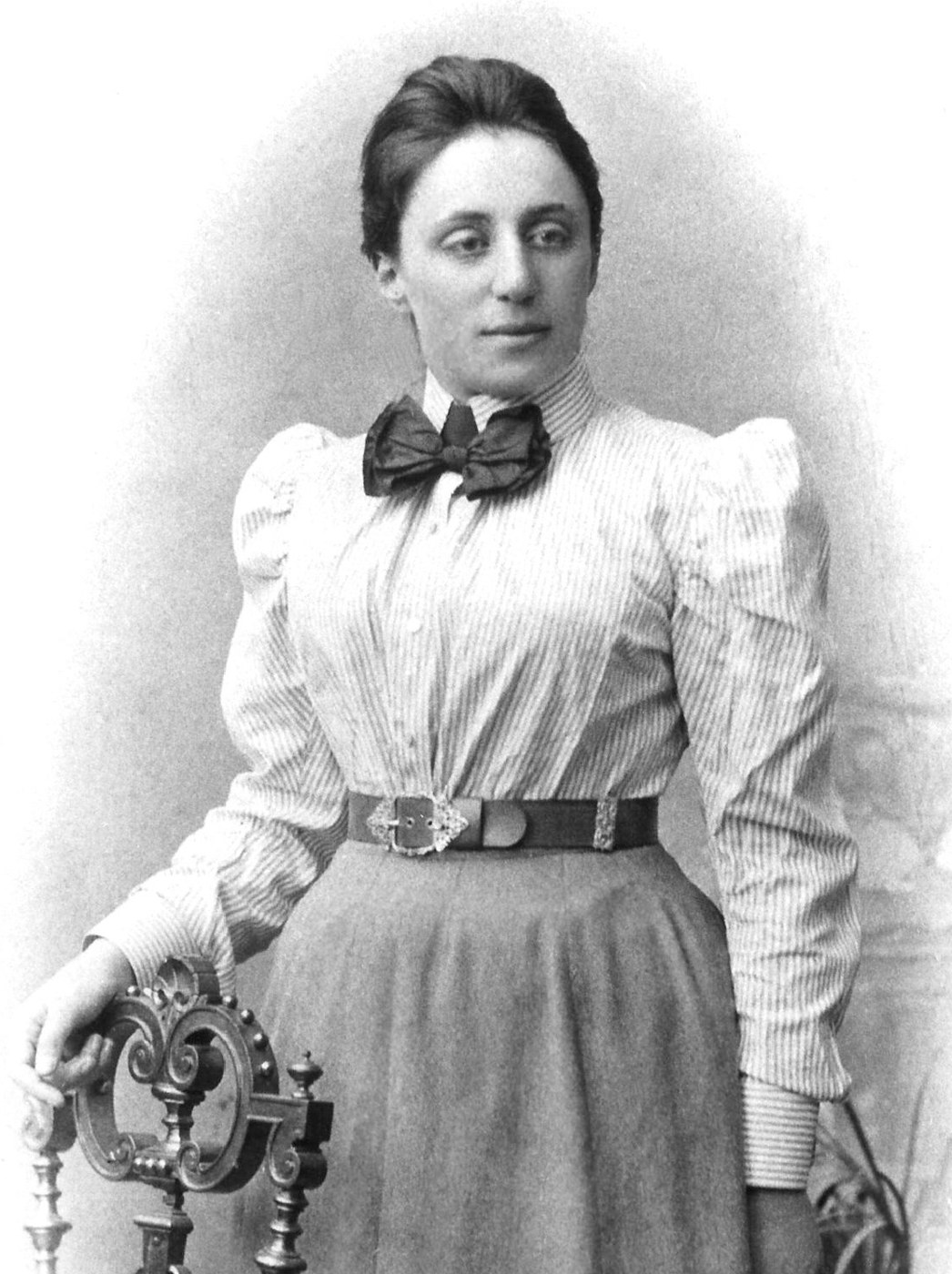
Contents — explore this biography
An unconventional route into mathematicsGöttingen and the problem of symmetryRebuilding algebra around conceptsTeaching despite institutional barriersExile, Bryn Mawr and an enduring schoolAn unconventional route into mathematics
Emmy Noether was born in Erlangen in 1882 into a family that included the mathematician Max Noether. Initially trained to teach languages, she chose university mathematics instead. Women’s restricted access meant that attending lectures and obtaining formal qualifications required separate battles. She earned her doctorate at Erlangen in 1907 under Paul Gordan, working on invariant theory. Her later mathematics moved away from elaborate calculations toward the structures that explain why whole classes of results hold.
Göttingen and the problem of symmetry
David Hilbert and Felix Klein invited Noether to Göttingen in 1915. Questions arising around relativity drew upon her expertise in invariants. Her 1918 paper on invariant variational problems established results connecting continuous symmetries of suitable physical systems with conservation laws. For example, time-translation symmetry is associated with conservation of energy under the theorem’s mathematical assumptions. The significance lies in deriving conservation from structure, rather than treating each conserved quantity as an unrelated empirical rule.
Rebuilding algebra around concepts
Noether’s influence extended well beyond the theorem familiar to physicists. Her work on ideals, rings and chain conditions helped establish the conceptual language of modern abstract algebra. A 1921 paper on ideal theory became especially influential. Instead of approaching each algebraic object as a separate computational puzzle, she investigated common properties and relationships. The term Noetherian now identifies important finiteness conditions throughout mathematics, reflecting an approach adopted and extended by generations of researchers.
Teaching despite institutional barriers
For years, Noether’s research standing exceeded her formal academic position. Göttingen did not approve her habilitation until 1919; earlier courses could be advertised under Hilbert’s name. She nevertheless built a powerful intellectual community through lectures, discussion and generous collaboration. Students and colleagues carried her methods into algebra, geometry and topology. The history of her teaching illustrates how mathematical authority can develop even when salary, title and institutional recognition fail to match scholarly influence.
Exile, Bryn Mawr and an enduring school
In 1933 the Nazi regime removed Noether from her university position because she was Jewish. Bryn Mawr College provided a new academic home in Pennsylvania, and she also gave informal lectures at the Institute for Advanced Study. She died in 1935, only a short time after beginning this American chapter. Her legacy survives through both published results and a way of reasoning: identify the underlying mathematical structure, state its assumptions clearly and use those relationships to unify seemingly different problems.
Career timeline
Born in Erlangen.
Completed her doctorate in mathematics.
Moved to Göttingen at the invitation of Hilbert and Klein.
Published her theorems on invariant variational problems.
Moved to Bryn Mawr after dismissal under Nazi racial policy.
Selected works & milestones
Invariant variational problems
Established fundamental relationships between symmetries and conservation laws.
Ideal theory in rings
Advanced the structural foundations of modern algebra.
Göttingen habilitation
Obtained formal permission to teach after years of institutional resistance.
Bryn Mawr and IAS lectures
Continued research and teaching in the United States.
- University of St Andrews — MacTutor biography
- Institute for Advanced Study — archival legacy
- Biographical references
Published 2026-11-05. Sources reviewed for this edition. Independent coverage of public professional activity.