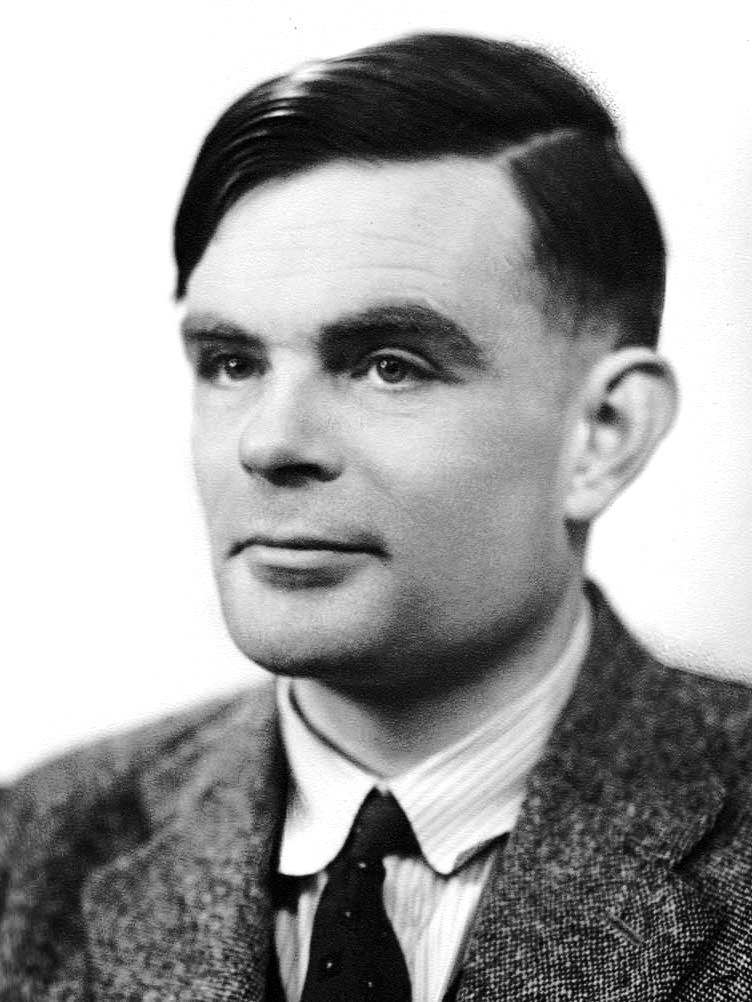
Contents — explore this biography
Mathematical education and early questionsThe 1936 computation paperBletchley Park and collaborative codebreakingEarly computers after the warMachine intelligence and biological patternPersecution and an enduring legacyMathematical education and early questions
Alan Turing studied at King’s College, Cambridge, before completing a doctorate at Princeton in 1938. His early work concerned mathematical logic and what can be achieved through a specified sequence of operations. These questions were not initially about the appearance of a modern laptop or smartphone. They concerned the underlying limits of a procedure, making the later significance of his work broader than one particular machine design.
The 1936 computation paper
In his 1936 work on computable numbers, Turing described an abstract machine that follows rules while reading and writing symbols. The model helped make the idea of a mechanical procedure precise. A universal machine could simulate other machines when supplied with an appropriate description. This was a theoretical framework, not a physical computer he built that year, and the distinction is important when explaining how mathematical ideas later relate to engineering.
Bletchley Park and collaborative codebreaking
During the Second World War, Turing worked at Bletchley Park, with a major role in the attack on German naval Enigma communications. The effort built on earlier Polish achievements and involved many other people, methods and machines. His contribution was significant without requiring a story in which one person alone broke an entire system. Intelligence depended on operations, captured material, technical advances and the continuing difficulty of changing enemy procedures.
Early computers after the war
After the war, Turing worked at the National Physical Laboratory on the Automatic Computing Engine and later at Manchester. These activities brought abstract ideas into contact with the practical design and use of early computers. Memory, speed and reliable implementation imposed requirements different from a proof in mathematical logic. The career thus connects foundational theory with engineering questions, while each setting retained its own standards for what counted as a successful result.
Machine intelligence and biological pattern
His 1950 paper Computing Machinery and Intelligence proposed an imitation-game framework for considering machine intelligence. In 1952 he published work on morphogenesis, exploring how interacting processes could produce biological patterns. The two projects illustrate the range of his interests rather than one continuous attempt to build a human replica. A mathematical model or a proposed test can sharpen a question without settling every philosophical or biological issue attached to it.
Persecution and an enduring legacy
Turing was prosecuted in 1952 under laws criminalizing sex between men and subjected to hormonal treatment. He died in 1954. The injustice is an essential part of his biography, alongside the technical work rather than as a replacement for it. His legacy includes concepts still used to discuss algorithms, computation and intelligence. Understanding that contribution requires resisting both the solitary-war-hero myth and the temptation to treat a famous name as an explanation for every later development in computing.
Career timeline
Publishes foundational work defining computation through an abstract machine model.
Completes his doctoral degree at Princeton.
Begins wartime work at Bletchley Park.
Publishes Computing Machinery and Intelligence.
Publishes work on morphogenesis and is prosecuted under anti-gay laws.
Selected works & milestones
On Computable Numbers
A foundational mathematical account of mechanical computation and its limits.
Bletchley Park research
Major contributions to collaborative wartime cryptanalysis, particularly naval Enigma.
Computing Machinery and Intelligence
Introduces an imitation-game approach to questions about machine intelligence.
The Chemical Basis of Morphogenesis
Mathematical research concerning the formation of patterns in biological systems.
- Alan Turing — biographical reference and cited sources
- King’s College Cambridge — Turing archive biography
- University of Manchester — historical profile
- Andrew Hodges — biographical account
Published 2026-10-31. Sources reviewed for this edition. Independent coverage of public professional activity.