Contents — explore this biography
Learning retail before WalmartA discount business built around smaller marketsDistribution, information and operating disciplineSam’s Club and a different retail formatLeadership, ownership and a lasting legacyLearning retail before Walmart
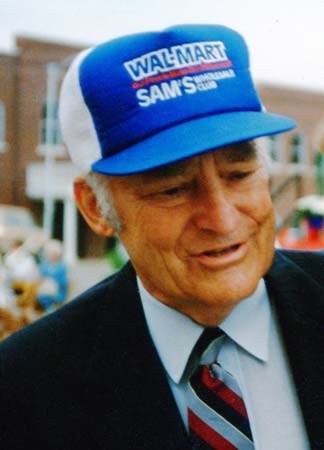
Sam Walton was born in Kingfisher, Oklahoma, in 1918 and developed his retail career through practical experience rather than a single invention. After university and an early period in department-store retailing, he served in the military during the Second World War. He married Helen Robson in 1943. Following military service, the couple moved to Newport, Arkansas, where he operated a variety store. His later move to Bentonville in 1950 led to Walton’s 5&10. These stores gave him direct experience of buying, stock turnover, customer habits and the vulnerability of a business whose success depended on a particular location.
A discount business built around smaller markets
Walton opened the first Walmart in Rogers, Arkansas, in 1962. Discount retailing already existed; his distinctive opportunity involved applying it to markets that larger competitors did not always prioritize. Low prices required more than persuasive advertising. They depended on purchasing, expense control and enough sales volume to make narrow margins workable. Expansion therefore involved a connected operating problem: how to offer a wide range of goods, keep them available and repeat the model in another town. This helps explain why his significance belongs to the organization of retail as much as to the identity of an individual store.
Distribution, information and operating discipline
Walmart’s growth linked stores with distribution centres and increasingly sophisticated information systems. Public ownership, beginning in 1970, helped finance expansion, while the business developed methods for tracking merchandise and communicating across its network. The important relationship was between what happened at a shelf and what happened elsewhere in the company. A low advertised price was useful only if the product could reach that shelf at a sustainable cost. Walton’s interest in visiting stores, observing competitors and discussing details with employees reflected this operational emphasis. The enterprise grew through repeated adjustments across a system rather than one dramatic commercial breakthrough.
Sam’s Club and a different retail format
The first Sam’s Club opened in 1983, extending Walton’s retail interests into membership-based warehouse shopping. This format organized the customer relationship differently from a conventional discount store: membership, bulk purchasing and a more limited assortment could support another balance between convenience, price and operating expense. Walmart also expanded its supercentre format, combining general merchandise with a full grocery offering. These developments show that the company’s growth did not simply mean building identical stores indefinitely. It involved testing formats and adapting the underlying retail system to different purchasing situations, while retaining a strong focus on volume and cost.
Leadership, ownership and a lasting legacy
Walton received the Presidential Medal of Freedom in 1992 and died that year. His autobiography, written with John Huey, presented his account of the company’s development and the habits he believed mattered. Its perspective is valuable but should be distinguished from a complete independent history. His legacy includes the extraordinary scale of the retail organization he founded, the commercial discipline associated with discounting and the influence large retailers exercise over suppliers and local markets. A careful biography therefore examines both personal leadership and institutional structure: the founder’s curiosity mattered, but distribution, finance, employees and repeatable routines made expansion possible.
Career timeline
Born in Kingfisher, Oklahoma.
Opened Walton’s 5&10 in Bentonville.
Opened the first Walmart in Rogers, Arkansas.
Opened the first Sam’s Club.
Received the Presidential Medal of Freedom and died later that year.
Selected works & milestones
Walton’s 5&10
The Bentonville variety store preceded Walmart.
First Walmart
A discount store opened in Rogers, Arkansas.
Sam’s Club
A membership warehouse format.
Made in America
Autobiography written with John Huey.
- Walmart — Sam Walton
- Walmart — company history
- University of Arkansas — Arkansas Business Hall of Fame
- Harvard Business School — Samuel M. Walton
Published 2026-11-07. Sources reviewed for this edition. Independent coverage of public professional activity.