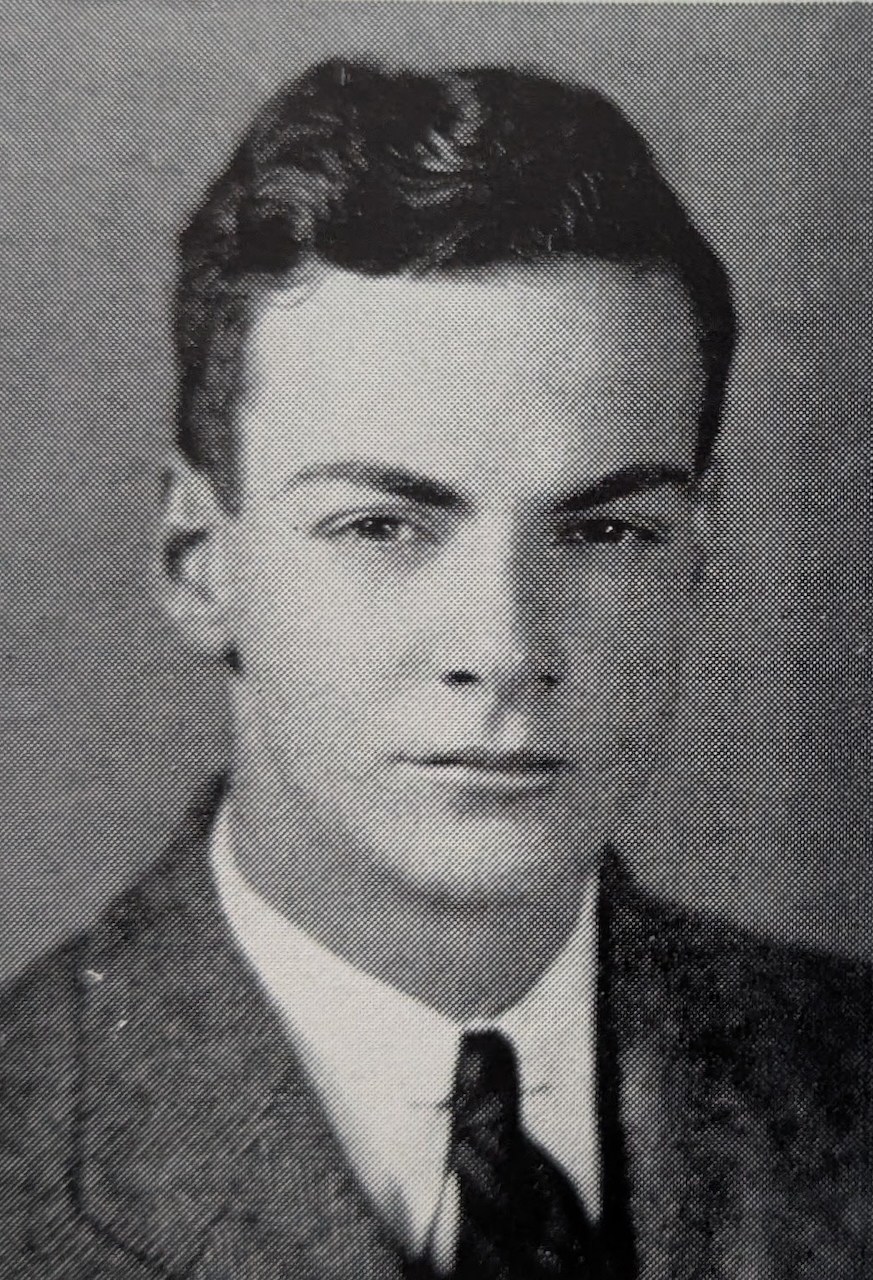
Contents — explore this biography
From MIT to PrincetonWartime Los AlamosPaths, diagrams and electrodynamicsCaltech and a shared Nobel PrizeTeaching and public investigationA legacy beyond anecdotesFrom MIT to Princeton
Feynman grew up in New York, studied at MIT and completed his doctorate at Princeton in 1942 under John Wheeler. His early work explored alternative ways to formulate quantum theory and electromagnetic interactions. The mathematical training preceded the distinctive public personality associated with his later books. His research depended on a wider community of physicists confronting difficult problems left open by earlier quantum mechanics.
Wartime Los Alamos
During the Second World War he joined the Manhattan Project at Los Alamos, contributing to theoretical and computational work on nuclear weapons. The project was a vast collective undertaking with scientific, military and ethical dimensions. His participation belongs in the biography alongside his later research. It should not be compressed into the misleading claim that he individually invented an atomic bomb or directed the entire programme.
Paths, diagrams and electrodynamics
Feynman developed a path-integral approach and a diagrammatic method for organizing terms in calculations. His work helped resolve problems in quantum electrodynamics, the theory of interactions between light and charged matter. The diagrams are precise mathematical bookkeeping, not literal pictures of a particle’s observed journey. Their practical power came from connecting visual organization with rules for obtaining quantities that experiments could test.
Caltech and a shared Nobel Prize
After teaching at Cornell, he joined Caltech in 1950. The 1965 Nobel Prize in Physics was shared with Sin-Itiro Tomonaga and Julian Schwinger for fundamental work in quantum electrodynamics. Other researchers, including Freeman Dyson, helped relate the approaches. The award therefore recognizes an important contribution within a field built through multiple independent formulations, not one person discovering all of modern particle physics.
Teaching and public investigation
The lectures he delivered at Caltech in the early 1960s became The Feynman Lectures on Physics, produced with Robert Leighton and Matthew Sands. In 1986 he served on the commission investigating the Challenger disaster, drawing attention to temperature-related behavior of an O-ring material. His demonstration mattered within a much larger investigation of technical evidence, management decisions and communication failures.
A legacy beyond anecdotes
Feynman died in 1988. His contributions also included superfluid helium and ideas that later influenced quantum computing. Popular stories convey curiosity and independence, but they do not replace the mathematics that made his research significant. A complete profile separates the celebrated raconteur from the working theorist while showing how clear explanation, skepticism and carefully specified calculations can support one another.
Career timeline
Completes doctoral research under John Wheeler.
Joins the California Institute of Technology.
Begins the lecture series later published with Leighton and Sands.
Shares the Physics Nobel with Tomonaga and Schwinger for quantum electrodynamics.
Participates in the investigation of the Space Shuttle disaster.
Selected works & milestones
Caltech appointment
Joins the California Institute of Technology.
Physics lectures
Begins the lecture series later published with Leighton and Sands.
Nobel Prize
Shares the Physics Nobel with Tomonaga and Schwinger for quantum electrodynamics.
Challenger commission
Participates in the investigation of the Space Shuttle disaster.
- Caltech — Feynman Lectures author biography
- Nobel Prize — Feynman biographical account
- Nobel Prize — Feynman’s original Nobel lecture
- Richard Feynman official archive — biographical record
- Richard Feynman — biographical reference and bibliography
- Birth date — institutional biographical record
Published 2026-10-31. Sources reviewed for this edition. Independent coverage of public professional activity.