Contents — explore this biography
From medicine to mathematicsTelescopes and new observationsEvidence and the arrangement of planetsThe conflict over CopernicanismMotion and the later bookThe significance of a mixed recordFrom medicine to mathematics
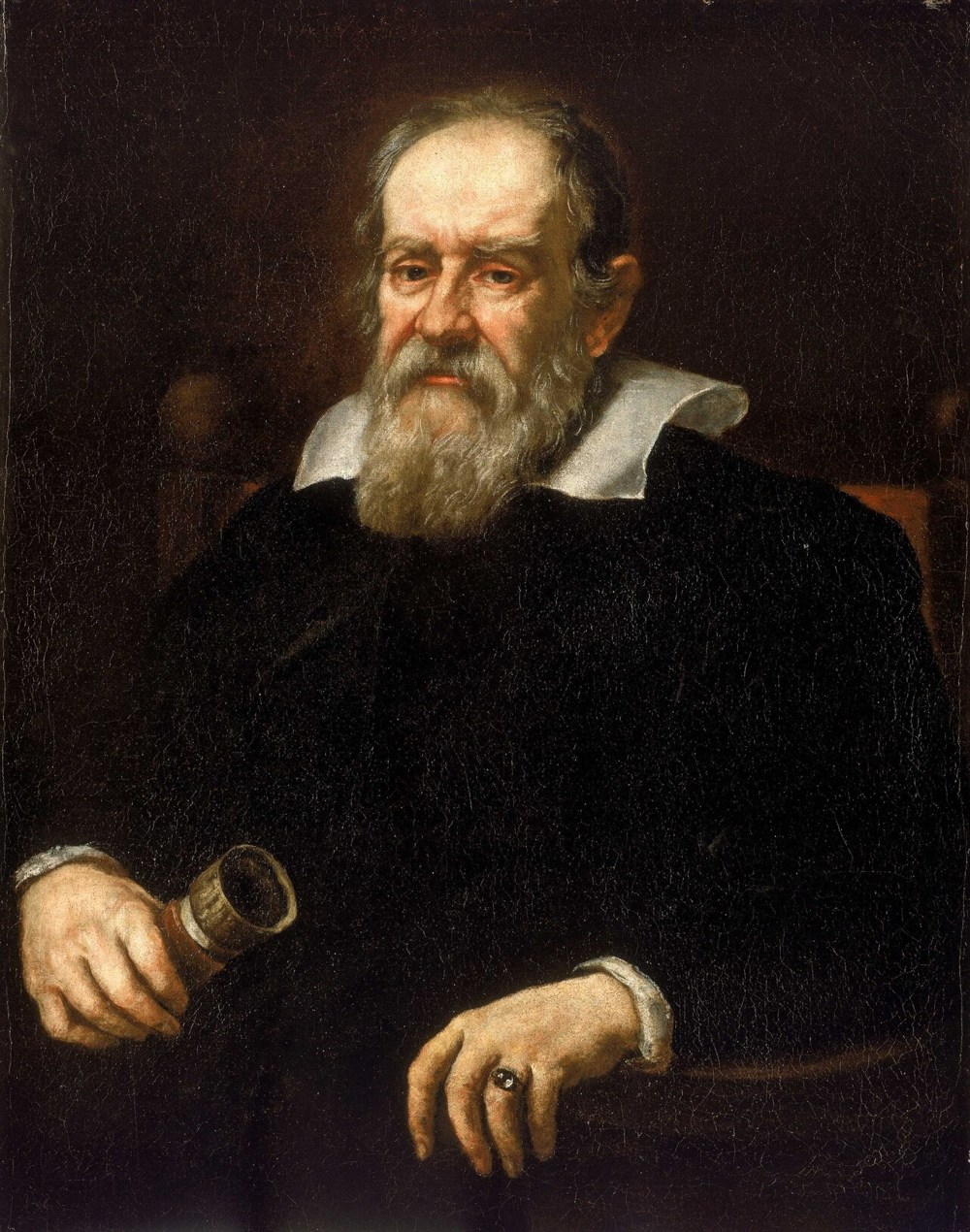
Galileo was born in Pisa in 1564 and began university study in medicine before concentrating on mathematics. He later taught in Pisa and Padua. His work developed within a culture of patrons, universities and practical instrument-making. That setting matters because early modern science did not operate through the same professional laboratories, journals and funding arrangements familiar in research today.
Telescopes and new observations
After hearing about telescopes developed elsewhere in Europe, Galileo improved his own instruments in 1609 and directed them toward the sky. He did not invent the telescope. His observations included the Moon’s uneven surface, many previously unresolved stars and four satellites orbiting Jupiter. Sidereus Nuncius, published in 1610, reported findings that expanded what instruments could reveal beyond unaided vision.
Evidence and the arrangement of planets
The phases of Venus were incompatible with the traditional Ptolemaic arrangement, while Jupiter’s satellites showed that not everything revolved directly around Earth. These discoveries supported alternatives to established astronomy. They did not by themselves exclude every Earth-centred mathematical model. Galileo argued for Copernicanism, but his explanation of tides as proof of Earth’s motion was mistaken, illustrating the difference between strong observations and an unsuccessful supporting argument.
The conflict over Copernicanism
Church authorities restricted advocacy of Copernican astronomy in 1616. Galileo’s Dialogue Concerning the Two Chief World Systems appeared in 1632 and led to his trial in 1633. He was required to recant and spent his remaining years under house arrest. The episode involved authority, scriptural interpretation, patronage and scientific argument; compressing it into a simple hostility toward all observation loses important historical detail.
Motion and the later book
His work on falling bodies, inclined planes and projectiles contributed to a mathematical study of motion. Discourses and Mathematical Demonstrations Relating to Two New Sciences was published in Leiden in 1638, during his confinement. Rather than treating every motion as a separate phenomenon, Galileo sought quantitative relationships. Later mechanics would build on these results while changing and extending the conceptual framework.
The significance of a mixed record
Galileo died at Arcetri in 1642. Surviving instruments, manuscripts and editions preserve both his achievements and the limits of his observations. His career demonstrates the productive interaction of measurement, mathematics and persuasion. It also shows that an influential scientist can be correct about central questions while wrong about particular mechanisms, a distinction that makes historical understanding more useful than uncomplicated hero worship.
Career timeline
Begins his long teaching period at the University of Padua.
Constructs instruments and starts systematic astronomical observations.
Reports lunar features, stars and Jupiter’s satellites.
Faces the Roman Inquisition and is placed under house arrest.
Publishes his major later treatment of motion and materials.
Selected works & milestones
Improved telescopes
Constructs instruments and starts systematic astronomical observations.
Sidereus Nuncius
Reports lunar features, stars and Jupiter’s satellites.
Trial and confinement
Faces the Roman Inquisition and is placed under house arrest.
Two New Sciences
Publishes his major later treatment of motion and materials.
- Museo Galileo — scholarly biography
- Museo Galileo — chronological record of his life
- Rice University Galileo Project — biography
- Galileo Galilei — biographical reference and bibliography
Published 2026-10-31. Sources reviewed for this edition. Independent coverage of public professional activity.