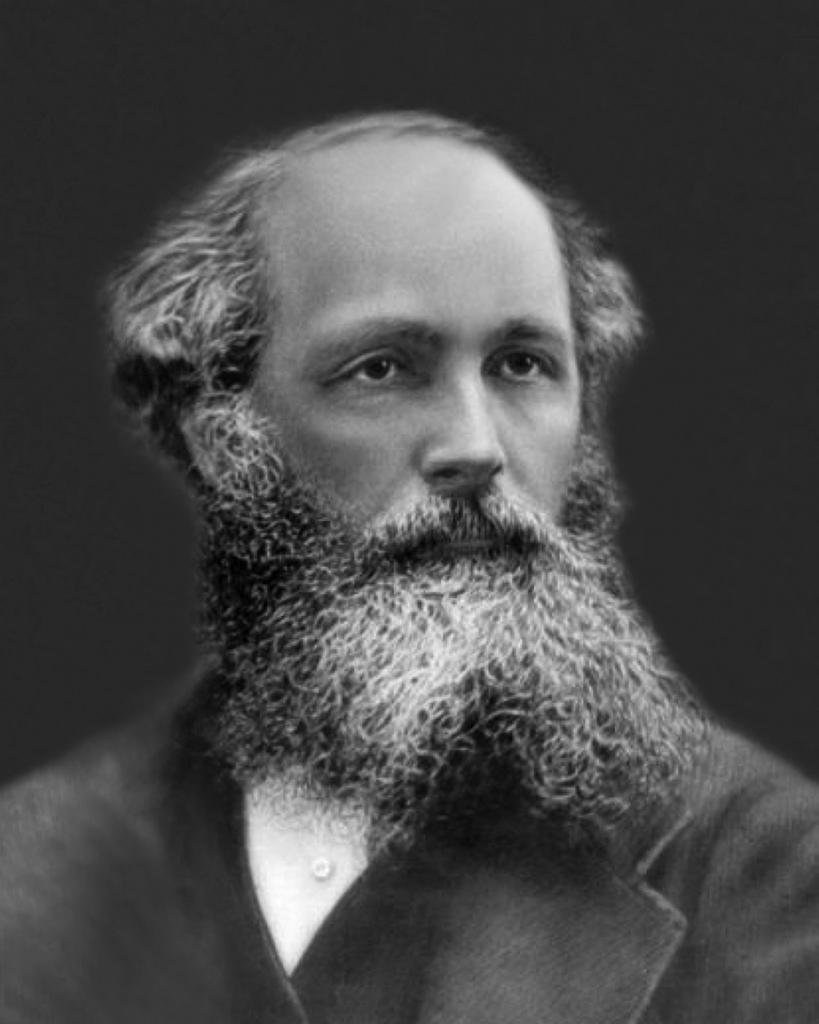
Contents — explore this biography
Education and early mathematical workFrom Faraday’s ideas to equationsLight as an electromagnetic waveGases and statistical physicsColour, Saturn and the laboratoryA foundation for later physicsEducation and early mathematical work
Maxwell was born in Edinburgh in 1831 and studied at Edinburgh University before moving to Cambridge. He developed a reputation for unusual mathematical ability while retaining interests in physical models and experiments. Appointments in Aberdeen and London followed. His intellectual development joined geometry and analysis with practical questions, rather than separating mathematical thought from the behavior of material systems.
From Faraday’s ideas to equations
Michael Faraday’s experimental work and lines of force influenced Maxwell’s approach to electricity and magnetism. Maxwell developed mathematical relationships that described coupled electric and magnetic fields. The compact four-equation vector form familiar in textbooks was shaped by later reformulation. His achievement should therefore be recognized without assuming that every modern notation and presentation appeared exactly as students now encounter it.
Light as an electromagnetic wave
In work presented in 1864 and published in 1865, Maxwell connected the propagation speed predicted by electromagnetic theory with the measured speed of light. He argued that light belongs to the same physical family as electromagnetic disturbances. Later experimental confirmation and developments in relativity changed the wider theoretical setting. The unification itself opened a route to understanding phenomena that had previously been studied as separate subjects.
Gases and statistical physics
Maxwell also studied how a gas can be described through the distribution of molecular speeds rather than by tracking every particle. His work helped build statistical mechanics and influenced Ludwig Boltzmann’s later development of the field. The famous thought experiment called Maxwell’s demon examined the relationship between molecular motion, information and thermodynamic reasoning; it was not a proposal for a demonstrated machine that produces unlimited energy.
Colour, Saturn and the laboratory
He investigated colour vision and helped produce a celebrated three-colour photographic demonstration in 1861. His analysis of Saturn’s rings argued for a system of many small bodies rather than a single rigid structure. In 1871 he became Cambridge’s first Cavendish Professor and helped establish the laboratory. The range of work shows a scientist pursuing connected problems through theory, measurement and institution-building.
A foundation for later physics
Maxwell died in 1879, leaving the Treatise on Electricity and Magnetism and a substantial body of research. Radio engineering and much later communications technology depend on physical principles his work clarified, but those systems required their own inventors and industrial development. His scientific legacy is a framework with continuing explanatory power, not personal authorship of every device that subsequently used an electromagnetic wave.
Career timeline
Becomes professor at Marischal College in Aberdeen.
Participates in the landmark three-colour photographic demonstration.
Publishes the major dynamical theory linking light with electromagnetic waves.
Becomes the first Cavendish Professor at Cambridge.
Publishes A Treatise on Electricity and Magnetism.
Selected works & milestones
Colour photography
Participates in the landmark three-colour photographic demonstration.
Electromagnetic field
Publishes the major dynamical theory linking light with electromagnetic waves.
Cavendish chair
Becomes the first Cavendish Professor at Cambridge.
Treatise
Publishes A Treatise on Electricity and Magnetism.
- James Clerk Maxwell Foundation — life and research chronology
- King’s College London — Maxwell and electromagnetic unification
- University of St Andrews — scholarly biography
- James Clerk Maxwell — biographical reference and bibliography
Published 2026-10-31. Sources reviewed for this edition. Independent coverage of public professional activity.