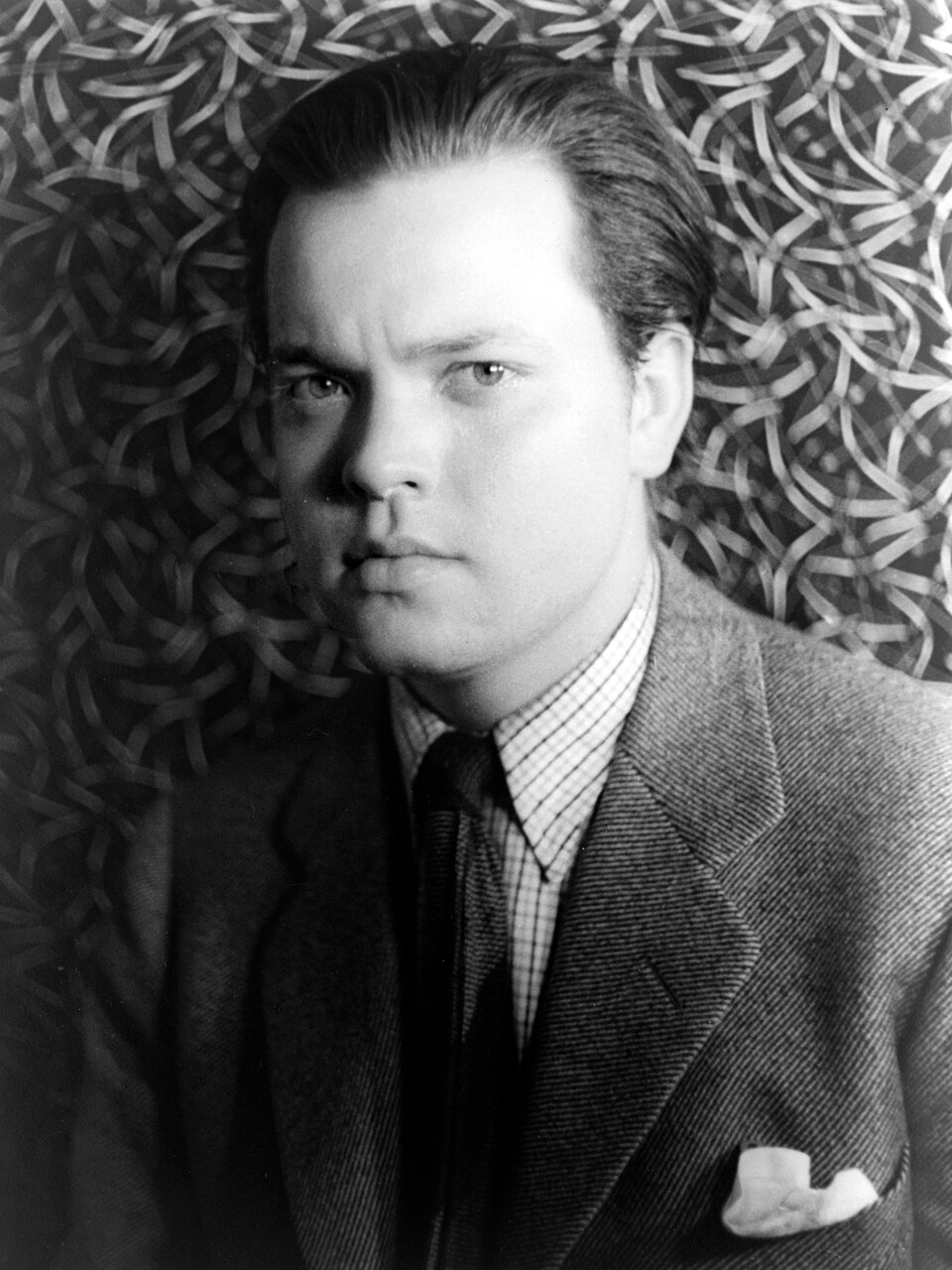
Contents — explore this biography
An artist formed across several mediaRadio and the authority of a familiar formatCitizen Kane and competing accounts of a lifeIndependence, adaptation and unfinished workArchives and a legacy of questioning appearancesAn artist formed across several media
Orson Welles was born in Kenosha, Wisconsin, in 1915 and developed his creative identity through performance, visual invention and an early engagement with Shakespeare. Theatre became a laboratory in which acting, movement, lighting and sound could be organized together. His later career never fitted comfortably within the category of film director alone. He worked as a writer, actor, broadcaster and presenter, carrying methods between media rather than leaving one behind for another. Understanding that movement helps explain why voice and theatrical space remain so important even in his most visually ambitious films.
Radio and the authority of a familiar format
With the Mercury Theatre, Welles helped build a company whose productions brought an energetic approach to established dramatic material. The 1938 radio adaptation of H. G. Wells’s The War of the Worlds became a defining episode in broadcasting history. Its use of simulated news interruptions drew attention to the credibility audiences could assign to the sound and structure of a report. Later accounts frequently enlarged the scale of the public reaction, so the broadcast is better studied through recordings and contemporary evidence than through a simple legend of nationwide panic. Its formal ingenuity remains audible without exaggeration.
Citizen Kane and competing accounts of a life
Citizen Kane, released in 1941, brought Welles to Hollywood as a director, producer, co-writer and leading performer. Its inquiry into a powerful man’s life unfolds through witnesses whose knowledge is partial and whose interpretations do not fully agree. The structure makes biography itself a problem: public evidence and private memory cannot be assembled into a perfectly transparent person. Welles and Herman J. Mankiewicz received the screenplay Oscar at the 1942 ceremony. The achievement also depended on collaborators, including cinematographer Gregg Toland, whose work contributed to the film’s layered visual organization.
Independence, adaptation and unfinished work
The production history of The Magnificent Ambersons demonstrated how strongly a film’s final form could be affected by studio decisions beyond its director’s control. Welles subsequently worked across American and European settings, adapting Shakespeare and other literary material while also appearing in films directed by others. Touch of Evil, Chimes at Midnight and F for Fake reveal different approaches to authority, performance and the unstable status of an account. His irregular financing and unfinished projects belong to that history. They should neither erase completed achievements nor be romanticized into proof that every unrealized idea would have become a masterpiece.
Archives and a legacy of questioning appearances
Welles received an Honorary Academy Award in 1971 and died in 1985. Collections at the University of Michigan, Indiana University and Wisconsin preserve scripts, correspondence and recordings that allow researchers to examine his working methods. The surviving material encourages a distinction between the public persona and the conditions under which particular works were made. His influence extends beyond distinctive camera positions or dramatic narration. He made the process of persuasion visible, repeatedly asking how an audience comes to trust a speaker, an image or a story, and how that trust can be redirected.
Career timeline
Born in Kenosha, Wisconsin.
The Mercury Theatre broadcast The War of the Worlds.
Citizen Kane was released.
Received an Honorary Academy Award.
Died after a career spanning stage, radio, film and television.
Selected works & milestones
The War of the Worlds
A radio adaptation using the conventions of news broadcasting.
Citizen Kane
A feature told through competing recollections of a public figure.
Touch of Evil
A crime film exploring corruption and authority.
F for Fake
An essay film concerned with art, deception and storytelling.
- University of Michigan — Orson Welles Papers
- Library of Congress — War of the Worlds record
- Academy — Citizen Kane at the 1942 ceremony
- Academy — 1971 awards
- BFI — Welles across media
Published 2026-11-07. Sources reviewed for this edition. Independent coverage of public professional activity.