Contents — explore this biography
A visual education in photographyFinding a route into feature filmmakingSatire, scale and the unknownAdaptation and the construction of atmosphereThe work behind the public reputationA visual education in photography
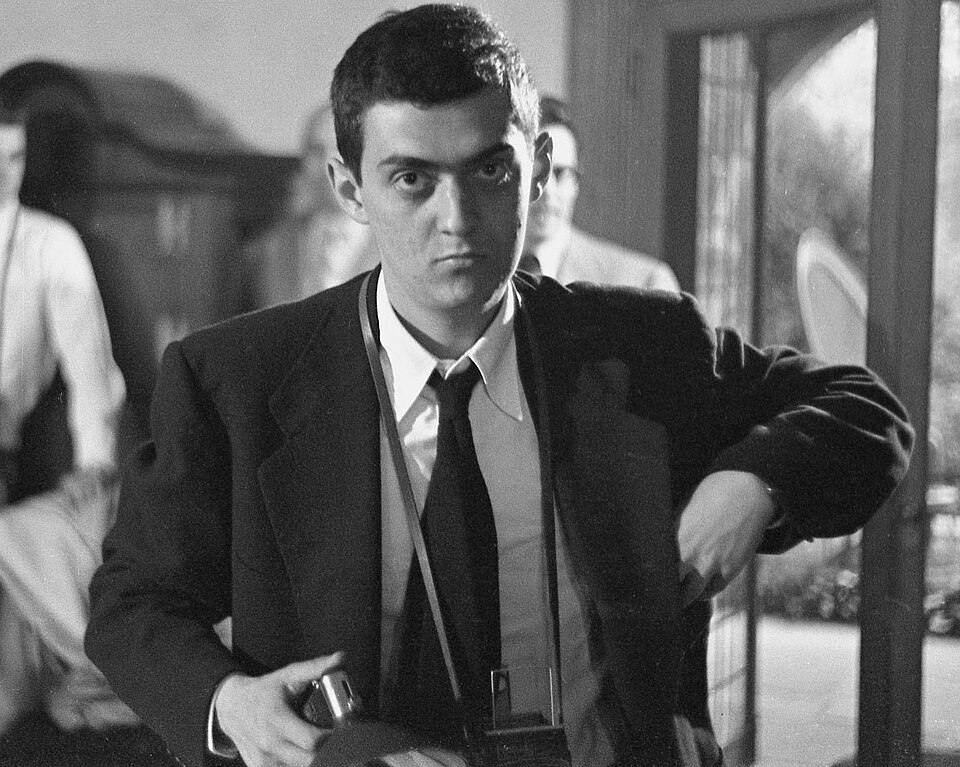
Stanley Kubrick was born in New York City in 1928 and first developed a professional visual practice through photography. After freelance sales to Look magazine, he became an apprentice photographer in 1946 and a staff photographer in 1947. The Library of Congress preserves negatives and contact sheets from many of his assignments. This material shows an artist working with sequences, public spaces and the behaviour of people before a camera. It also provides a useful corrective to the image of a filmmaker who emerged fully formed: observational work and editorial deadlines preceded his large feature productions.
Finding a route into feature filmmaking
Kubrick moved from short documentaries into independently produced features, gradually building experience in financing, shooting and editing. The Killing, released in 1956, uses a robbery plot whose overlapping points of view disrupt straightforward chronology. Paths of Glory followed in 1957, placing military authority and individual responsibility within a sharply controlled dramatic structure. Spartacus, released in 1960, brought him into a major historical production with established stars and substantial resources. These different circumstances reveal a director negotiating the practical conditions of film production while developing a recognizably exact approach to images and performance.
Satire, scale and the unknown
Dr. Strangelove, released in 1964, converts nuclear strategy into an unsettling comedy of institutional reasoning and human frailty. Four years later, 2001: A Space Odyssey widened the scale from a crisis of command to questions of evolution, technology and intelligence. Its extended passages of movement and music allow the audience to experience uncertainty rather than receive a complete explanation through dialogue. The contrast between these films is instructive: Kubrick could treat immense subjects through absurd speech or through the partial withdrawal of speech, changing the form to suit the demands of the imagined world.
Adaptation and the construction of atmosphere
Literary adaptation runs throughout Kubrick’s career, but his films are not merely illustrated versions of books. Barry Lyndon uses costume, setting and a deliberately measured visual organization to examine social ascent and dependence. The Shining transforms a hotel into a disquieting arrangement of spaces, sounds and repeated movements. Full Metal Jacket divides its account of war between military training and combat environments. Across these different projects, rhythm and the relation between bodies and institutions become central expressive tools. The films ask viewers to interpret systems of behaviour as well as follow the fortunes of a protagonist.
The work behind the public reputation
Kubrick died in 1999, the year his final feature, Eyes Wide Shut, was released. His archive at University of the Arts London contains scripts, research, production papers, photographs and materials for completed and unfinished projects. Those records make the labour behind an apparently self-contained film more visible, including choices that changed during preparation. They also complicate the familiar mythology of total control. Kubrick’s legacy includes a distinctive body of films, but it depends on collaborations, available technologies and production histories that can be investigated rather than replaced by anecdotes about perfectionism alone.
Career timeline
Born in New York City.
Began an apprenticeship with Look magazine.
Paths of Glory was released.
2001: A Space Odyssey was released.
Died; Eyes Wide Shut was released later that year.
Selected works & milestones
Paths of Glory
A drama examining military hierarchy and responsibility.
Dr. Strangelove
A satirical film about nuclear command and political judgment.
2001: A Space Odyssey
A science-fiction feature exploring technology, intelligence and human origins.
The Shining
A literary adaptation built around isolation and psychological uncertainty.
- Library of Congress — Kubrick’s Look photography
- BFI — a guide to Kubrick’s films
- UAL — Stanley Kubrick Archive
- LACMA — career exhibition
Published 2026-11-07. Sources reviewed for this edition. Independent coverage of public professional activity.