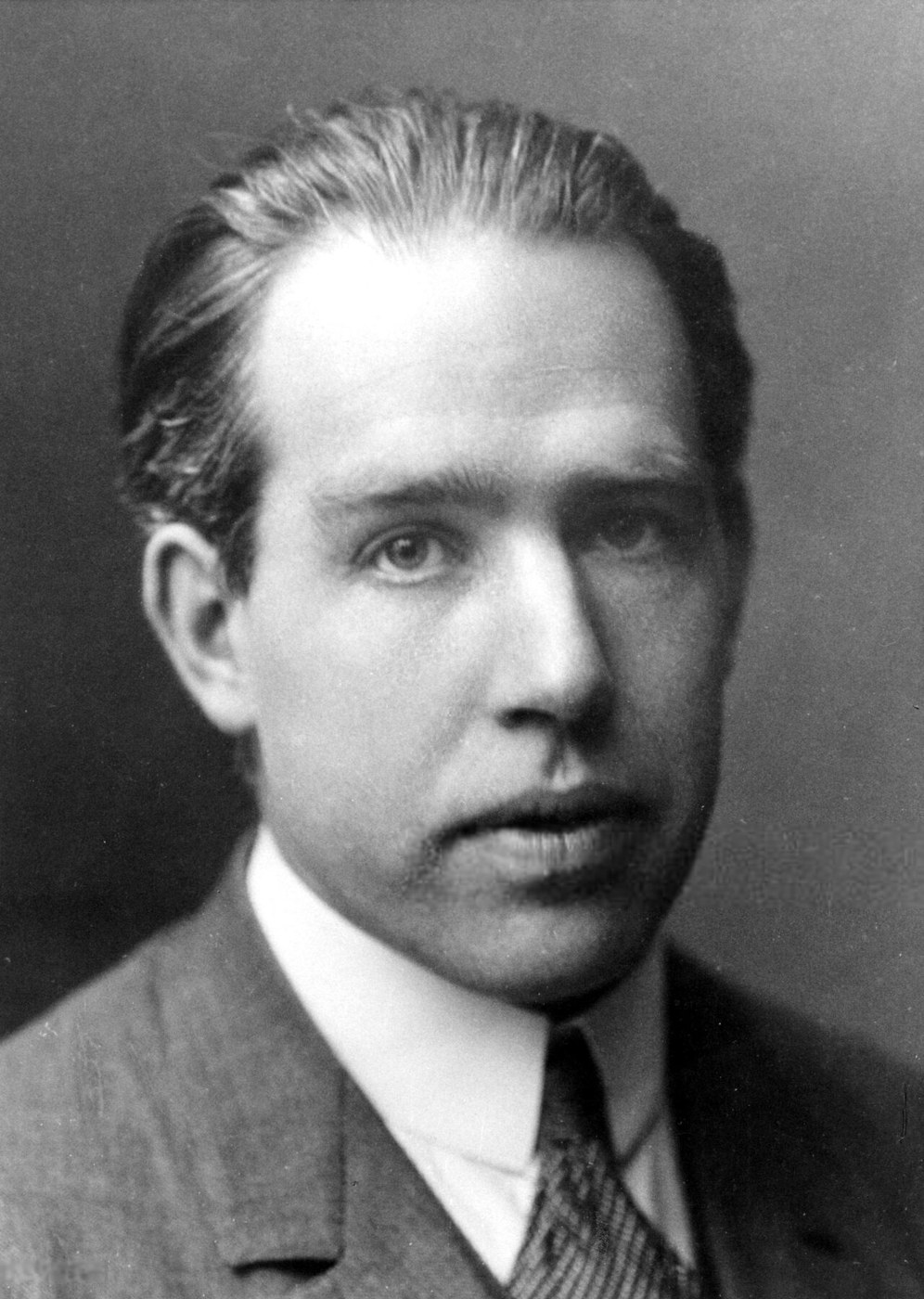
Contents — explore this biography
Copenhagen and an experimental educationThe atomic model of 1913Building an international research centreComplementarity and the limits of descriptionWar, responsibility and scientific memoryCopenhagen and an experimental education
Bohr was born in Copenhagen in 1885 and studied physics at the city’s university. His early research concerned the behaviour of electrons in metals. He subsequently worked in Britain, including with Ernest Rutherford in Manchester, where a new nuclear picture of the atom provided the setting for his most influential early contribution.
The atomic model of 1913
Rutherford’s nuclear atom raised difficult questions about stability and the light emitted by atoms. In 1913 Bohr proposed permitted atomic states and transitions involving particular energy differences. The model explained important features of hydrogen’s spectrum. It combined the nuclear atom with quantum ideas while retaining elements that later quantum mechanics would replace.
Building an international research centre
Bohr’s Copenhagen institute opened in 1921 and attracted researchers from many countries. Its importance extended beyond one scientist’s publications: visitors exchanged calculations, challenged interpretations and trained new generations. The institute helped make theoretical physics a collaborative international enterprise, with Copenhagen functioning as a meeting place during a period of rapid conceptual change.
Complementarity and the limits of description
Bohr received the Nobel Prize in Physics in 1922. His later discussions of complementarity addressed how different experimental arrangements reveal different aspects of quantum phenomena. These debates, including exchanges with Albert Einstein, concern the interpretation of physical evidence. They should not be reduced to a claim that human thoughts create physical reality.
War, responsibility and scientific memory
During the Second World War Bohr escaped occupied Denmark and participated in Allied atomic research. After the war he advocated openness and international discussion of nuclear dangers. He died in 1962. His legacy joins a historically important atomic model, an influential research institute and sustained reflection on the political responsibilities created by modern science.
Career timeline
Born in Copenhagen.
Earned his doctorate at the University of Copenhagen.
Published the quantum model of the atom.
His Copenhagen institute opened.
Awarded the Nobel Prize in Physics.
Selected works & milestones
Atomic model
Explained hydrogen spectra using permitted atomic states.
Copenhagen institute
Established a lasting centre for international physics.
Nobel Prize in Physics
Recognized investigations into atomic structure and radiation.
Complementarity
Developed a framework for discussing quantum experiments.
- Nobel Prize — biographical record
- Nobel Prize — award and facts
- Biographical references and further reading
Published 2026-11-02. Sources reviewed for this edition. Independent coverage of public professional activity.