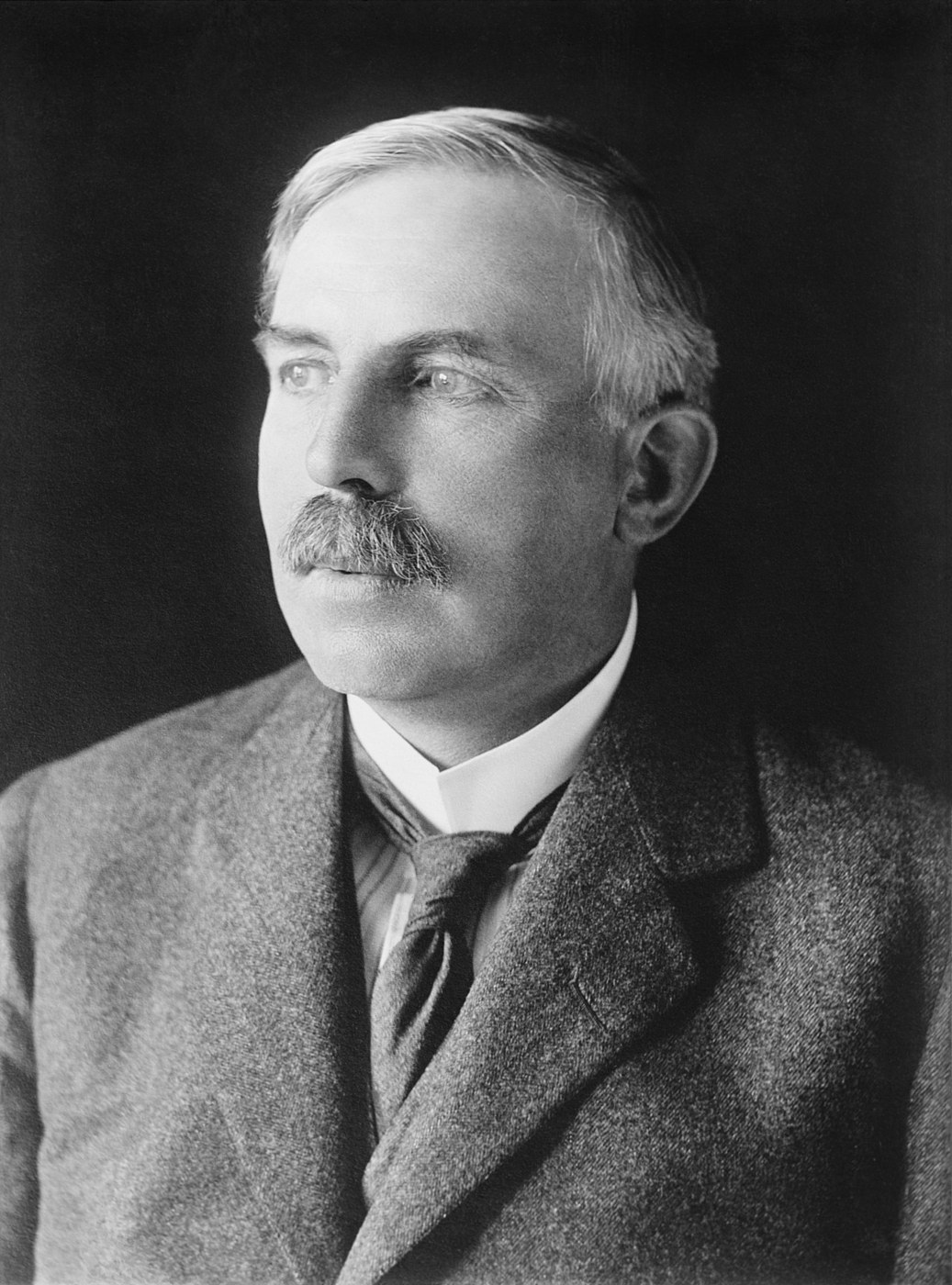
Contents — explore this biography
From New Zealand to CambridgeRadioactivity and changing elementsThe scattering experiments and nuclear atomNobel recognition and further experimentsThe Cavendish years and research legacyFrom New Zealand to Cambridge
Rutherford grew up in New Zealand and studied at Canterbury College before moving to Cambridge in 1895 on a research scholarship. At the Cavendish Laboratory he worked under J. J. Thomson. His early investigations of electrical phenomena and radiation established the experimental foundation for a career that would cross several countries and scientific disciplines.
Radioactivity and changing elements
At McGill University in Montreal, Rutherford investigated radioactive emissions and worked with Frederick Soddy on radioactive transformation. Their research helped establish that radioactive elements change into other elements. This challenged the older view of atoms as permanently indivisible units and connected measurements of decay with a new account of matter’s internal processes.
The scattering experiments and nuclear atom
After moving to Manchester, Rutherford interpreted the scattering experiments carried out by Hans Geiger and Ernest Marsden. In 1911 he proposed that most atomic mass and positive charge occupied a very small nucleus. Large deflections of a minority of particles became decisive evidence: seemingly exceptional observations exposed the inadequacy of the earlier diffuse-charge model.
Nobel recognition and further experiments
Rutherford’s 1908 Nobel Prize was in Chemistry, recognizing work on radioactive substances and the disintegration of elements. It preceded the nuclear model, an important chronological distinction. Later experiments with nitrogen contributed to the study of induced nuclear transformations, extending his investigation from naturally occurring radioactivity to changes produced through laboratory bombardment.
The Cavendish years and research legacy
Rutherford returned to Cambridge as Cavendish Professor in 1919 and helped guide a major experimental research community. Niels Bohr’s atomic theory developed from questions raised by the nuclear atom, while later nuclear physics extended the experimental programme. Rutherford died in 1937. His career illustrates how instruments, collaborators and careful interpretation can overturn apparently secure physical assumptions.
Career timeline
Born near Nelson in New Zealand.
Began research at Cambridge.
Moved to McGill University in Montreal.
Awarded the Nobel Prize in Chemistry.
Proposed the nuclear model of the atom.
Selected works & milestones
Alpha and beta radiation
Distinguished important classes of radioactive emission.
Radioactive transformation
Developed the transformation account with Frederick Soddy.
Nuclear atom
Interpreted scattering as evidence for a small central nucleus.
Induced nuclear transformation
Published experiments involving nitrogen bombarded by alpha particles.
- Nobel Prize — biographical record
- Nobel Prize — award and facts
- Biographical references and further reading
Published 2026-11-02. Sources reviewed for this edition. Independent coverage of public professional activity.