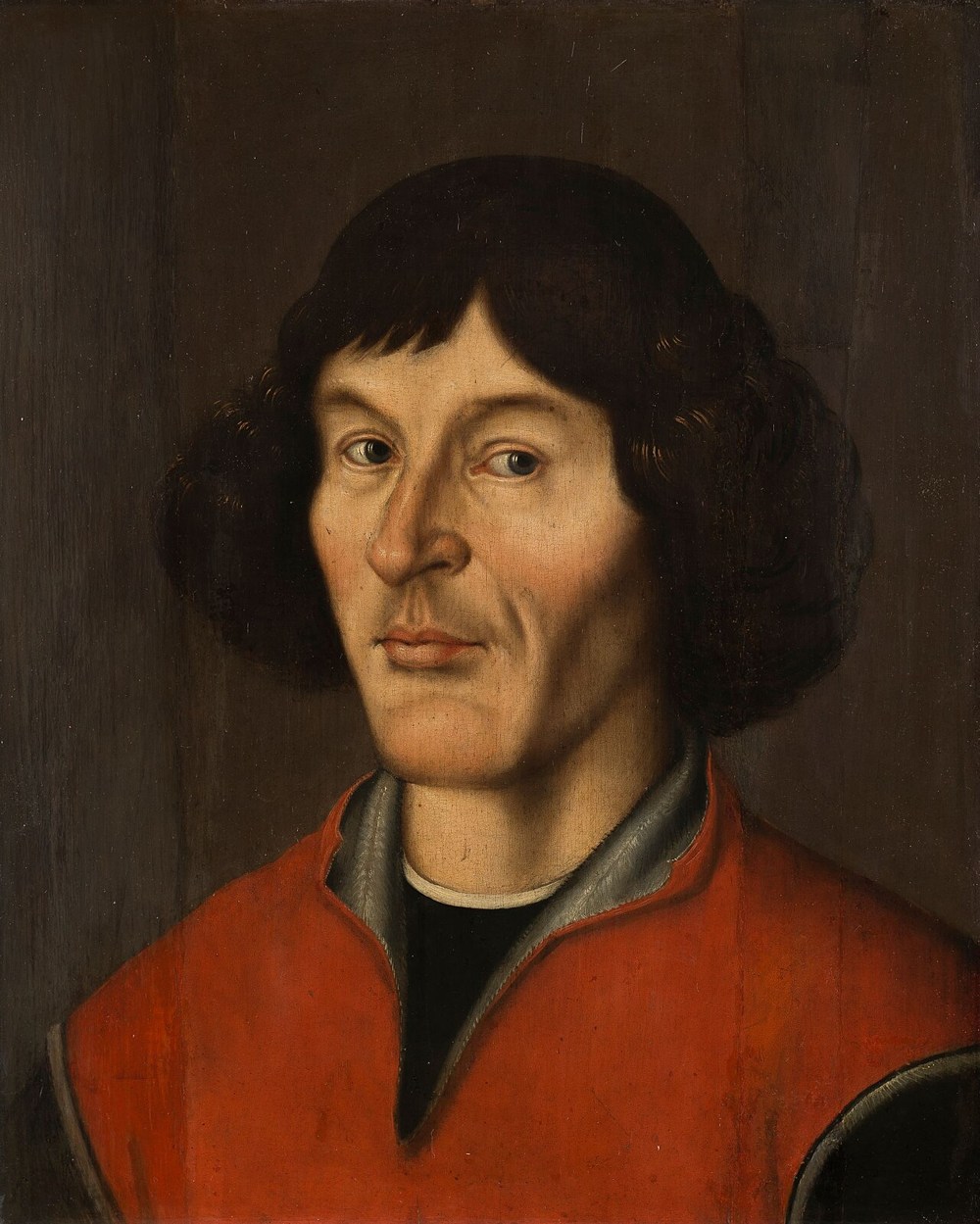
Contents — explore this biography
Education across Renaissance EuropeA cathedral canon and administratorRearranging the planetary systemThe publication of De revolutionibusReception and later developmentAn intellectual turning pointEducation across Renaissance Europe
Copernicus was born in Toruń in 1473 and studied in Kraków before continuing in Italy at Bologna, Padua and Ferrara. His education included mathematics, canon law and medicine. He received a doctorate in canon law at Ferrara in 1503. Astronomy developed alongside these responsibilities rather than through a separate modern scientific degree or a full-time observatory position.
A cathedral canon and administrator
He served as a canon of the Warmian cathedral chapter, spending much of his working life in what is now northern Poland. Administrative duties, financial questions and medical activity accompanied his astronomical interests. The public role provided a living and a setting for scholarship. It should not be confused with the claim that his professional responsibilities consisted solely of making celestial observations.
Rearranging the planetary system
Copernicus proposed that Earth rotates daily and moves annually around the Sun, while the Moon remains its satellite. This arrangement explained features such as apparent retrograde planetary motion in a different way from traditional geocentric models. His system still used combinations of circular motion. It was a major reorganization of astronomy, not the finished elliptical-orbit mechanics that later readers may associate with the word heliocentric.
The publication of De revolutionibus
A shorter account circulated before his major book, De revolutionibus orbium coelestium, appeared in 1543, the year of his death. Georg Joachim Rheticus helped publicize and prepare the work for print. The printed volume also included an unsigned introductory statement by Andreas Osiander framing the scheme as a calculating hypothesis. That preface was not a straightforward expression of Copernicus’s own position.
Reception and later development
The model offered a powerful organizing idea but did not immediately settle every observational or physical question. Tycho Brahe, Johannes Kepler, Galileo and Newton later contributed different evidence and theories. Kepler’s ellipses and Newtonian dynamics were not already present in the original book. Keeping these stages separate prevents the history from becoming a retrospective claim that one author completed several centuries of astronomy.
An intellectual turning point
Copernicus also wrote about monetary questions, illustrating the breadth of Renaissance learned activity. His enduring scientific importance lies in changing the framework within which planetary motions could be interpreted. That transformation required publication, criticism and later modification. A careful biography therefore records the achievement without describing the original model as identical to present-day cosmology or assuming that contemporaries could evaluate it using evidence discovered much later.
Career timeline
Begins university studies before later education in Italy.
Receives his doctorate at Ferrara.
A short outline of the heliocentric arrangement circulates among scholars.
Rheticus publishes an initial account of Copernicus’s theory.
The major astronomical work appears in the year of his death.
Selected works & milestones
Canon-law doctorate
Receives his doctorate at Ferrara.
Early model
A short outline of the heliocentric arrangement circulates among scholars.
Narratio Prima
Rheticus publishes an initial account of Copernicus’s theory.
De revolutionibus
The major astronomical work appears in the year of his death.
- University of St Andrews — scholarly Copernicus biography
- NASA — Copernicus and the heliocentric revolution
- Nicolaus Copernicus — biographical reference and bibliography
Published 2026-10-31. Sources reviewed for this edition. Independent coverage of public professional activity.