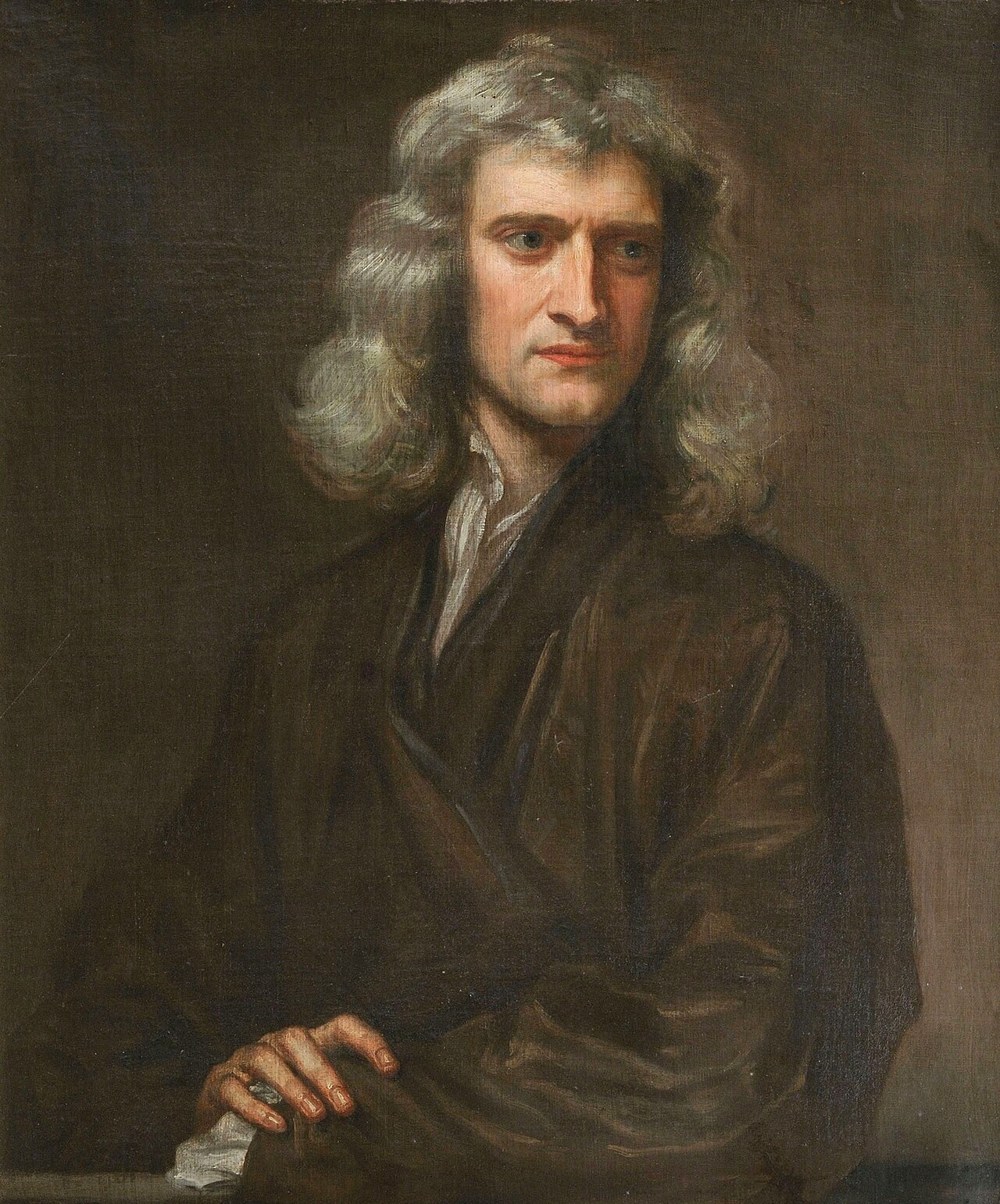
Contents — explore this biography
A Cambridge educationCalculus and the plague yearsMotion and universal gravitationOptics and instrumentsPublic offices and controversyScientific legacy and its limitsA Cambridge education
Newton grew up in rural Lincolnshire and entered Trinity College, Cambridge, in 1661. Study of mathematics and natural philosophy brought him into contact with problems extending beyond the university curriculum. His birth is given here as 4 January 1643 in the Gregorian calendar; contemporary English records used 25 December 1642 in the Julian calendar. Both refer to the same day, not competing life histories.
Calculus and the plague years
During the university’s plague-related closure in the 1660s, he worked at Woolsthorpe on mathematical methods, motion and light. His method of fluxions developed alongside work on infinite series. Gottfried Wilhelm Leibniz independently developed calculus and published a different notation. Their later priority dispute should not erase either contribution or suggest that modern calculus appeared in one finished moment.
Motion and universal gravitation
The Principia, published in 1687 with Edmond Halley’s support, presented laws of motion and universal gravitation using mathematical argument. It connected falling objects and celestial trajectories rather than treating them as unrelated kinds of motion. The familiar apple story is an anecdote about a question, not a substitute for the prolonged calculations and observations underpinning the published theory.
Optics and instruments
Newton investigated how a prism separates white light into colours and argued that colour is associated with the light itself. He also constructed a reflecting telescope, reducing problems associated with lenses. Opticks, published in 1704, presented experiments and questions in a form different from the Principia. These investigations show an experimental career alongside the mathematical one, rather than a physicist working exclusively through equations.
Public offices and controversy
He became warden of the Royal Mint in 1696 and later its master, participating in monetary administration as well as science. He served as Royal Society president from 1703 until his death in 1727. Disputes with Hooke, Leibniz and others accompanied his prominence. Institutional authority and intellectual achievement were connected parts of his life, but authority itself did not establish the truth of a physical argument.
Scientific legacy and its limits
Newtonian mechanics remains exceptionally useful in appropriate regimes, although relativity and quantum theory changed its foundations and range of application. His surviving papers also contain theology and alchemy, interests that resist a simplified modern picture of disciplinary boundaries. Understanding his legacy means distinguishing mathematical results that remain productive from personal convictions and historical assumptions that belong to his own intellectual setting.
Career timeline
Enters Cambridge to study before developing an independent mathematical programme.
Becomes Lucasian Professor of Mathematics at Cambridge.
Publishes the mathematical account of motion and universal gravitation.
Begins his presidency of the Royal Society.
Publishes the major English-language account of his optical research.
Selected works & milestones
Lucasian professorship
Becomes Lucasian Professor of Mathematics at Cambridge.
Principia
Publishes the mathematical account of motion and universal gravitation.
Royal Society
Begins his presidency of the Royal Society.
Opticks
Publishes the major English-language account of his optical research.
- Royal Society — archival biography and offices
- Newton Project — scholarly edition of the surviving papers
- Isaac Newton — biographical reference and bibliography
Published 2026-10-31. Sources reviewed for this edition. Independent coverage of public professional activity.