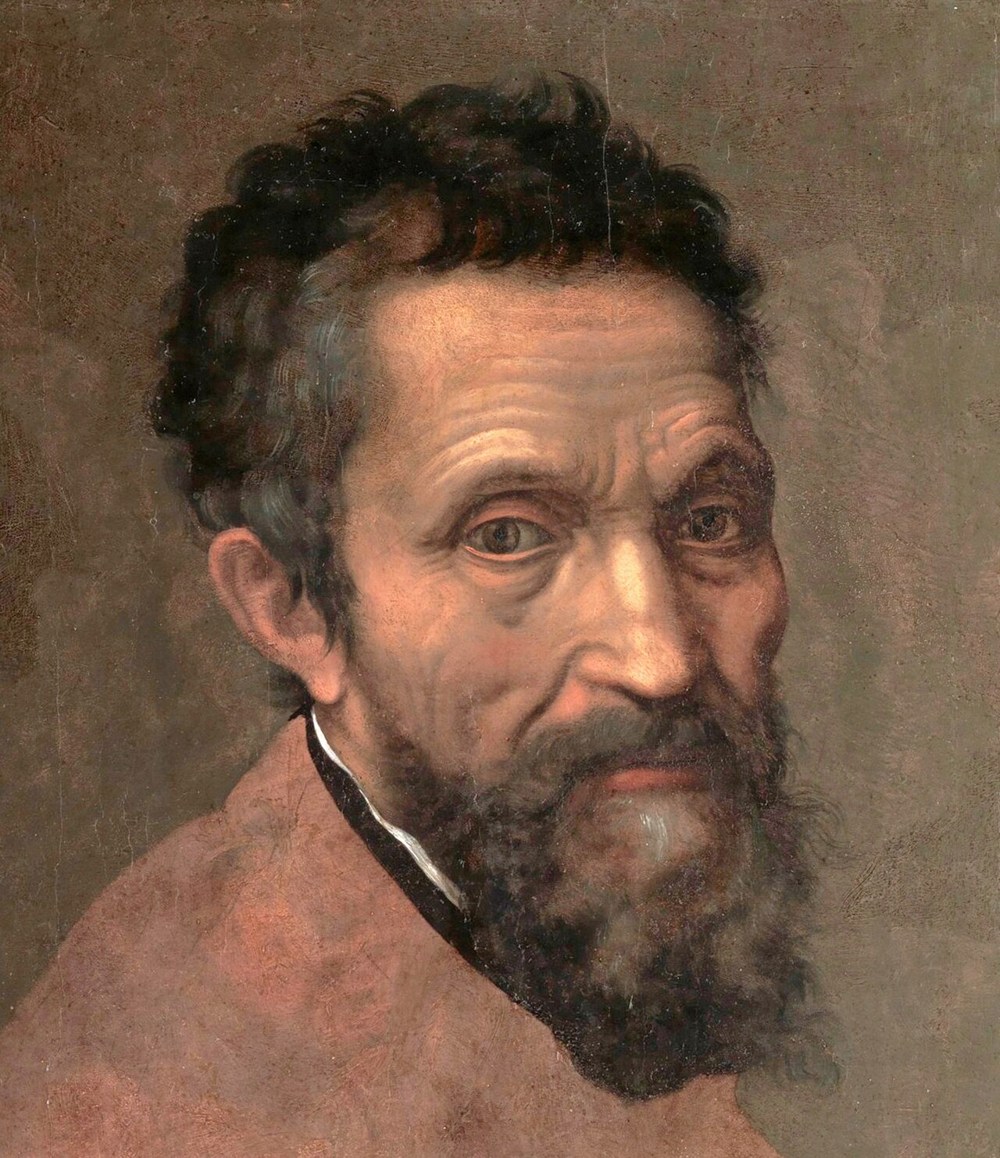
Contents — explore this biography
Origins and artistic formationMarble and public reputationThe Sistine ceilingPatronage, tombs and interrupted projectsLater Rome and architectureHistorical significanceOrigins and artistic formation
Michelangelo Buonarroti was born in Caprese in 1475 and grew up in the Florentine cultural world. He trained with Domenico Ghirlandaio before studying sculpture in the circle supported by Lorenzo de’ Medici. Painting and sculpture were connected aspects of that education. Antique models, bodily movement and the political importance of major commissions all helped define the ambitions of his early work.
Marble and public reputation
The Pietà in Rome and David in Florence established his ability to give marble an intensely physical and emotional presence. David, completed in 1504, became a civic image as well as a sculptural achievement. His figures often suggest potential action rather than relaxed equilibrium. The meaning of such work depends on its original setting and patronage, not solely its later status as a museum masterpiece.
The Sistine ceiling
Between 1508 and 1512 he painted the Sistine Chapel ceiling for Pope Julius II. Old Testament narratives appear within an elaborate framework of prophets, sibyls and surrounding figures. The project demanded planning, practical fresco technique and sustained physical work. The familiar myth that he simply painted the whole ceiling lying on his back misrepresents the working conditions documented by the artist and later scholarship.
Patronage, tombs and interrupted projects
His repeated work on Julius II’s tomb illustrates the instability of large commissions. Plans changed over decades as papal priorities and resources shifted. Other projects, including Medici funerary sculpture and architectural work in Florence, connected artistic decisions to dynastic memory. Unfinished sculptures preserve different stages of carving, but incompletion should not automatically be explained as a deliberate aesthetic manifesto in every case.
Later Rome and architecture
The Last Judgment, painted on the Sistine altar wall between 1536 and 1541, belongs to a later phase than the ceiling. In 1546 Michelangelo took charge of the design of St Peter’s Basilica. He did not construct the entire church alone, and the dome was completed after his death. His architectural contribution must be understood within a continuing project involving successive architects and builders.
Historical significance
Michelangelo died in Rome in 1564. Sculpture, painting, architecture and poetry form a related but varied body of work, extending beyond a handful of universally reproduced images. His powerful bodies influenced later artists, while his professional life reveals negotiation, revision and dependence on patrons. The surviving record supports exceptional artistic authority without removing the practical and political conditions under which that authority operated.
Career timeline
Completes the marble Pietà in Rome.
Completes David for Florence.
Paints the chapel ceiling for Julius II.
Creates the altar-wall fresco in the Sistine Chapel.
Assumes architectural leadership at the basilica.
Selected works & milestones
David
Completes David for Florence.
Sistine ceiling
Paints the chapel ceiling for Julius II.
Last Judgment
Creates the altar-wall fresco in the Sistine Chapel.
St Peter’s
Assumes architectural leadership at the basilica.
- National Gallery — Michelangelo biography
- Vatican Museums — Sistine Chapel and Michelangelo
- Michelangelo — biographical reference and source notes
Published 2026-10-31. Sources reviewed for this edition. Independent coverage of public professional activity.