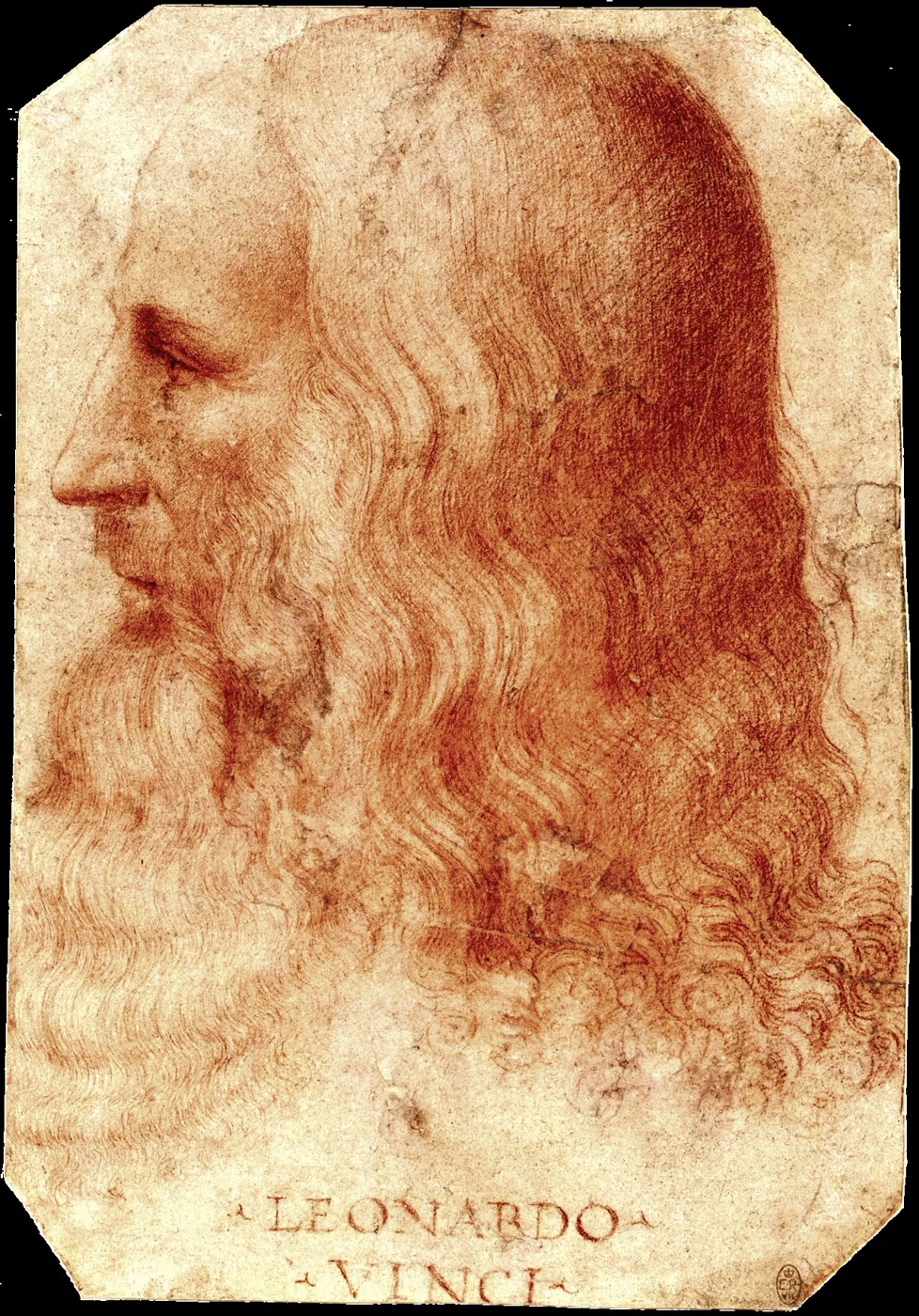
Contents — explore this biography
Training in FlorenceMilan and court servicePainting human presenceNotebooks and investigationLate career and surviving evidencePlace in art historyTraining in Florence
Leonardo was born in the vicinity of Vinci in 1452 and trained in Andrea del Verrocchio’s Florentine workshop. Such a workshop joined painting with sculpture and practical craft, providing a setting in which materials and observation mattered together. By 1472 he belonged to the city’s painters’ guild. His later range of interests developed from this artistic environment rather than a modern university research programme.
Milan and court service
In the early 1480s he moved toward employment in Milan under the Sforza court, presenting himself as useful in engineering as well as painting. Court patronage created opportunities for elaborate projects but also obligations to powerful clients. Designs, performances, military proposals and religious commissions belonged to the same working life. Many projected enterprises remained unfinished or survived mainly through drawings and descriptions.
Painting human presence
The Last Supper, produced for Santa Maria delle Grazie in the 1490s, organizes a biblical event through gestures, reactions and perspective. The Virgin of the Rocks and the Mona Lisa explore different relationships between figures, landscape and atmosphere. Soft transitions of light help forms appear continuous rather than enclosed by hard outlines. These visual methods, rather than the later celebrity of individual pictures, explain much of his influence.
Notebooks and investigation
His notebooks record studies of anatomy, water, mechanics, geometry and flight. They reveal repeated observation and visual reasoning, but a drawing of a machine is not evidence that a functioning modern device was built. Some studies remained private and had limited immediate circulation. Reading them historically requires distinguishing an insightful proposal, a tested mechanism and a later technology that resembles the sketch.
Late career and surviving evidence
Leonardo worked again in Florence and Milan, spent time in Rome and accepted French royal patronage late in life. He died near Amboise in 1519. Assistants and pupils contributed to the circulation of his compositions. The distinction between autograph work, workshop production and later copies is therefore essential, especially because his small painted output attracts frequent attribution disputes.
Place in art history
His importance extends from the construction of believable figures to an unusually rich archive of visual inquiry. The popular image of a solitary inventor can obscure patrons, workshops and earlier technical traditions. A useful account holds the paintings and manuscripts together while recognizing that their methods served different purposes. His historical achievement is substantial without assigning him every subsequent invention associated with a superficially similar drawing.
Career timeline
Recorded in the Florentine painters’ guild.
Works for Milanese patrons and develops major artistic projects.
Creates the celebrated mural in Santa Maria delle Grazie.
Develops the portrait now held by the Louvre.
Dies near Amboise after receiving French royal patronage.
Selected works & milestones
Milan period
Works for Milanese patrons and develops major artistic projects.
The Last Supper
Creates the celebrated mural in Santa Maria delle Grazie.
Mona Lisa
Develops the portrait now held by the Louvre.
Death in France
Dies near Amboise after receiving French royal patronage.
- National Gallery — Leonardo biography and workshop context
- Royal Collection Trust — Leonardo drawings and scientific investigations
- Leonardo da Vinci — biographical reference and source notes
Published 2026-10-31. Sources reviewed for this edition. Independent coverage of public professional activity.