Contents — explore this biography
Cornell and the chromosome laboratorySeeing the physical basis of inheritanceCold Spring Harbor and maizeMobile genetic elementsRecognition over a long careerThe importance of careful observationCornell and the chromosome laboratory
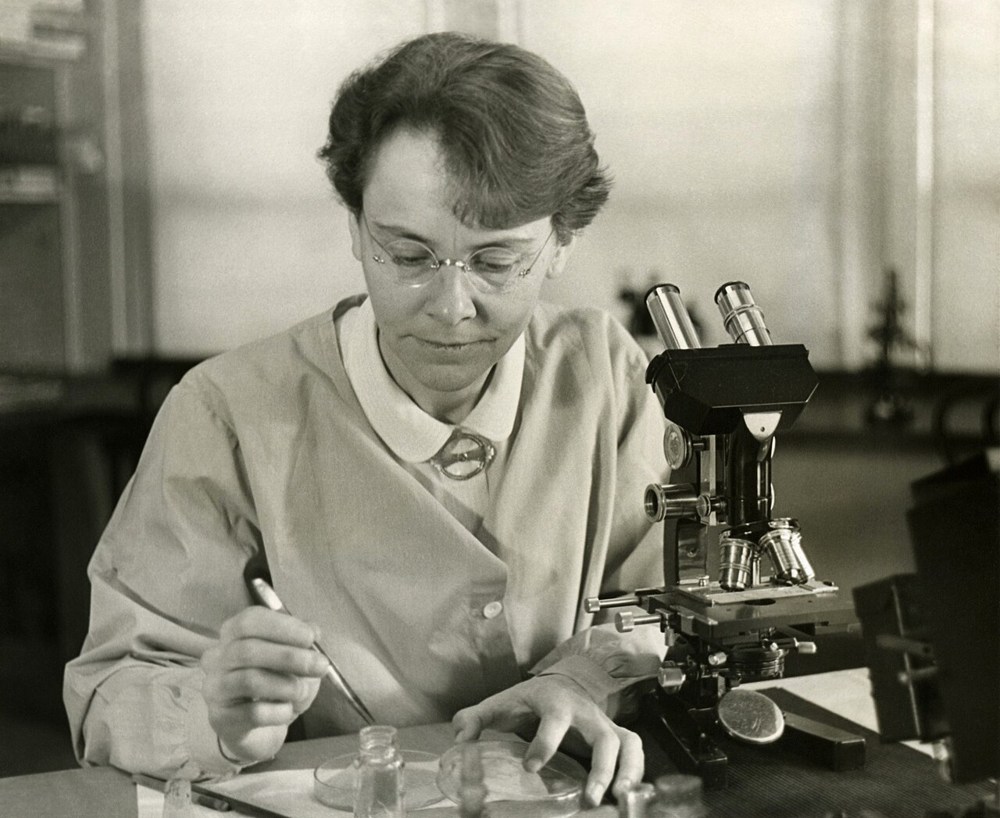
McClintock studied at Cornell University, completing her doctorate in botany in 1927. She became an expert in cytogenetics, which connects chromosome behavior observed under a microscope with inherited characteristics. Maize provided a productive experimental system because visible traits and recognizable chromosomes could be studied together. Her research depended on sustained cultivation and observation as much as on abstract genetic models.
Seeing the physical basis of inheritance
Working with Harriet Creighton, she helped demonstrate in 1931 that genetic recombination corresponded to physical exchange between chromosomes. This connected patterns inferred from breeding experiments with actual chromosome behavior. The achievement was collaborative and preceded her better-known discovery of mobile elements. It established a strong experimental foundation for asking how alterations in chromosome structure affected the traits appearing in successive generations.
Cold Spring Harbor and maize
She joined the research community at Cold Spring Harbor in 1941 after earlier appointments and fellowships. Her continuing maize studies examined chromosome breakage, fusion and the inheritance of changing colour patterns in kernels. Such patterns were not merely decorative variation. They offered a way to connect the timing and position of genetic events with visible biological outcomes across a carefully tracked line of plants.
Mobile genetic elements
During the 1940s she identified controlling elements that could change position and influence gene activity. The elements later known as Ac and Ds helped explain unexpected patterns that a completely fixed genetic arrangement could not. Her findings did not mean that all genes move freely at will. They established particular mechanisms of transposition and control, subsequently placed within a much broader molecular understanding of genomes.
Recognition over a long career
Her interpretations were difficult for many contemporaries to incorporate into prevailing models, and wider acceptance developed over time as other systems revealed related mechanisms. She continued research rather than simply withdrawing into obscurity. In 1983 she received the unshared Nobel Prize in Physiology or Medicine for mobile genetic elements. The long interval between discovery and award should not erase the scientific recognition she had already received.
The importance of careful observation
McClintock died in 1992. Her legacy links chromosome structure, developmental timing and genetic regulation, while transposable elements now form a major area of genome research. The enduring lesson is methodological: apparently irregular results can reveal an underlying mechanism when they are observed with sufficient precision. Her achievement was not a rejection of evidence-based genetics, but an expansion of what its evidence required scientists to explain.
Career timeline
Completes doctoral study in botany and chromosome research.
With Harriet Creighton, connects genetic recombination to physical chromosome exchange.
Begins the major Cold Spring Harbor phase of her research.
Publishes influential findings on the origin and behavior of mutable maize loci.
Receives the unshared Nobel Prize in Physiology or Medicine.
Selected works & milestones
Crossing-over evidence
With Harriet Creighton, connects genetic recombination to physical chromosome exchange.
Cold Spring Harbor
Begins the major Cold Spring Harbor phase of her research.
Controlling elements
Publishes influential findings on the origin and behavior of mutable maize loci.
Nobel Prize
Receives the unshared Nobel Prize in Physiology or Medicine.
- Nobel Prize — McClintock biography
- Cornell University — life and mobile genetic elements
- US National Library of Medicine — archival research account
- Barbara McClintock — biographical reference and bibliography
- Birth date — institutional biographical record
Published 2026-10-31. Sources reviewed for this edition. Independent coverage of public professional activity.