Contents — explore this biography
Baghdad, Beirut and LondonDrawings and an independent practiceFrom proposals to buildingsPritzker recognitionAn expanding international portfolioLegacy and the continuing practiceBaghdad, Beirut and London
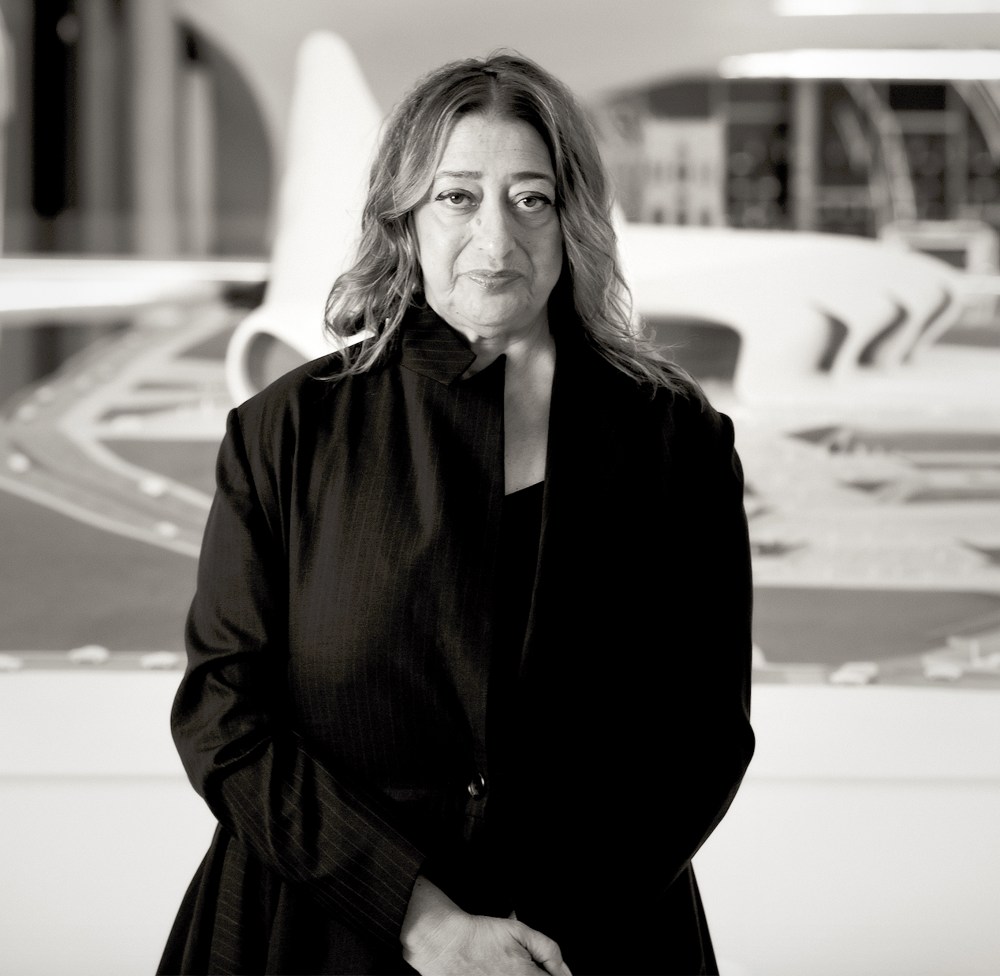
Zaha Mohammad Hadid was born in Baghdad on 31 October 1950. She studied mathematics at the American University of Beirut before entering the Architectural Association in London in 1972. After graduating in 1977 she worked with the Office for Metropolitan Architecture. This formation combined formal investigation with an international architectural setting, preceding the independent practice that made her name widely known.
Drawings and an independent practice
She established her London practice around 1980 and won the Peak competition in Hong Kong in 1983. The project remained unbuilt, but the drawings became influential in their own right. They were tools for investigating perspective, fragmentation and spatial relationships rather than simply illustrations of a finished building. Competition work and teaching helped sustain her ideas before a substantial built portfolio emerged.
From proposals to buildings
The Vitra Fire Station, completed in 1993, demonstrated how angular surfaces and dynamic spatial sequences could become a physical environment. Later projects included the Bergisel ski jump and the Rosenthal Center for Contemporary Art in Cincinnati. These commissions differed in programme and scale, requiring the design language to engage with visitors, circulation and the practical demands of a particular site.
Pritzker recognition
Hadid received the Pritzker Architecture Prize in 2004, becoming its first woman laureate. The distinction recognized a body of work developed through both theoretical experimentation and completed buildings. It should not imply that all subsequent projects were personally resolved by one architect. Large offices work through teams, consultants and engineers whose technical contributions help make an ambitious form buildable.
An expanding international portfolio
Projects including MAXXI in Rome, the Guangzhou Opera House and the London Aquatics Centre expanded the practice’s public reach. Later work often used more fluid geometries than the early angular projects, aided by evolving design and construction methods. Recognizable form can attract attention, but a building also has to be understood through its programme, setting, structural demands and the people who use it.
Legacy and the continuing practice
Hadid died in 2016. The architectural office continues under later leadership, so a building completed afterward requires a careful distinction between her lifetime design involvement and subsequent execution. Her historical contribution includes new ways of representing and organizing space, as well as a changed professional landscape for women in architecture. Both achievements are more specific than a generic claim that every curved building follows her invention.
Career timeline
Wins the influential Hong Kong competition, although the proposal is not built.
Completes the early landmark in Germany.
Becomes the first woman to receive the prize.
The building serves the London Olympic Games.
Dies after building a major international architectural practice.
Selected works & milestones
Vitra Fire Station
Completes the early landmark in Germany.
Pritzker Prize
Becomes the first woman to receive the prize.
London Aquatics Centre
The building serves the London Olympic Games.
Death
Dies after building a major international architectural practice.
- Pritzker Architecture Prize — 2004 laureate biography and citation
- Zaha Hadid Architects — founder profile and project record
- Zaha Hadid — biographical reference and source notes
Published 2026-10-31. Sources reviewed for this edition. Independent coverage of public professional activity.