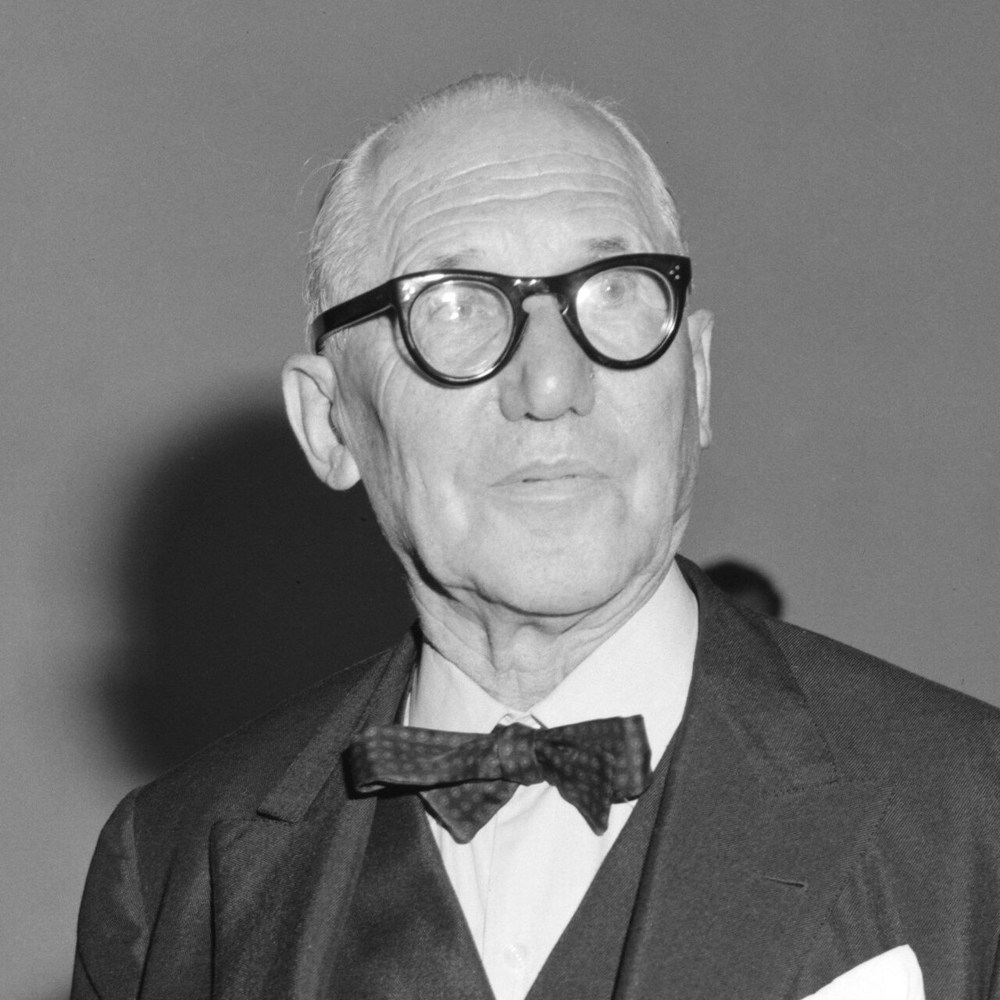
Contents — explore this biography
A Swiss beginningParis, Purism and publishingThe modern houseHousing and urban proposalsChandigarh and later buildingsLegacy and critical readingA Swiss beginning
Charles-Édouard Jeanneret was born in La Chaux-de-Fonds in 1887. Training at the local art school introduced him to craft and drawing, and his teacher Charles L’Eplattenier directed his interests toward architecture. Travel and work with other practitioners enlarged that education. His early buildings and studies preceded the name Le Corbusier and the polemical identity through which he later became internationally known.
Paris, Purism and publishing
He settled in Paris in 1917 and developed Purist painting with Amédée Ozenfant. Around 1920 he adopted the name Le Corbusier in the context of the magazine L’Esprit Nouveau. Publishing became an important part of his architectural practice. Books and articles could circulate proposals far beyond completed buildings, allowing arguments about industry, proportion and modern living to shape professional discussion.
The modern house
Working with his cousin Pierre Jeanneret, he developed buildings associated with free plans, structural supports and roof terraces. The Villa Savoye, designed in the late 1920s, became a prominent demonstration of these principles. Such ideas were not purely visual motifs: they concerned the relationship between structure, enclosure and movement. Their use also depended on construction quality, climate and the requirements of real occupants.
Housing and urban proposals
His urban schemes advocated large-scale reorganization, often separating functions and replacing dense older fabric with new forms of circulation and housing. Some remained proposals, including the Plan Voisin for Paris. The Unité d’Habitation in Marseille, completed in 1952, translated aspects of collective living into a substantial built project. Later criticism of modernist planning makes the gap between a persuasive diagram and lived urban experience an essential part of the story.
Chandigarh and later buildings
His work for Chandigarh in India involved a larger administrative and planning team, including Pierre Jeanneret, Jane Drew and Maxwell Fry. It should not be attributed to a single designer alone. Later buildings such as the chapel at Ronchamp explored a more sculptural language than the early white villas. This variation challenges the assumption that his entire career followed one rigid formula.
Legacy and critical reading
Le Corbusier died in 1965. Seventeen projects were later inscribed as a UNESCO World Heritage series, recognizing an international architectural contribution. Recognition does not remove the need to examine his political affiliations, planning assumptions or the performance of individual buildings. His historical importance lies in the interaction of construction, images and argument, together with the contested consequences of applying architectural theory to collective life.
Career timeline
Adopts the name in his publishing activity.
Publishes the influential architectural argument.
Develops the modern house at Poissy.
The Marseille housing complex is completed.
The chapel of Notre-Dame-du-Haut is completed.
Selected works & milestones
Towards an Architecture
Publishes the influential architectural argument.
Villa Savoye
Develops the modern house at Poissy.
Unité d’Habitation
The Marseille housing complex is completed.
Ronchamp
The chapel of Notre-Dame-du-Haut is completed.
- Fondation Le Corbusier — archival chronology
- UNESCO — architectural works of Le Corbusier
- Fondation Le Corbusier — early biography
- Le Corbusier — biographical reference and source notes
Published 2026-10-31. Sources reviewed for this edition. Independent coverage of public professional activity.