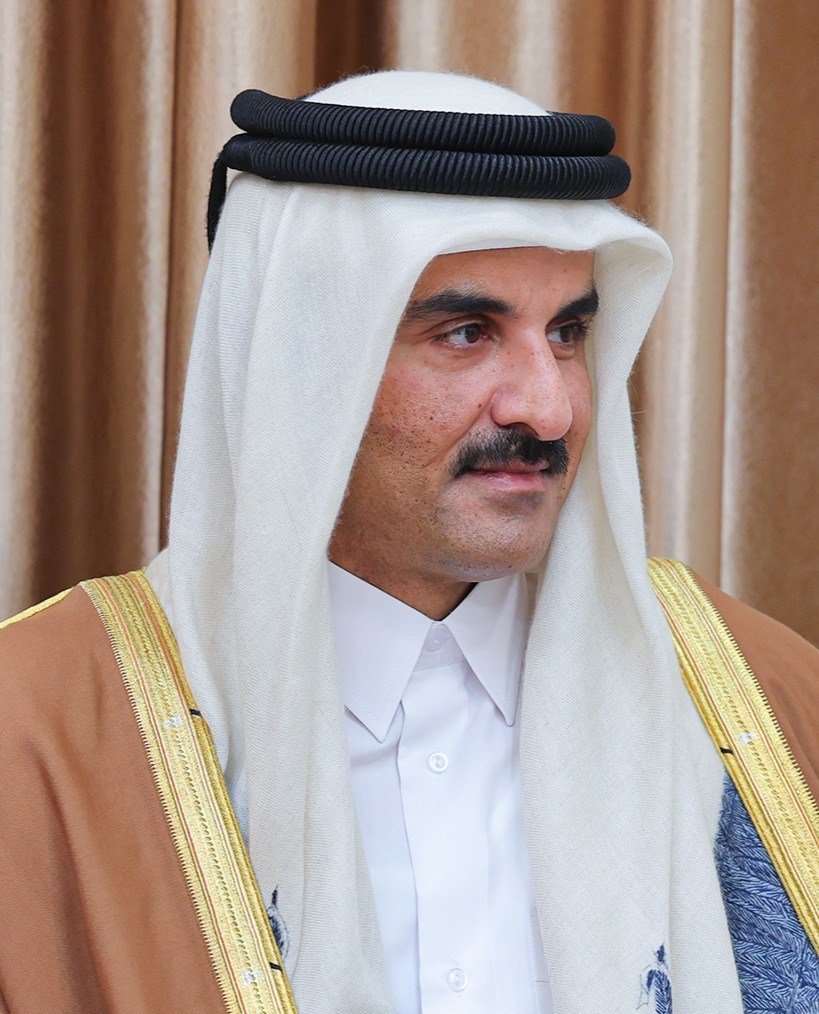
Contents — explore this biography
Family and schoolingThe heir-apparent periodThe transfer of power in 2013National development and the World CupReform and the limits of headline claimsThe Al Thani family contextFamily and schooling
Tamim bin Hamad Al Thani was born in Doha in 1980, a son of Hamad bin Khalifa Al Thani and Sheikha Moza bint Nasser. His schooling included Sherborne in Britain, followed by the Royal Military Academy Sandhurst. Qatar’s official biography records his graduation in 1998. Those early experiences preceded military service and the succession role through which he became increasingly involved in public affairs.
The heir-apparent period
Tamim became heir apparent in 2003. During that period he held responsibilities connected with defense, sport and national institutions. The crown-prince role was distinct from the amirship held by his father. Qatar’s growing international profile, including sports diplomacy and investment, developed through organizations and public policies in which an heir could have responsibilities without yet exercising the full office of head of state.
The transfer of power in 2013
On 25 June 2013, Hamad handed leadership to Tamim. The succession was an abdication and transfer rather than the death of a reigning ruler. The official Amiri Diwan chronology makes this distinction explicit. Tamim’s formal position is Amir of Qatar; this directory uses the state’s English title rather than describing every Gulf ruler as a king.
National development and the World Cup
His reign includes the period in which Qatar prepared for and hosted the 2022 football World Cup. Infrastructure, transport and international visibility were central to the event’s public significance. Its history also involved international scrutiny of migrant workers’ conditions. An institutional biography should not treat hosting a major event as proof that all related policy questions were resolved or that one person alone produced its outcomes.
Reform and the limits of headline claims
The International Labour Organization has documented labor reforms in Qatar, alongside continuing implementation gaps. Such evidence provides a more precise context than either a purely celebratory or entirely dismissive account. The amir’s public role also includes foreign relations and diplomacy, but specific initiatives should be assessed through their documented decisions and results. Official intentions, legal changes and conditions experienced by workers are separate questions.
The Al Thani family context
Tamim is grouped here with Sheikha Moza, whose public role concerns educational and social institutions rather than the amirship. Their relationship connects the biographies without making their responsibilities interchangeable. The country page is a starting point for understanding Qatar’s ruling family, with titles and source dates made visible. It is not an official royal page or a complete account of the state’s political history.
Career timeline
Graduates from the Royal Military Academy Sandhurst.
Becomes heir apparent to the Qatari throne.
Assumes office as Amir following his father’s transfer of power.
Qatar introduces a national minimum wage as part of its labor-reform programme.
Qatar hosts the FIFA World Cup during his reign.
Selected works & milestones
Heir-apparent appointment
A decade-long preparation period before assuming the amirship.
Accession as Amir
Succeeds Hamad bin Khalifa through an announced transfer of leadership.
World Cup hosting period
A major international event accompanied by infrastructure investment and labor scrutiny.
Amir of Qatar
The head-of-state role identified in current official Amiri Diwan records.
- Tamim bin Hamad Al Thani — biographical reference and cited sources
- Amiri Diwan — official biography
- International Labour Organization — labor reforms and implementation
Published 2026-10-31. Sources reviewed for this edition. Independent coverage of public professional activity.