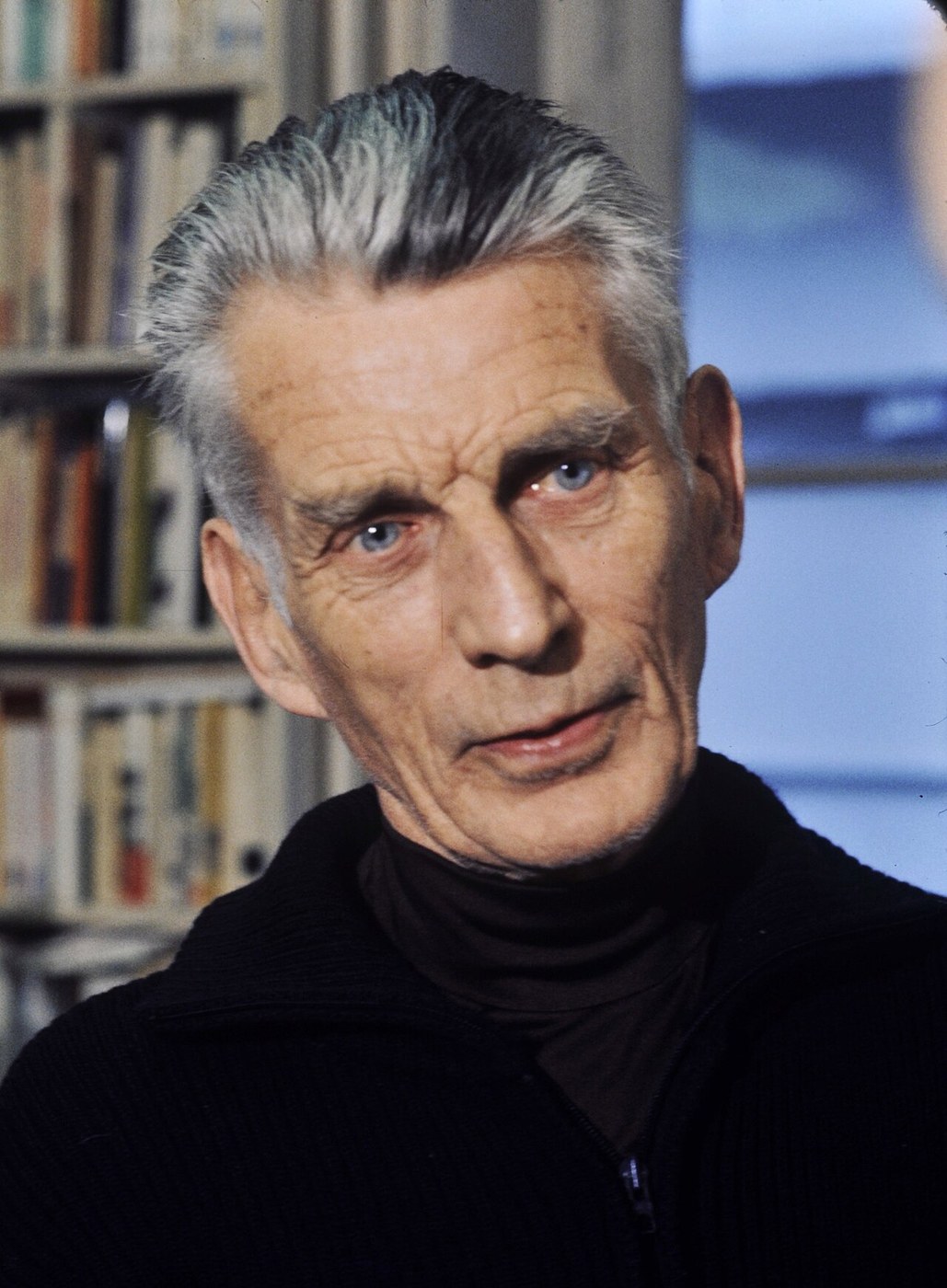
Contents — explore this biography
Dublin, languages and a move to FranceWar and a change in literary directionWaiting for Godot and the theatre of waitingProse, performance and radical concentrationNobel Prize and a continuing performance lifeDublin, languages and a move to France
Beckett was born near Dublin in 1906 and studied modern languages at Trinity College Dublin. Time in Paris brought him into contact with James Joyce and a wider European literary world. He eventually settled in France, developing a writing life that moved between English and French rather than remaining confined to a single national literary tradition.
War and a change in literary direction
During the Second World War Beckett worked with the French Resistance and later took refuge in southern France. His postwar writing became increasingly concentrated in language and setting. This development was an artistic process rather than a simple transcription of wartime experience: the resulting works investigate memory, dependence and the difficulty of sustaining a coherent account of oneself.
Waiting for Godot and the theatre of waiting
Waiting for Godot premiered in Paris in 1953. Its two central figures wait, converse, disagree and repeat actions while the expected arrival remains uncertain. The play challenged familiar dramatic expectations about plot and resolution. Its humour is integral to that challenge, preventing the work from being reduced to a solemn philosophical message or a puzzle with one authorized solution.
Prose, performance and radical concentration
The novels Molloy, Malone Dies and The Unnamable appeared in French in the early 1950s. Endgame and later stage works continued Beckett’s examination of constrained bodies and uncertain speech. Writing for radio and television extended his experiments across media, with each format allowing different relationships among voice, silence, physical presence and the attention of an audience.
Nobel Prize and a continuing performance life
Beckett received the Nobel Prize in Literature in 1969 and died in Paris in 1989. His plays remain works for performance, where pace, gesture and silence are as consequential as verbal interpretation. The continuing range of productions demonstrates how a deliberately restricted theatrical vocabulary can generate complex and changing experiences rather than a narrow or exhausted set of meanings.
Career timeline
Born in Foxrock near Dublin.
Published the novel Murphy.
Published Molloy and Malone Dies in French.
Waiting for Godot premiered in Paris.
Awarded the Nobel Prize in Literature.
Selected works & milestones
Molloy
A novel exploring movement, memory and narrative uncertainty.
Waiting for Godot
A play built around waiting, repetition and companionship.
The Unnamable
A sustained experiment with the speaking narrative voice.
Endgame
A concentrated drama of dependence and confinement.
- The Samuel Beckett Society — biography
- Nobel Prize — biographical record
- Nobel Prize — award and facts
- Biographical references and further reading
Published 2026-11-02. Sources reviewed for this edition. Independent coverage of public professional activity.