Contents — explore this biography
An activist before a famous arrestThe bus protest in its local contextA boycott sustained by a communityDetroit and the continuation of public workMemory, recognition and the historical recordAn activist before a famous arrest
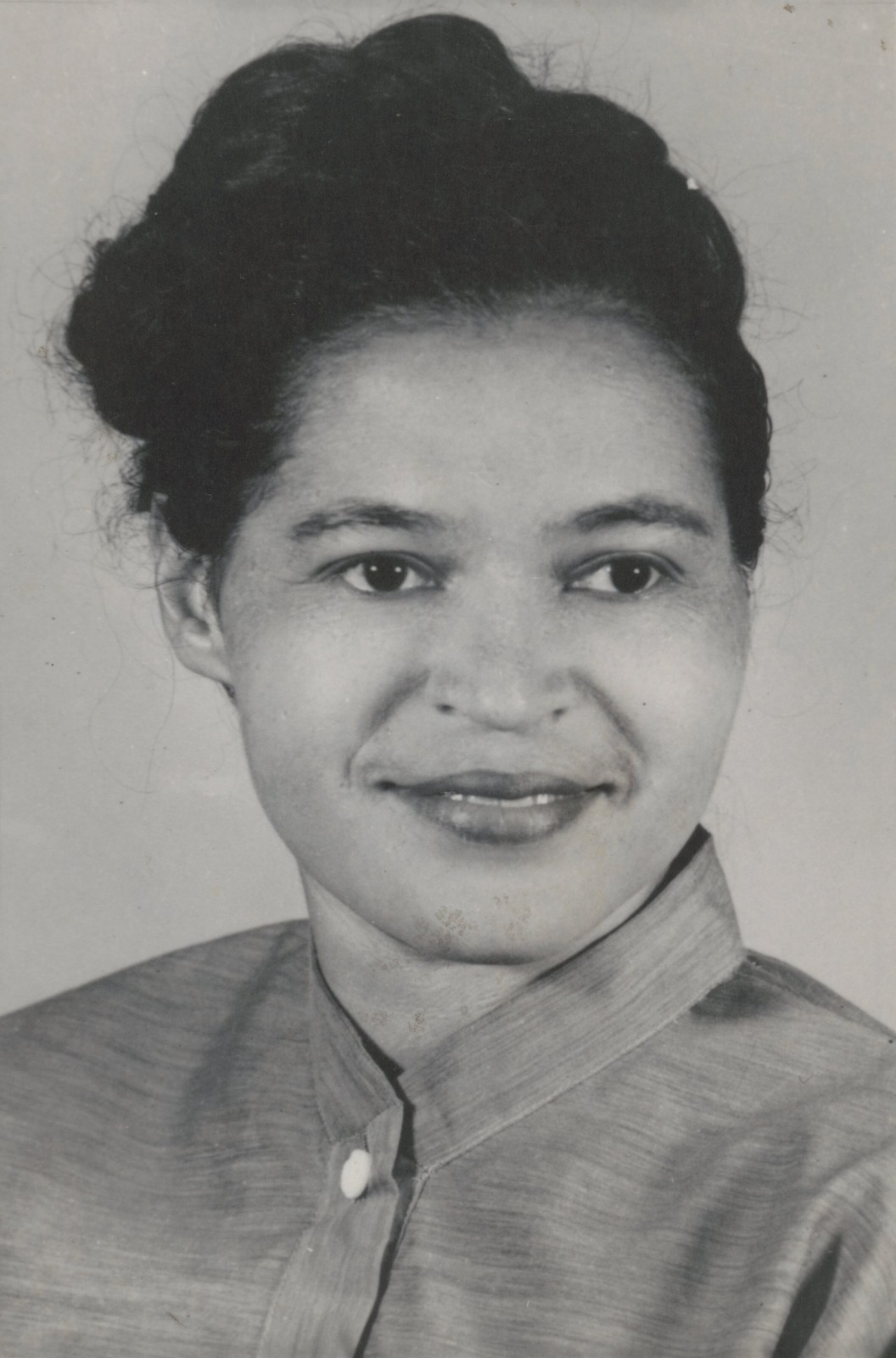
Rosa Parks was born Rosa Louise McCauley in Tuskegee, Alabama, in 1913. Her childhood and education unfolded within the restrictions of racial segregation, but her political life cannot be reduced to a single spontaneous refusal. She married Raymond Parks in 1932 and became involved in organized civil rights work. In 1943 she joined the Montgomery branch of the National Association for the Advancement of Colored People, serving as its secretary. That experience placed her within networks of investigation, voter registration and community advocacy long before her name became internationally known. Her experience combined local knowledge with sustained institutional responsibility.
The bus protest in its local context
On 1 December 1955, Parks refused a bus driver’s instruction to relinquish her seat to a white passenger in Montgomery. Her arrest became a rallying point for an existing community movement. Other Black residents had already resisted bus segregation, and organizers had considered how to challenge the system. Recognizing this background strengthens rather than diminishes the importance of her decision. Parks acted within a discriminatory institution and understood the risks, while the response depended on the ability of local people to turn one arrest into sustained collective action.
A boycott sustained by a community
The Montgomery bus boycott began on 5 December 1955 and continued for more than a year. Churches, women’s organizations, drivers, walkers and volunteer organizers made participation possible through everyday practical work. Martin Luther King Jr. emerged as a prominent leader through the Montgomery Improvement Association. The legal defeat of bus segregation came through Browder v. Gayle, a separate federal case brought by other plaintiffs. Parks’s arrest and the litigation therefore belonged to interconnected but distinct parts of the struggle: public protest created pressure while organized legal challenges contested the rules themselves.
Detroit and the continuation of public work
The consequences of resistance extended into Parks’s private and working life. She faced economic insecurity and moved to Detroit in 1957. Her subsequent decades of activism involved housing, education, racial justice and support for other campaigners. She also worked in the congressional office of John Conyers. In 1987 she co-founded the Rosa and Raymond Parks Institute for Self Development with Elaine Eason Steele. This later work is essential to understanding her career, because it reveals a continuing concern with young people and civic participation rather than a public life completed in Montgomery.
Memory, recognition and the historical record
Parks’s memoir My Story, written with Jim Haskins and published in 1992, helped place her own account alongside the popular symbolism attached to her name. She received the Presidential Medal of Freedom in 1996 and the Congressional Gold Medal in 1999. She died in 2005. Her papers, photographs and correspondence preserve evidence of a much broader political life than the familiar bus narrative suggests. Her legacy combines an unmistakable individual act with the less visible organization, relationships and persistence that allow a civil rights movement to endure.
Career timeline
Born in Tuskegee, Alabama.
Joined the Montgomery NAACP and became its secretary.
Arrested after refusing to surrender her bus seat; the Montgomery boycott followed.
Co-founded the Rosa and Raymond Parks Institute for Self Development.
Died after decades of civil rights and community work.
Selected works & milestones
Montgomery NAACP work
Secretaryship within an established civil rights organization.
Montgomery bus boycott
Her arrest helped catalyze a sustained community campaign.
Rosa and Raymond Parks Institute
Youth development and civic education organization.
Rosa Parks: My Story
Memoir written with Jim Haskins.
- Rosa Parks Institute — biography
- Library of Congress — Rosa Parks timeline
- National Archives — arrest records and historical context
- Stanford King Institute — Rosa Parks
- National Park Service — Rosa Parks
Published 2026-11-09. Sources reviewed for this edition. Independent coverage of public professional activity.