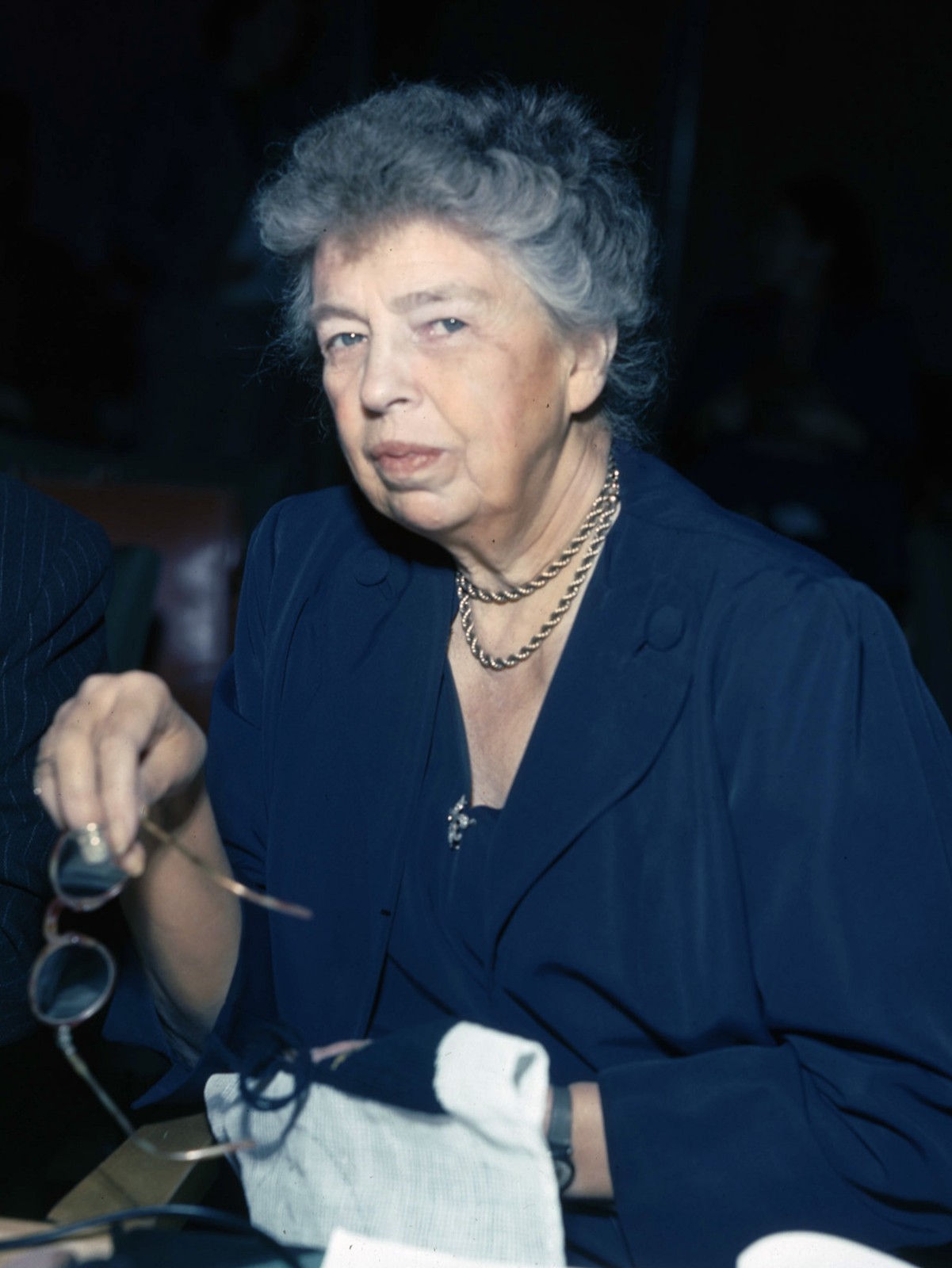
Contents — explore this biography
Education and a developing public voiceA different use of the First Lady’s positionWriting, civil rights and public accountabilityThe United Nations and a collective declarationA legacy of participation and negotiationEducation and a developing public voice
Anna Eleanor Roosevelt was born in New York City in 1884. The early loss of both parents and her education at Allenswood in England formed part of a childhood that did not prepare her simply for public confidence. Returning to New York, she became involved in social service and teaching. She married Franklin Delano Roosevelt in 1905, but her later political identity developed through organizations and work of her own. Women’s political groups, labor advocacy and education offered practical settings in which she learned to connect individual experience with public institutions.
A different use of the First Lady’s position
When Franklin Roosevelt became president in 1933, Eleanor Roosevelt expanded the possibilities of the First Lady’s role. She traveled to observe relief projects and working conditions, communicated with citizens and brought information back to the administration. She also held press conferences for women reporters, opening professional opportunities in a political environment that often excluded them. These activities gave her influence without an elected office. Her position rested on access, publicity and persistent engagement, while disagreements within the administration showed that being close to power did not make every intervention successful.
Writing, civil rights and public accountability
Roosevelt used journalism and public speaking to maintain a relationship with readers beyond formal ceremonies. Her My Day newspaper column began in 1935 and became an important record of her observations and arguments. She supported civil rights causes and resigned from the Daughters of the American Revolution in 1939 after its refusal to allow Marian Anderson to perform in Constitution Hall. Her advocacy operated within the political compromises and racial inequalities of her time. Studying both her interventions and their limits offers a fuller account than presenting moral influence as equivalent to direct governmental authority.
The United Nations and a collective declaration
After her husband’s death in 1945, Roosevelt continued public service as a United States delegate to the United Nations. As the first chair of the Commission on Human Rights, she helped guide negotiations toward the Universal Declaration of Human Rights, adopted on 10 December 1948. The declaration was a collective international achievement shaped by delegates with different legal and cultural traditions. Her contribution involved chairing, persuading and sustaining agreement across those differences. It is therefore more accurate to describe her as a crucial leader of the process than as the sole author of its principles.
A legacy of participation and negotiation
Roosevelt remained active in politics, writing and human rights advocacy until her death in 1962. Her career crossed the boundaries between social work, journalism, presidential life and diplomacy. The common element was an effort to bring conditions experienced by ordinary people into institutions capable of responding. Her papers also make visible the labor behind public influence: correspondence, visits, arguments and revised drafts. Her legacy lies partly in the rights language associated with the United Nations, and partly in a model of public participation that combined moral conviction with the difficult practical work of negotiation.
Career timeline
Born in New York City.
Became First Lady and began holding press conferences for women journalists.
Began the My Day newspaper column.
Helped secure adoption of the Universal Declaration of Human Rights.
Died after a continuing career in writing, politics and human rights.
Selected works & milestones
First Lady’s press conferences
Used access to support women journalists and public discussion.
My Day
A long-running newspaper column.
UN Commission on Human Rights
Became its first chair.
Universal Declaration of Human Rights
Played a central leadership role in a collective drafting and negotiation process.
- FDR Presidential Library — Eleanor Roosevelt biography
- George Washington University — Eleanor Roosevelt Papers
- United Nations — drafting committee
- FDR Presidential Library — Universal Declaration
Published 2026-11-09. Sources reviewed for this edition. Independent coverage of public professional activity.