Contents — explore this biography
A creative education across countriesBuilding a New York labelColour, ornament and the occasion wardrobeA parallel role in Paris coutureRecognition and a continuing nameA creative education across countries
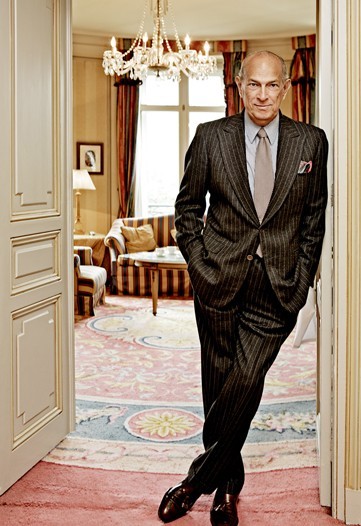
Oscar de la Renta was born in Santo Domingo in 1932. He travelled to Madrid as a young man to study painting, but his professional direction shifted toward fashion. An apprenticeship with Cristóbal Balenciaga introduced him to the disciplined construction associated with couture. He later worked in Paris at Lanvin-Castillo before moving to New York in 1963. These changes of country were more than a sequence of addresses. They placed him within different artistic and commercial traditions, giving his later American career a foundation in European atelier practice while preserving the Dominican background that remained an important part of his personal identity.
Building a New York label
After arriving in New York, de la Renta worked at Elizabeth Arden before establishing his own company in 1965. The city offered a fashion system shaped by department stores, ready-to-wear and customers whose wardrobes combined public occasions with everyday social and professional life. His label developed within that environment. Success required an understanding of business and clients alongside the ability to produce desirable clothes. The relationship between polished daywear and elaborate evening dress became important to his reputation. His career demonstrates how couture training could be adapted to the scale and rhythm of an American designer business without abandoning attention to fabric and proportion.
Colour, ornament and the occasion wardrobe
De la Renta became particularly associated with dresses for formal occasions, using colour, embroidery, rich surfaces and generous movement. His work drew on several cultural references, including Spanish dress traditions and his Caribbean origins, without being confined to a single national vocabulary. Ornament was organized through silhouette and the way fabric moved around a wearer. This helps explain why his clothing was attractive to clients whose appearances were photographed and discussed in public. The image of glamour depended on construction as well as decoration. Museum collections make that relationship visible by allowing individual garments to be examined beyond the celebrity context in which they were originally seen.
A parallel role in Paris couture
From 1993 to 2002 de la Renta also designed haute couture for Balmain in Paris. The appointment connected his established New York business with the institutional traditions in which he had trained. Maintaining both activities required responding to different systems of production and presentation. Couture involved individual clients and intensive atelier work, while his American company operated within another commercial framework. The two roles are therefore best understood as complementary responsibilities rather than as a single undifferentiated label. His Balmain period forms a significant chapter in the exchange between European couture and American fashion during the later twentieth century.
Recognition and a continuing name
The Council of Fashion Designers of America records de la Renta’s Lifetime Achievement recognition in 1990 and Womenswear Designer of the Year awards in 2000 and 2007. Such honours reflect recognition within his professional community as well as the public popularity of his clothes. He died on 20 October 2014. The company continued beyond its founder, making it important to separate subsequent collections from his own lifetime output. Museums and university collections preserve evidence of that output across decades. His legacy combines an international apprenticeship, a major American fashion business and a sustained ideal of dress designed for the social and ceremonial dimensions of modern life.
Career timeline
Born in Santo Domingo on 22 July.
Moved to New York after training and work in Spain and France.
Established his namesake company.
Designed haute couture for Balmain in Paris.
Died on 20 October.
Selected works & milestones
Oscar de la Renta label
Established an independent New York fashion company.
CFDA Lifetime Achievement Award
Recognition of his contribution to American fashion.
Balmain haute couture
Led couture design alongside his own American label.
CFDA Womenswear Designer of the Year
Professional recognition for his womenswear design.
- Kent State University Museum — American Elegance
- Mount Mary University — designer archive
- CFDA — Oscar de la Renta
- FIDM Museum — Oscar de la Renta
- SCAD — Oscar de la Renta
Published 2026-11-09. Sources reviewed for this edition. Independent coverage of public professional activity.