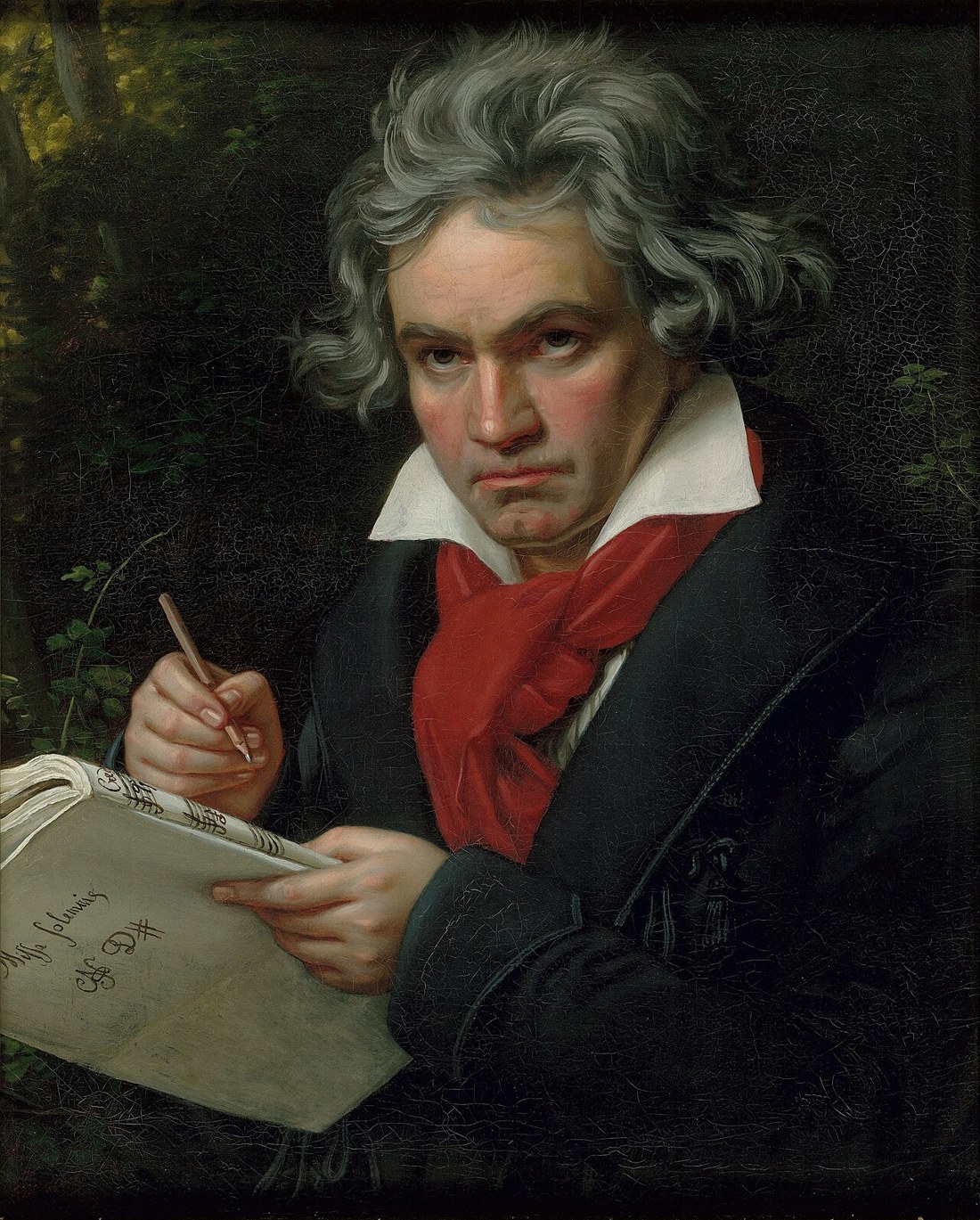
Contents — explore this biography
Bonn and the formation of a musicianVienna and an independent professional lifeHearing loss and the middle-period worksSymphonies, sonatas and the late styleA legacy shaped by performance and interpretationBonn and the formation of a musician
Beethoven was born in Bonn in 1770; his baptism is recorded on 17 December, while the exact birth date is not securely documented. He trained as a keyboard player and worked within the electoral court’s musical environment. Early experience in performance, teaching and composition provided a practical foundation before the move that established his mature career.
Vienna and an independent professional life
He moved to Vienna in 1792, studying with Joseph Haydn and other teachers while gaining attention as a pianist. Patronage, publication and public performance supported his work. He developed within the musical world shaped by Wolfgang Amadeus Mozart, but increasingly expanded established forms through larger structures, unexpected contrasts and a demanding relationship between performer and score.
Hearing loss and the middle-period works
Progressive hearing difficulties altered Beethoven’s performance career and social life. The private document known as the Heiligenstadt Testament, written in 1802, records his distress and determination to continue. Subsequent works such as the Eroica Symphony show a widening of scale and dramatic argument; their meaning cannot be reduced to a simple story of personal triumph over disability.
Symphonies, sonatas and the late style
The Fifth and Sixth Symphonies, piano sonatas and string quartets approach musical continuity in different ways. Late works explore concentrated variation, fugue and striking contrasts of texture. The Ninth Symphony, first performed in 1824, introduces solo voices and chorus into its final movement, setting Friedrich Schiller’s words within a large-scale symphonic design.
A legacy shaped by performance and interpretation
Beethoven died in Vienna in 1827. His works became central to concert programming, music education and arguments about artistic freedom. Their later ceremonial and political uses form a history distinct from the circumstances of composition. Scores, letters, sketches and conversation books allow researchers to examine the working musician behind the many heroic images built around his name.
Career timeline
Born in Bonn; baptized on 17 December.
Moved to Vienna for further study and work.
Wrote the Heiligenstadt Testament.
The Ninth Symphony received its first performance.
Died in Vienna.
Selected works & milestones
Symphony No. 3, Eroica
Completed a work that greatly expanded symphonic scale.
Symphony No. 5
A symphony organized around concentrated musical development.
Missa solemnis
A large-scale setting of the Latin Mass.
Symphony No. 9
A symphony whose final movement incorporates voices and chorus.
Published 2026-11-02. Sources reviewed for this edition. Independent coverage of public professional activity.