Contents — explore this biography
Childhood and access to educationFrom military night writing to a smaller cellPublication, revision and independent writingMusic and the range of tactile notationDelayed recognition and an enduring legacyChildhood and access to education
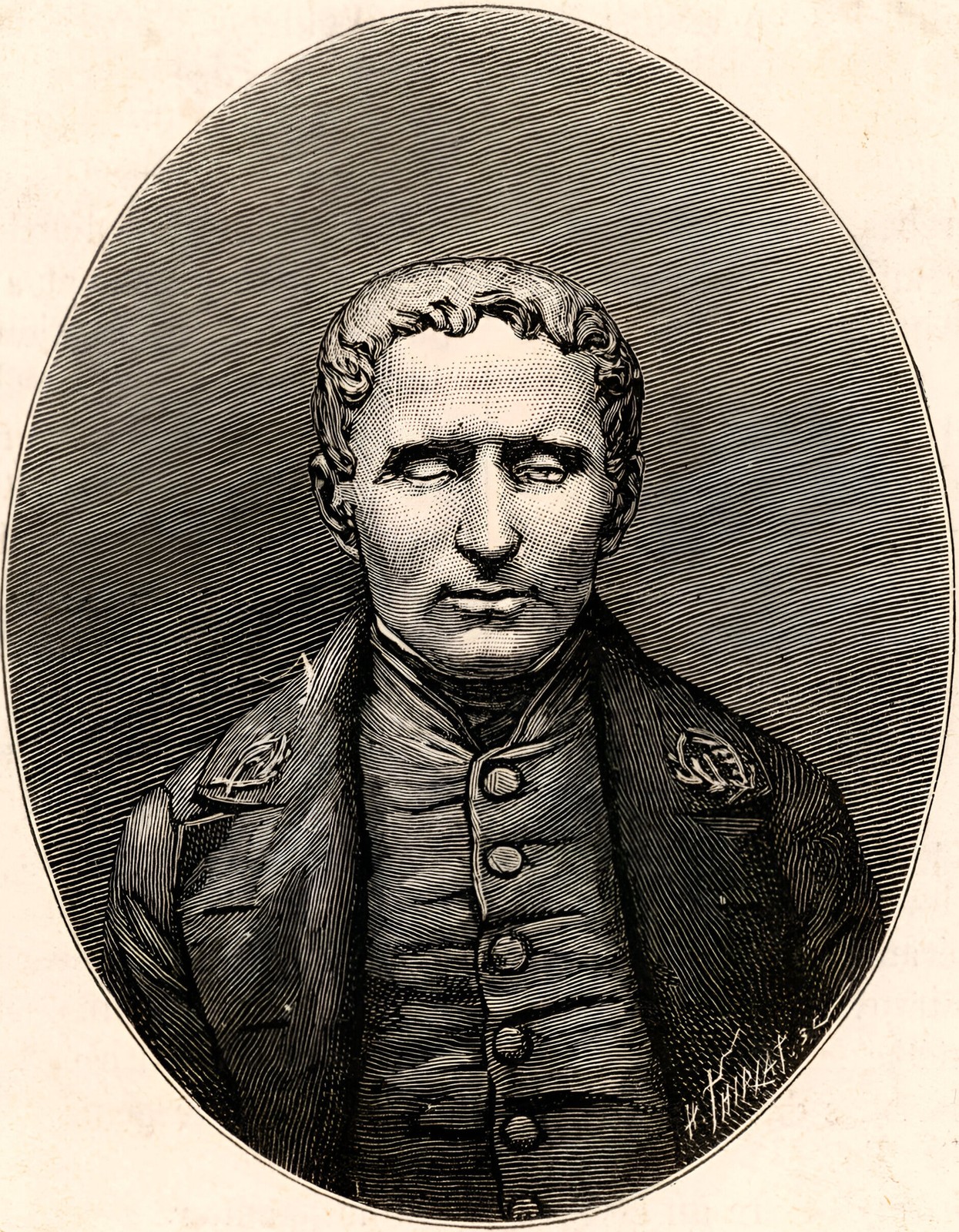
Louis Braille was born in Coupvray, France, in 1809 and lost his sight following an injury in early childhood. He later attended the Royal Institute for Blind Youth in Paris, where his education exposed him both to the possibilities of organized teaching and to the limitations of the reading materials then available. Systems based on raised print letters could make books accessible, but reading them by touch was slow and the books were cumbersome. Braille’s later achievement grew from a practical educational problem: how could blind readers obtain a written system that was efficient to read and possible to produce themselves?
From military night writing to a smaller cell
At the institute Braille encountered Charles Barbier’s raised-dot method, associated with communication without light. He recognized useful principles while also seeing why a larger, more complicated arrangement could be difficult to read with a fingertip. By his teens he had developed the foundations of a more compact code. The six-dot cell became central to the resulting system, allowing combinations to represent letters, punctuation and other signs. This was an adaptation and a substantial redesign rather than an invention without predecessors. Its strength lay in fitting the organization of written information to the physical process of tactile reading.
Publication, revision and independent writing
The institute published Braille’s explanation of his method in 1829. He continued refining the code, with a further edition in 1837. The development concerned writing as well as reading: the ability to make dots with relatively simple tools changed the relationship between the reader and the written page. Access did not have to depend entirely on another person printing a conventional alphabet in relief. A compact symbolic system could support notes, study and communication. Its importance therefore involves personal agency and literacy, not merely the substitution of one set of shapes for another.
Music and the range of tactile notation
Braille was also a musician and teacher, and his work extended to the representation of music. A notation that could communicate relationships between sounds required more than attaching ordinary letter names to raised dots. Its development showed the broader capacity of a tactile code to organize specialized knowledge. Over time, braille systems were adapted for different languages and purposes. These later developments involved communities, educators and institutions beyond Braille himself. His biography provides the beginning of that history, while the continuing work of users and specialists explains how an initial invention became a family of practical literacy systems.
Delayed recognition and an enduring legacy
Braille died in 1852 at the age of forty-three. Official adoption of his system in France came after his death, in 1854, illustrating that technical usefulness does not ensure immediate institutional acceptance. The growth of braille depended on teaching, publishing, standardization and the advocacy of blind people as well as on the original code. His lasting contribution can be understood as a design for participation: a way to read, write and study without making sight the condition of literacy. That principle remains relevant alongside audio and digital technologies, which offer complementary forms of access rather than making tactile reading historically obsolete.
Career timeline
Born in Coupvray, France.
Developed an early version of his tactile reading and writing code.
Published the first explanation of his method.
Published a revised account of the system.
Died in Paris; France officially adopted the code in 1854.
Selected works & milestones
Six-dot tactile cell
A compact basis for reading and writing by touch.
Method of Writing Words, Music and Plain Songs
The first published explanation of Braille’s method.
Revised method
A further development of the tactile code.
Braille music notation
An extension of tactile literacy into musical study.
- Library of Congress — legacy and influence
- American Foundation for the Blind — books in braille
- Musée Louis Braille — biography
- Library of Congress NLS — Louis Braille
Published 2026-11-09. Sources reviewed for this edition. Independent coverage of public professional activity.