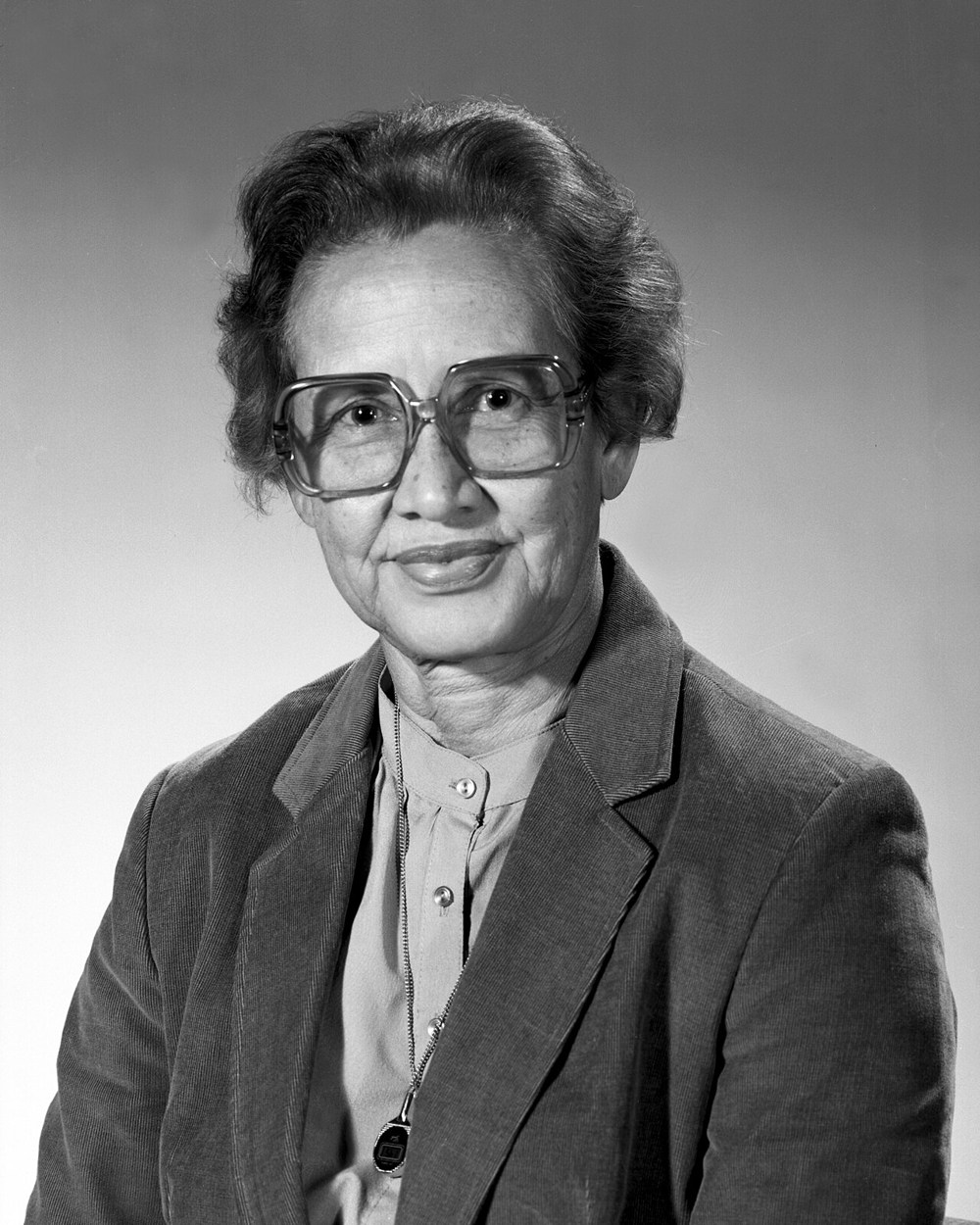
Contents — explore this biography
An accelerated educationJoining the Langley computing workforceTrajectory analysis and published researchMercury and the transition to computersApollo and a long working careerRecognition and historical recoveryAn accelerated education
Born Katherine Coleman in West Virginia, Johnson advanced rapidly through school despite the restrictions imposed on Black students under segregation. Her family moved so that she could continue her education. She graduated from West Virginia State College in 1937 with studies in mathematics and French. The educational achievement preceded her aerospace career and depended on both personal ability and practical family support.
Joining the Langley computing workforce
She joined the National Advisory Committee for Aeronautics at Langley in 1953, initially entering the segregated West Area Computing group. Human computers performed mathematical work supporting research and engineering. Johnson moved into work with flight researchers, asking questions and contributing analysis. NACA became part of NASA in 1958, so the agency name changed during the same continuing institutional career.
Trajectory analysis and published research
Her work involved relating flight paths, launch conditions and landing requirements through mathematical methods. In 1960 she co-authored a report with Ted Skopinski on orbital flight and a specified landing position. Reports and calculations place her contribution within the technical record. The work was not simply arithmetic performed quickly; it involved understanding the geometry and assumptions required to make a trajectory useful.
Mercury and the transition to computers
Johnson calculated the path for Alan Shepard’s 1961 spaceflight and checked electronic-computer results ahead of John Glenn’s orbital mission in 1962. That checking role illustrates a transition between computational systems rather than a contest in which one person replaced all machinery. Reliable spaceflight depended on independent verification, engineers, programmers and mission teams as well as the confidence an astronaut placed in her calculations.
Apollo and a long working career
Her later work included Apollo-related navigation problems, the Space Shuttle and Earth-observation research. She authored or co-authored twenty-six reports and retired in 1986 after more than three decades at Langley. The breadth matters because popular retellings often compress her career into one Mercury flight. She contributed to a continuing programme whose technical challenges changed as missions, instruments and computing systems developed.
Recognition and historical recovery
Johnson received the Presidential Medal of Freedom in 2015 and died in 2020 at 101. Hidden Figures helped bring her work and that of other Black women mathematicians to a larger audience. Her biography records the structural barriers alongside the professional achievement. Neither the discrimination she faced nor her later celebrity should obscure the specific mathematical contributions that made her part of the history of spaceflight.
Career timeline
Completes her mathematics and French degree at West Virginia State College.
Joins NACA’s computing workforce in Virginia.
Co-authors a technical report on orbital flight and landing position.
Checks electronic-computer calculations before John Glenn’s orbital mission.
Receives the United States’ highest civilian honour.
Selected works & milestones
Langley appointment
Joins NACA’s computing workforce in Virginia.
Orbital research report
Co-authors a technical report on orbital flight and landing position.
Glenn verification
Checks electronic-computer calculations before John Glenn’s orbital mission.
Medal of Freedom
Receives the United States’ highest civilian honour.
- NASA — detailed Johnson biography and career
- NASA Science — life, education and recognition
- NASA Technical Reports Server — original research archive
- Katherine Johnson — biographical reference and bibliography
Published 2026-10-31. Sources reviewed for this edition. Independent coverage of public professional activity.