Contents — explore this biography
Mathematics and wartime serviceProgramming early machinesCompilers and reusable instructionsBusiness languages and COBOLStandards and naval leadershipMyth, memory and technical influenceMathematics and wartime service
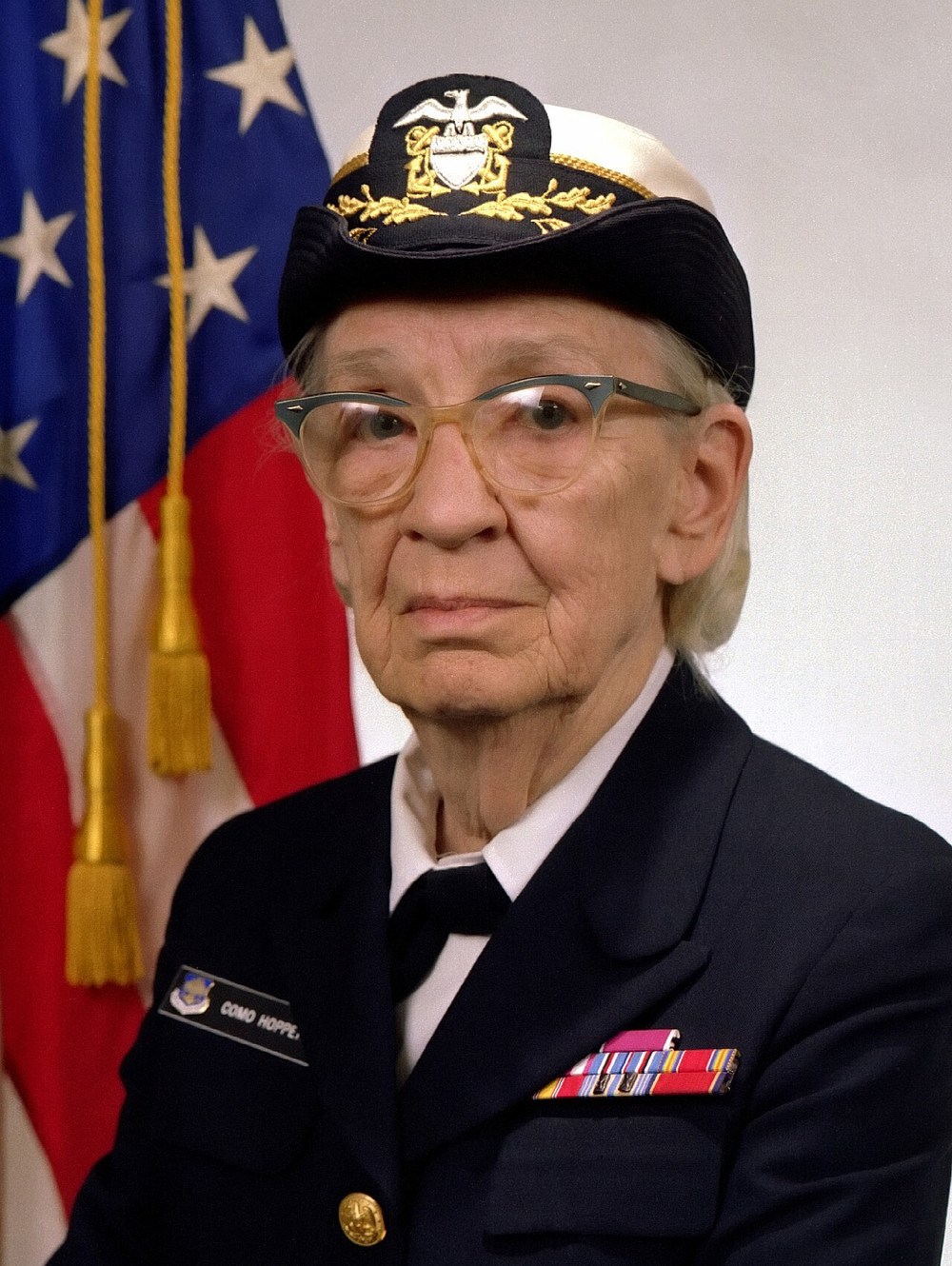
Born Grace Murray, Hopper graduated from Vassar and completed a doctorate in mathematics at Yale in 1934. She taught before joining the US Naval Reserve during the Second World War. Assigned to Harvard, she worked with Howard Aiken’s team on the Mark I computer. Her early career therefore combined substantial formal mathematical education with practical programming in a new technological environment.
Programming early machines
Mark I work involved translating problems into detailed operations and documenting how the machine could be used. Instructions, numerical methods and machine limitations had to be coordinated carefully. Hopper’s experience helped show that programming was an intellectual and organizational discipline in its own right. Early computers were not machines that understood ordinary requests without the demanding preparation undertaken by their operators and programmers.
Compilers and reusable instructions
At the company developing UNIVAC, she worked on systems that assembled reusable routines and translated higher-level descriptions into machine operations. The A-0 system of the early 1950s is often described as an early compiler, although its precise classification differs from later language compilers. The historical point is the move toward automated translation and reusable software rather than repeated hand coding of every operation.
Business languages and COBOL
Her FLOW-MATIC work demonstrated that business-oriented programs could use English-like commands. That experience influenced the committee process that produced COBOL in 1959. Hopper was an important advocate and contributor, but she did not single-handedly create the entire language. COBOL’s development involved government, industry and a wider design group responding to the need for programs that could serve different computer systems.
Standards and naval leadership
Hopper returned to active naval duty and worked on programming-language standardization and compatibility. These issues mattered because an organization buying different machines needed dependable software and comparable language behavior. She retired as a rear admiral in 1986. Public lectures later made her recognizable to a wider audience, but the administrative and standards work was central to turning programming ideas into usable institutional practice.
Myth, memory and technical influence
She died in 1992. The famous moth taped into a computer logbook illustrates literal hardware trouble, but the word bug existed before that incident. Her stronger legacy concerns abstraction: allowing people to express a task more clearly while software manages lower-level operations. That development required disciplined translation and standards, not the removal of technical constraints, and it helped shape the software systems used far beyond her original machines.
Career timeline
Completes doctoral study in mathematics before her naval career.
Works on programming and documentation for the early computer.
Develops an early system for automated assembly and translation of routines.
FLOW-MATIC experience influences the collaborative creation of COBOL.
Retires from the Navy with the rank of rear admiral.
Selected works & milestones
Harvard Mark I
Works on programming and documentation for the early computer.
A-0 system
Develops an early system for automated assembly and translation of routines.
COBOL development
FLOW-MATIC experience influences the collaborative creation of COBOL.
Naval retirement
Retires from the Navy with the rank of rear admiral.
- US Naval History and Heritage Command — official biography
- US Navy — Grace Hopper biographical record
- Computer History Museum — Grace Hopper
- Grace Hopper — biographical reference and bibliography
Published 2026-10-31. Sources reviewed for this edition. Independent coverage of public professional activity.