Contents — explore this biography
A familiar landscape becomes a subjectObservation and the example of older mastersThe scale of the Stour paintingsWeather, invention and receptionA legacy beyond the rural idyllA familiar landscape becomes a subject
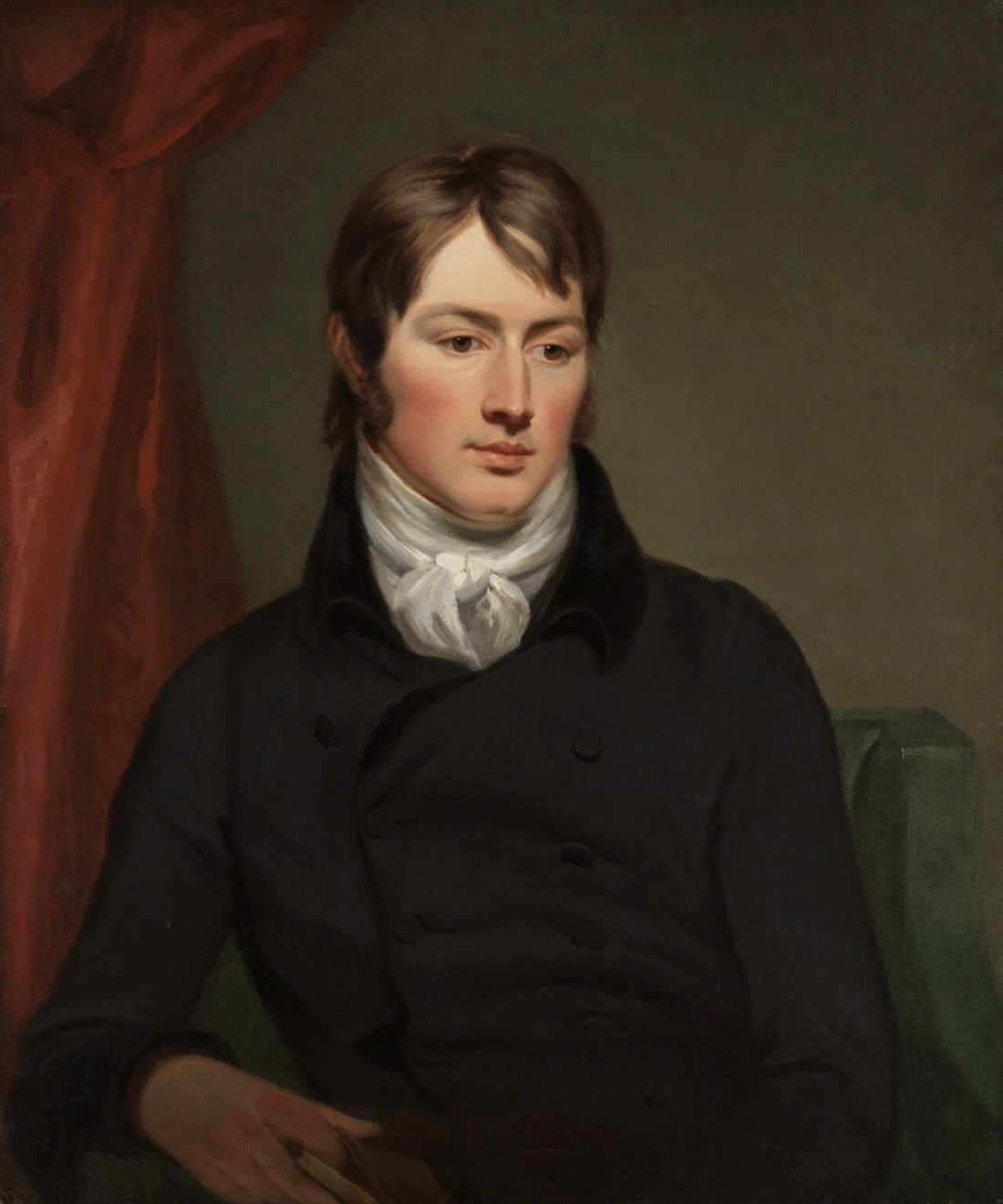
John Constable was born in East Bergholt in 1776, within the Suffolk landscape that would supply many of his most important subjects. His family’s milling business connected him to the working environment around the River Stour. Fields, waterways, buildings and labour therefore carried personal associations rather than appearing as anonymous rural scenery. He gradually chose an artistic career, developing through independent study before entering the Royal Academy Schools at the end of the eighteenth century.
Observation and the example of older masters
Constable looked closely at earlier landscape painting, including Dutch artists and the ordered compositions of Claude Lorrain. Those examples offered ways to arrange space and colour without determining his response to familiar surroundings. Outdoor studies helped him record changing skies, vegetation and reflected light. These observations were then reconsidered in the studio. His work combines the immediacy of a particular encounter with a deliberate construction of the picture, so the distinction between spontaneous sketch and carefully developed painting remains important.
The scale of the Stour paintings
From 1819 Constable exhibited a sequence of large landscapes often called his six-foot paintings. Their scale gave everyday rural subjects an ambition commonly reserved for grander historical themes. The Hay Wain, exhibited in 1821, depicts the millpond at Flatford and the house associated with Willy Lott. Although its setting was deeply familiar, the painting was prepared through studies and made in the studio. Its sense of freshness is therefore an artistic achievement, not evidence that the entire canvas was painted outdoors.
Weather, invention and reception
Constable’s skies are active parts of a composition, establishing illumination and emotional tone rather than merely filling the background. Cloud studies helped him investigate these effects, while bright touches of paint suggest moisture, movement and flickering light. His landscapes did not meet with uniform approval in Britain. Their reception in France was more enthusiastic, and The Hay Wain won distinction at the Paris Salon in 1824. The Cornfield also demonstrates that close observation could coexist with invention: its distant village was constructed for the composition.
A legacy beyond the rural idyll
Constable became a full Royal Academician in 1829 and died in 1837. His later reputation sometimes reduces the paintings to reassuring images of an unchanged countryside, overlooking their labour, commerce and highly worked surfaces. They also belong to a period of rapid economic and social transformation. His influence on French painting helped establish landscape as a serious experimental field. The continuing interest of the work lies in the relationship between intimate knowledge of a place and the formal decisions needed to make that knowledge visible.
Career timeline
Born in East Bergholt, Suffolk.
Began his training at the Royal Academy Schools.
Exhibited The Hay Wain.
The Hay Wain received recognition at the Paris Salon.
Died in London.
Selected works & milestones
Wivenhoe Park
A country estate viewed through carefully observed light and space.
Stratford Mill
A major Stour landscape with a working watermill.
The Hay Wain
A monumental studio painting based on the Flatford landscape.
The Cornfield
A Suffolk lane transformed through observation and compositional invention.
- National Gallery — biography
- National Gallery — The Hay Wain
- National Gallery — The Cornfield
- National Gallery of Art — collection
Published 2026-11-05. Sources reviewed for this edition. Independent coverage of public professional activity.