Contents — explore this biography
An education in drawing and older artModern subjects and constructed viewpointsThe ballet as work and repetitionAn independent within the Impressionist circleSculpture, late work and a complicated legacyAn education in drawing and older art
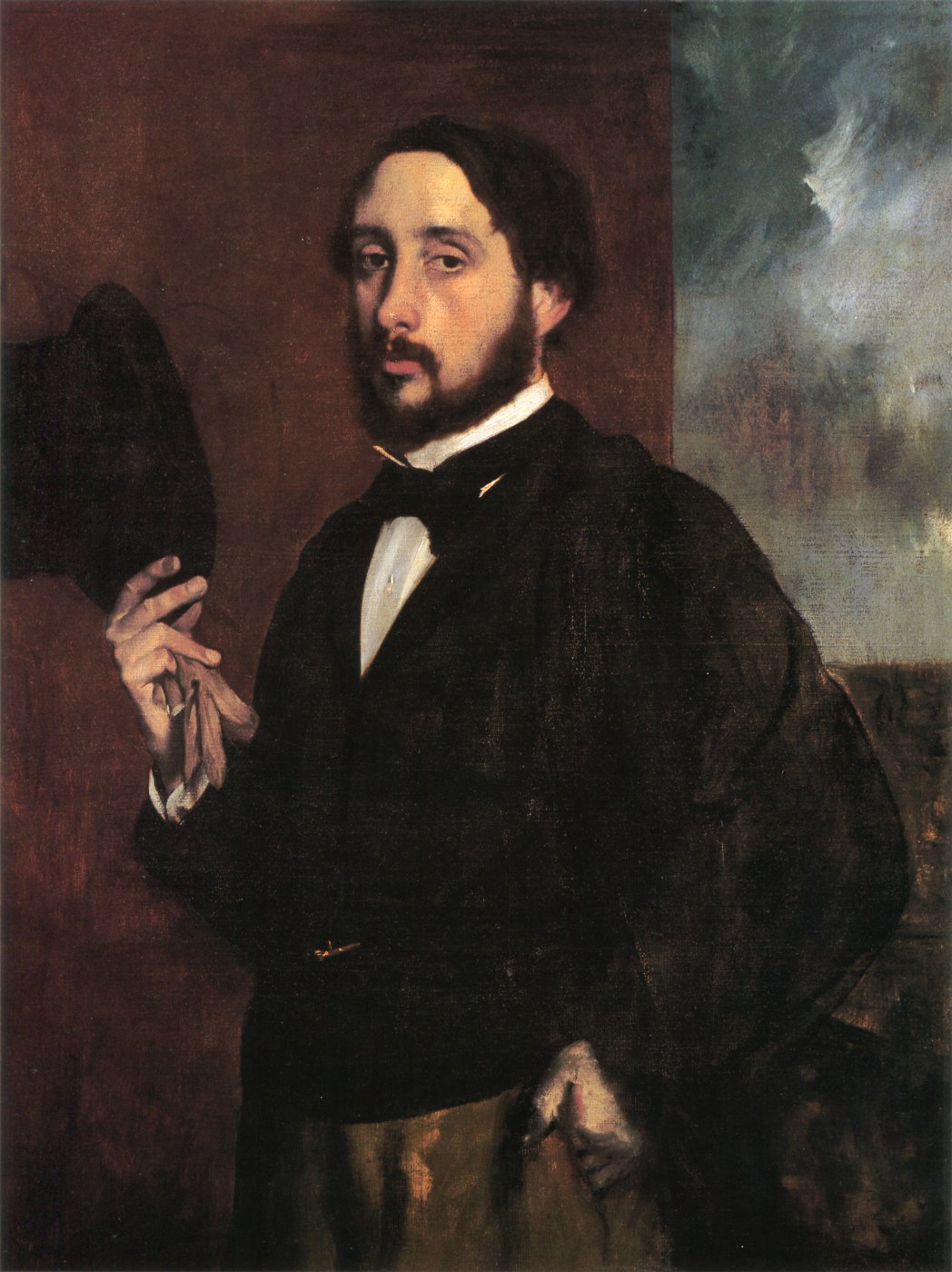
Edgar Degas was born in Paris in 1834 into a prosperous family. His education and early artistic training encouraged sustained attention to drawing, while museums and travel in Italy brought him into close contact with earlier painting. He initially pursued historical subjects before turning increasingly toward contemporary life. The discipline of studying a figure and revising its position remained central throughout his career. His later images of apparently passing moments rest on this foundation of deliberate preparation and structural control.
Modern subjects and constructed viewpoints
Degas painted theatres, racing grounds, cafés and working environments, often selecting viewpoints that seem partial or interrupted. Figures can be cut by the edge of the picture, and empty areas may occupy unexpectedly large portions of a composition. These decisions create the sensation of encountering life in progress, but they are carefully organized. He was interested in the relationship between bodies and their surroundings: the angle of a chair, a floorboard or a railing can direct attention as strongly as a face.
The ballet as work and repetition
Dancers became a recurring subject because rehearsals and backstage spaces offered varied movements, pauses and social relationships. Degas examined the labour behind performance as well as its public spectacle. A dancer adjusting a shoe or resting between exercises reveals a different rhythm from a finished stage appearance. Repeated studies allowed him to transfer and modify poses across works. The resulting paintings should therefore be read as constructed investigations of movement and observation, rather than transparent records of a single visit to the theatre.
An independent within the Impressionist circle
Degas helped organize the independent exhibitions associated with Impressionism and contributed to seven of the eight shows. He shared the group’s interest in contemporary subjects but preferred the description of realist or independent. Unlike painters primarily occupied with outdoor light, he often worked with interiors and artificial illumination. Pastel, monotype and mixed techniques expanded his possibilities, producing surfaces that could be layered, reworked and intensified. His artistic exchanges included a long, sometimes difficult relationship with Édouard Manet and an important connection with Mary Cassatt.
Sculpture, late work and a complicated legacy
Degas also modelled dancers and horses, using three-dimensional forms to investigate balance and bodily action. Little Dancer Aged Fourteen, exhibited in 1881, combined wax with real materials; the familiar bronze versions were cast after his death. Later pastels push colour and texture toward increasing intensity, while deteriorating sight affected his working life. He died in 1917. His contribution lies in showing how a modern subject can emerge through rigorous design, repetition and experimentation across media, rather than through rapid observation alone.
Career timeline
Born in Paris.
Studied earlier art during an extended stay in Italy.
Participated in the first independent Impressionist exhibition.
Exhibited Little Dancer Aged Fourteen.
Died in Paris.
Selected works & milestones
The Bellelli Family
A family portrait built around complex spatial and emotional relationships.
The Dance Class
A rehearsal scene connecting individual gestures with a large composition.
In a Café (L’Absinthe)
A study of proximity and isolation in a modern interior.
Little Dancer Aged Fourteen
A sculpture exhibited in wax; bronze versions followed posthumously.
- Metropolitan Museum of Art — painting and drawing
- Metropolitan Museum of Art — sculpture
- National Gallery of Art — artist collection
Published 2026-11-05. Sources reviewed for this edition. Independent coverage of public professional activity.