Contents — explore this biography
Coyoacán and early lifeAccident and the turn to paintingPortraiture, dress and visual languageDiego Rivera and international exhibitionsMajor paintings and later yearsReputation and the historical artistCoyoacán and early life
Magdalena Carmen Frida Kahlo y Calderón was born in Coyoacán in 1907. Her father Guillermo was a photographer, and she grew up in the house later known as the Casa Azul. Childhood polio affected her health, but her early education included interests extending beyond art. The political and cultural changes after the Mexican Revolution formed part of the environment in which her identity developed.
Accident and the turn to painting
A severe bus accident in 1925 left lasting injuries and contributed to a prolonged period of recovery. Painting became a sustained activity during this time. The resulting work cannot be explained only through physical suffering: Kahlo chose formats, symbols and cultural references with precision. A biographical event supplies context, while the composition determines how that experience is communicated to another person.
Portraiture, dress and visual language
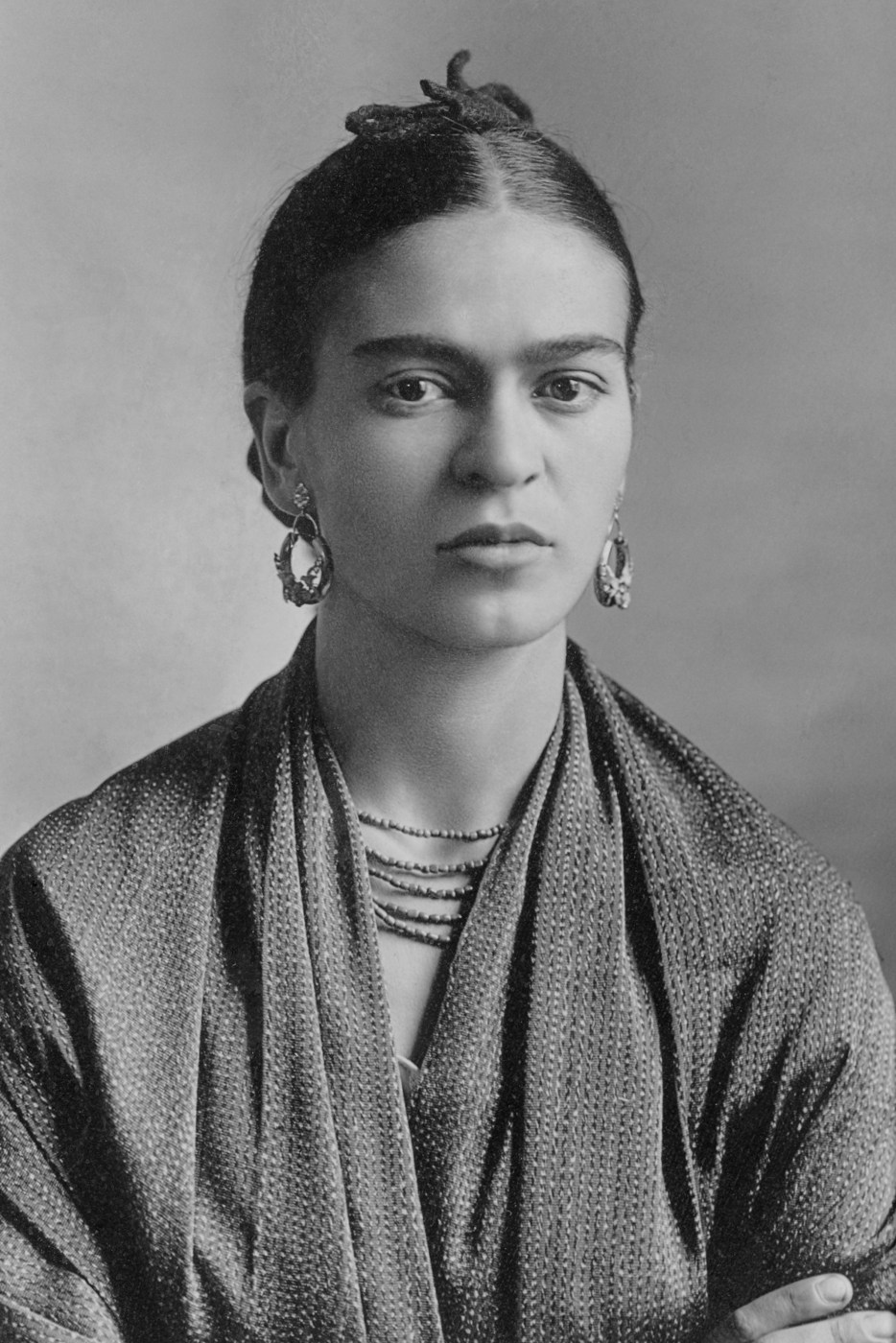
Self-portraits often place her face against tightly organized settings, with animals, plants, clothing or objects carrying additional meanings. Her use of Mexican dress participated in debates about national and personal identity. The pictures can bring intimate events into dialogue with religious imagery, popular painting and the language of retablos. Their small scale frequently asks for close attention rather than the distant viewing associated with monumental murals.
Diego Rivera and international exhibitions
Kahlo married Diego Rivera in 1929; they divorced in 1939 and remarried in 1940. Time in the United States and exhibitions in New York and Paris expanded the audience for her work. André Breton connected her with Surrealism, but she resisted being understood simply through that movement. Her painting developed in relation to international art without losing the specificity of its Mexican contexts.
Major paintings and later years
Works such as The Two Fridas and Self-Portrait with Cropped Hair use doubling, dress and altered appearance to examine identity and relationship. Health difficulties and political commitments remained important in her later life. A solo exhibition in Mexico in 1953 was a significant recognition during her lifetime. She died on 13 July 1954, leaving a compact but carefully differentiated body of paintings.
Reputation and the historical artist
The Casa Azul opened as a museum after her death, while later scholarship brought increasing attention to her independent achievement. The popular icon sometimes overshadows the painter’s formal decisions. Reading the work closely means separating an image from an assumed confession and acknowledging political commitments without reducing every object to a single symbol. Her biography concerns artistic construction as much as the extraordinary public afterlife of her appearance.
Career timeline
Begins an extended recovery during which painting becomes central.
Marries the Mexican muralist Diego Rivera.
Presents a solo exhibition at the Julien Levy Gallery.
Paints the double self-portrait in a year of personal and artistic change.
Receives a major solo presentation in Mexico during her lifetime.
Selected works & milestones
Marriage to Rivera
Marries the Mexican muralist Diego Rivera.
New York exhibition
Presents a solo exhibition at the Julien Levy Gallery.
The Two Fridas
Paints the double self-portrait in a year of personal and artistic change.
Mexico solo exhibition
Receives a major solo presentation in Mexico during her lifetime.
- Museo Frida Kahlo — archival life chronology
- MoMA — Frida Kahlo and collection works
- National Museum of Women in the Arts — Kahlo biography
- Frida Kahlo — biographical reference and source notes
Published 2026-10-31. Sources reviewed for this edition. Independent coverage of public professional activity.