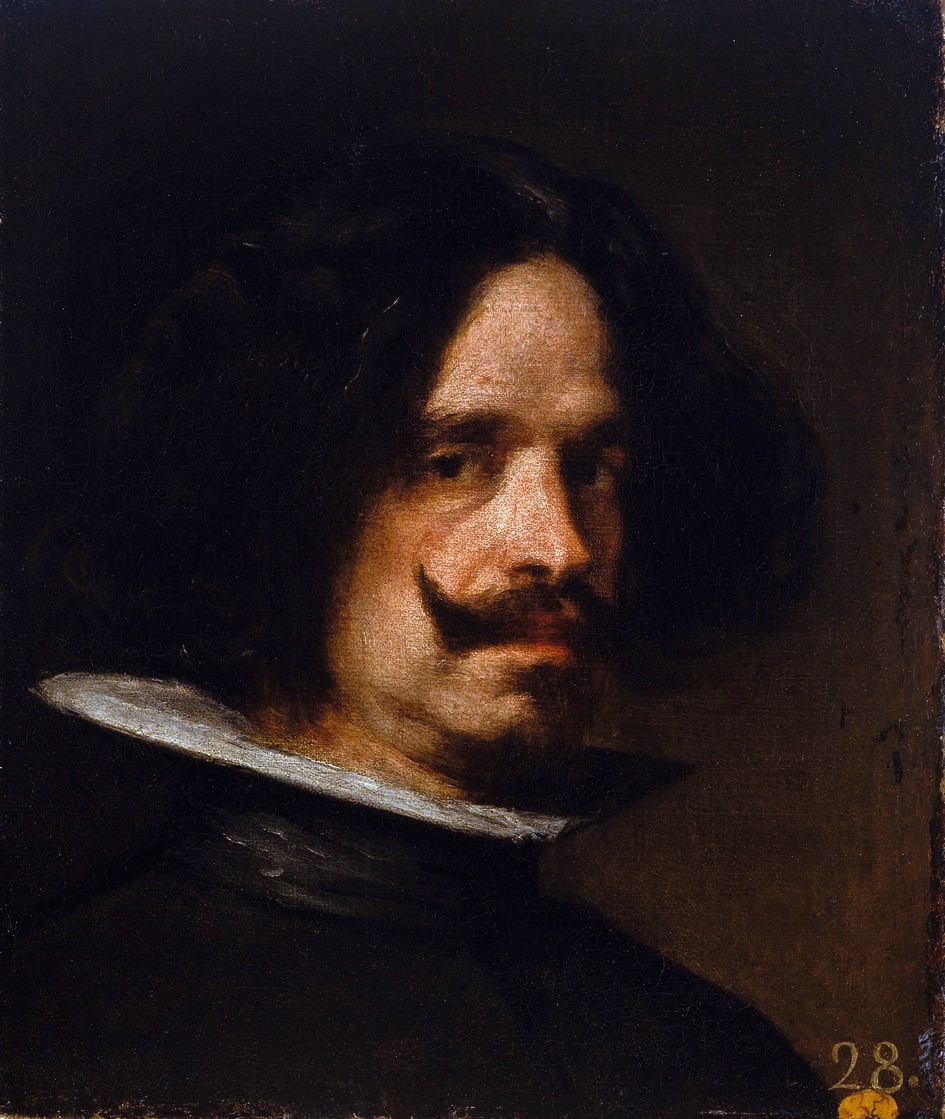
Contents — explore this biography
Seville and the discipline of observationEntering the court of Philip IVItaly and an increasingly flexible techniqueHistory, mythology and the royal householdLas Meninas and the problem of lookingSeville and the discipline of observation
Diego Rodríguez de Silva y Velázquez was born in Seville in 1599. Training with Francisco Pacheco introduced him to the technical and intellectual foundations of painting within a major Spanish commercial city. His early kitchen scenes, or bodegones, give objects and working people a weighty physical presence. Pots, food, cloth and faces receive close attention under strongly directed light. This naturalism provided a foundation for later experiments even as his handling of paint became more open and economical.
Entering the court of Philip IV
Velázquez moved into royal service in Madrid in 1623, beginning a long relationship with Philip IV. Court portraiture required more than resemblance: pose, costume and pictorial restraint communicated rank within a tightly organized political world. Access to the royal collection, particularly paintings by Titian, broadened his understanding of colour and brushwork. His responsibilities also extended beyond painting into court administration, so his career must be understood within the institution that provided both patronage and demanding obligations.
Italy and an increasingly flexible technique
Visits to Italy in 1629–1631 and 1649–1651 expanded Velázquez’s experience of earlier and contemporary art. His paintings increasingly suggest forms through separate touches that resolve at a distance, allowing light and atmosphere to connect figures with their surroundings. The portrait of Pope Innocent X and the portrait of Juan de Pareja belong to the second journey. Pareja, who had been enslaved by Velázquez, later gained freedom and developed his own career as a painter; that history should accompany discussion of the celebrated likeness.
History, mythology and the royal household
The Surrender of Breda presents a military victory through an encounter between opposing commanders, making gesture and the handling of space central to its meaning. Other paintings explore mythology or members of the royal household without relying on uniform idealization. Velázquez’s portraits of court entertainers and people with dwarfism are especially important to discussions of representation and hierarchy. Their individual presence remains visible even as the circumstances of their employment reveal the unequal social structures surrounding the royal collection.
Las Meninas and the problem of looking
Painted in 1656, Las Meninas places the artist, the young infanta and attendants within a room whose mirrors, glances and openings complicate the viewer’s position. Its lasting importance rests partly on this uncertainty about who is seeing whom and how a royal image is made. Velázquez died in Madrid in 1660. Later painters studied both his ambitious compositions and his economical brushwork, finding a model for how apparently loose marks could produce unusually convincing bodies, spaces and effects of light.
Career timeline
Born in Seville.
Entered the service of Philip IV in Madrid.
Made his first journey to Italy.
Painted Las Meninas.
Died in Madrid.
Selected works & milestones
Old Woman Cooking Eggs
An early Seville painting attentive to everyday objects and human presence.
The Surrender of Breda
A historical composition for the Buen Retiro Palace.
Juan de Pareja
A portrait made during the second Italian journey.
Las Meninas
An intricate investigation of court life, painting and the position of the viewer.
- National Gallery — Velázquez biography
- Metropolitan Museum of Art — Velázquez
- National Gallery of Art — Velázquez
Published 2026-11-05. Sources reviewed for this edition. Independent coverage of public professional activity.