Contents — explore this biography
A Scottish upbringing and a London laboratoryWartime infection and the limits of treatmentThe observation that led to penicillinFrom laboratory finding to shared Nobel recognitionReputation and historical significanceA Scottish upbringing and a London laboratory
Alexander Fleming was born at Lochfield in Ayrshire in 1881 and moved to London while still young. After working in a shipping office, he entered St Mary’s Hospital Medical School in 1901. His professional life became closely connected with the institution and with the bacteriologist Almroth Wright. Laboratory work gave Fleming a setting in which careful observation and practical experimentation mattered as much as formal theory. He developed techniques for investigating infection and remained interested in how substances might damage bacteria without causing equivalent harm to the tissues of a patient.
Wartime infection and the limits of treatment
During the First World War, Fleming served in a wound-research team in France. The treatment of infected injuries presented a difficult problem: a chemical that killed bacteria in a laboratory could also injure living tissue or fail to reach organisms deep inside a wound. This experience helped shape his continuing interest in the body’s defences and selective antibacterial action. His later work on lysozyme, an enzyme present in bodily secretions, belonged to the same line of inquiry. It demonstrated a natural antibacterial mechanism even though it did not become the broad solution to serious infections he sought.
The observation that led to penicillin
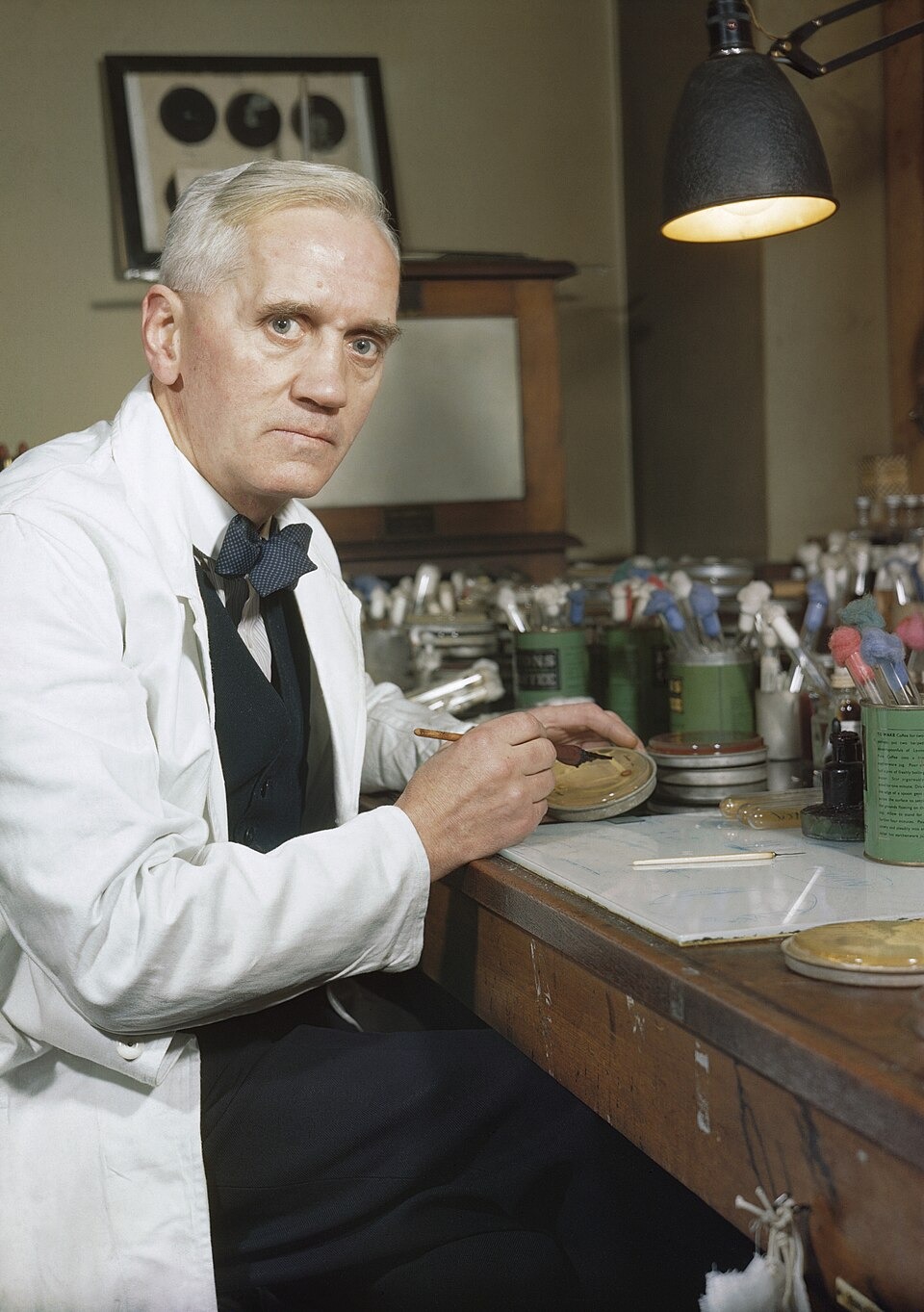
In 1928, Fleming noticed that bacterial growth had been inhibited around a contaminating mould on a culture plate. He investigated the effect rather than simply discarding the plate, and named the active substance penicillin. His findings were published in 1929. The familiar story of an accidental discovery captures only its opening moment: recognizing the pattern, testing the mould’s action and communicating the result required scientific preparation. At this stage, however, penicillin had not yet become a reliably purified drug that hospitals could administer widely. Discovery of an effect and development of a treatment were different achievements.
From laboratory finding to shared Nobel recognition
Howard Florey, Ernst Chain and their Oxford colleagues subsequently developed penicillin research into a practical therapeutic programme. Further work in purification, testing and large-scale production made widespread treatment possible during the Second World War. Fleming shared the 1945 Nobel Prize in Physiology or Medicine with Florey and Chain. The joint award reflects the collaborative nature of the achievement: the original observation was essential, but it could not alone deliver a medicine at scale. The history includes scientists, clinicians, industrial specialists and manufacturing systems whose contributions connected a laboratory phenomenon with everyday medical care.
Reputation and historical significance
Fleming became an internationally recognized figure, was knighted in 1944 and continued to be associated with St Mary’s and bacteriological research. He died in 1955 and was buried in St Paul’s Cathedral. His career is often used to illustrate the value of noticing an unexpected result, but it also shows the importance of following a finding through evidence rather than attaching a heroic explanation to it afterward. Penicillin transformed the treatment of susceptible bacterial infections. Its history remains a useful example of how observation, disciplined development and institutional cooperation can produce a change far larger than any single experiment.
Career timeline
Born in Lochfield, Ayrshire.
Entered St Mary’s Hospital Medical School in London.
Observed the antibacterial effect that led to penicillin.
Shared the Nobel Prize with Ernst Chain and Howard Florey.
Died in London on March 11.
Selected works & milestones
Lysozyme research
Published research on a naturally occurring antibacterial enzyme.
Penicillin paper
Reported the antibacterial action of a Penicillium mould culture.
Royal Society fellowship
Elected Fellow of the Royal Society.
Nobel Prize in Physiology or Medicine
Joint recognition for penicillin and its therapeutic effects.
- Science History Institute — Fleming and penicillin
- MIT Lemelson — research and career
- Royal College of Physicians — historical biography
- Nobel Prize — 1945 award
Published 2026-11-05. Sources reviewed for this edition. Independent coverage of public professional activity.