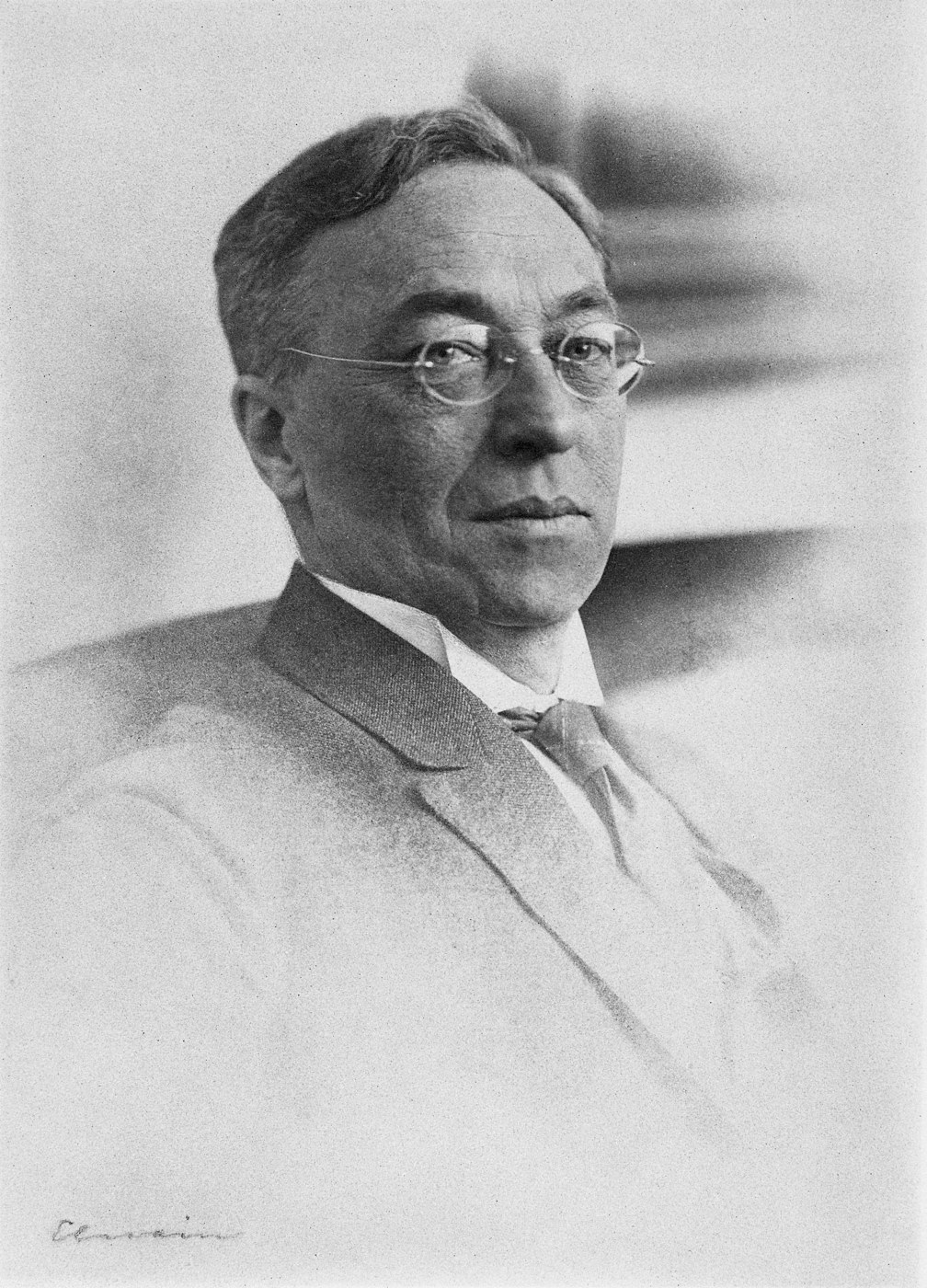
Contents — explore this biography
From legal scholarship to artThe Blue Rider and a new pictorial languageAbstraction as a process of constructionRussia and the BauhausThe final years in FranceFrom legal scholarship to art
Born in Moscow in 1866, Wassily Kandinsky studied law and economics before choosing an artistic career. In 1896 he moved to Munich, where he trained with Anton Ažbe and later Franz von Stuck. This transition brought him into a lively environment of exhibitions, schools and artists’ associations. Travel, folk art and the landscape around Murnau contributed to his developing interests, while Gabriele Münter became an important artistic companion within the same creative milieu.
The Blue Rider and a new pictorial language
During the years before the First World War, Kandinsky’s landscapes and figures increasingly gave way to independent arrangements of colour and shape. With Franz Marc and others he developed the Blue Rider exhibitions and almanac, which connected contemporary painting with a wide range of artistic traditions. His book Concerning the Spiritual in Art argued for painting guided by inner expressive necessity. The comparison with music helped explain how an artwork might move viewers without representing a recognizable scene.
Abstraction as a process of construction
Kandinsky’s path toward abstraction was gradual rather than a single moment that settled the direction of modern art. Paintings such as Composition VII combine sweeping movement, dense intersections and carefully tested relationships. Studies and revisions underlie their apparent spontaneity. His vocabulary of impressions, improvisations and compositions distinguished different approaches to making pictures. The work belongs to a wider history of abstract experiments by multiple artists, while retaining an unusually sustained connection between theory and studio practice.
Russia and the Bauhaus
Kandinsky returned to Russia after war began in 1914 and worked within cultural institutions following the revolution. He later returned to Germany and joined the Bauhaus in 1922. Teaching encouraged a more systematic exploration of points, lines, angles and geometric relationships, developed in his 1926 book Point and Line to Plane. His paintings changed accordingly, but geometry remained expressive rather than merely technical. The school placed his ideas in conversation with design, architecture and other approaches to artistic education.
The final years in France
After the Bauhaus closed in 1933, Kandinsky settled in Neuilly-sur-Seine near Paris. His late paintings introduced small, organic-looking forms into increasingly intricate arrangements. He died there in 1944. Across these different settings, his enduring contribution was to make abstraction both a visual practice and a subject of articulated thought. His teaching and writing helped later artists consider how rhythm, tension and proportion could organize a picture independently of conventional storytelling or naturalistic description.
Career timeline
Born in Moscow.
Moved to Munich to pursue art after studying law and economics.
Helped launch the Blue Rider exhibitions and almanac; published his spiritual theory of art.
Joined the teaching staff of the Bauhaus.
Died in Neuilly-sur-Seine, France.
Selected works & milestones
Concerning the Spiritual in Art
A theoretical statement about expression, colour and artistic necessity.
Composition VII
A large and densely organized work from his early abstract period.
Composition VIII
A geometric composition made during the Bauhaus years.
Point and Line to Plane
A systematic examination of basic pictorial elements and their relationships.
- Museo Thyssen-Bornemisza — artist biography
- Peggy Guggenheim Collection — artist chronology
- Milwaukee Art Museum — retrospective biography
Published 2026-11-05. Sources reviewed for this edition. Independent coverage of public professional activity.