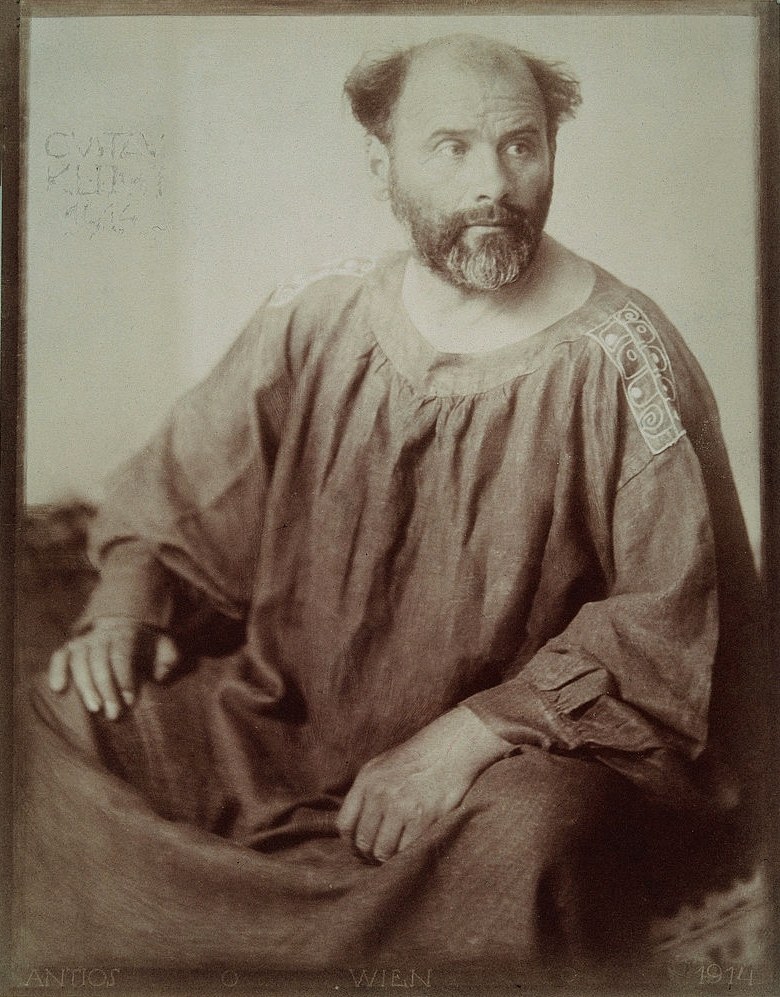
Contents — explore this biography
Training in an imperial capitalSecession and artistic independencePublic controversy and private patronageGold, pattern and the human figureA wider legacy than the golden imageTraining in an imperial capital
Gustav Klimt was born in 1862 in Baumgarten, on the outskirts of Vienna, into a family connected with artistic craft. He attended the city’s School of Applied Arts, where his education emphasized drawing and established decorative traditions. With his brother Ernst and Franz Matsch, he formed a studio that won commissions for theatre interiors. The polished historicism of this early work differs markedly from the flattened surfaces and symbolism associated with his mature paintings.
Secession and artistic independence
In 1897 Klimt helped establish the Vienna Secession and became its first president. The association sought room for new art and international exchange outside the existing exhibition establishment. Its ambitions crossed boundaries between painting, architecture and applied design. Klimt’s participation therefore involved more than a personal change of style: it helped build an institutional setting in which modern artists could present their work and challenge the hierarchy separating fine art from decoration.
Public controversy and private patronage
Klimt’s paintings for the University of Vienna brought the limits of official patronage into focus. His allegorical treatment of philosophy, medicine and jurisprudence unsettled viewers expecting reassuring academic images. The dispute contributed to his withdrawal from state commissions. Portraiture and independent projects became increasingly important, supported by patrons within Vienna’s cultural life. This history places his decorative richness within debates about sexuality, knowledge and artistic authority rather than treating the paintings only as luxurious surfaces.
Gold, pattern and the human figure
Works including Judith I, Portrait of Adele Bloch-Bauer I and The Kiss combine carefully observed faces with ornamental fields that partly dissolve the body. Gold and other metallic effects recall precious objects and mosaics while disrupting conventional pictorial depth. The Kiss, dated 1908–1909 by the Belvedere, concentrates these devices around an embracing couple. Klimt also made landscapes, where repeated foliage, flowers and water offered a different route toward dense pattern and the organization of a painted surface.
A wider legacy than the golden image
Klimt died in Vienna in 1918. His recognizable style has made individual paintings ubiquitous in reproduction, but his importance also lies in the relationships between image, setting and patronage. The Secession’s exhibition culture and his experiments with allegory helped define a distinctive form of Central European modernism. Viewing the early commissions, landscapes and drawings alongside the celebrated golden pictures reveals a career shaped by changing materials, institutions and expectations, rather than by one decorative formula.
Career timeline
Born in Baumgarten near Vienna.
Began studying at Vienna’s School of Applied Arts.
Co-founded the Vienna Secession and became its first president.
Developed The Kiss during his celebrated golden period.
Died in Vienna.
Selected works & milestones
Judith I
A biblical subject transformed through sensuality and ornamental gold.
Beethoven Frieze
A decorative ensemble created for the Secession’s Beethoven exhibition.
Portrait of Adele Bloch-Bauer I
A major portrait integrating figure, pattern and metallic surfaces.
The Kiss
An embracing couple surrounded by elaborate ornamental fields.
- Belvedere — Klimt, the Secession and modernism
- Neue Galerie — artist biography
- Klimt Foundation database — biography
Published 2026-11-05. Sources reviewed for this edition. Independent coverage of public professional activity.