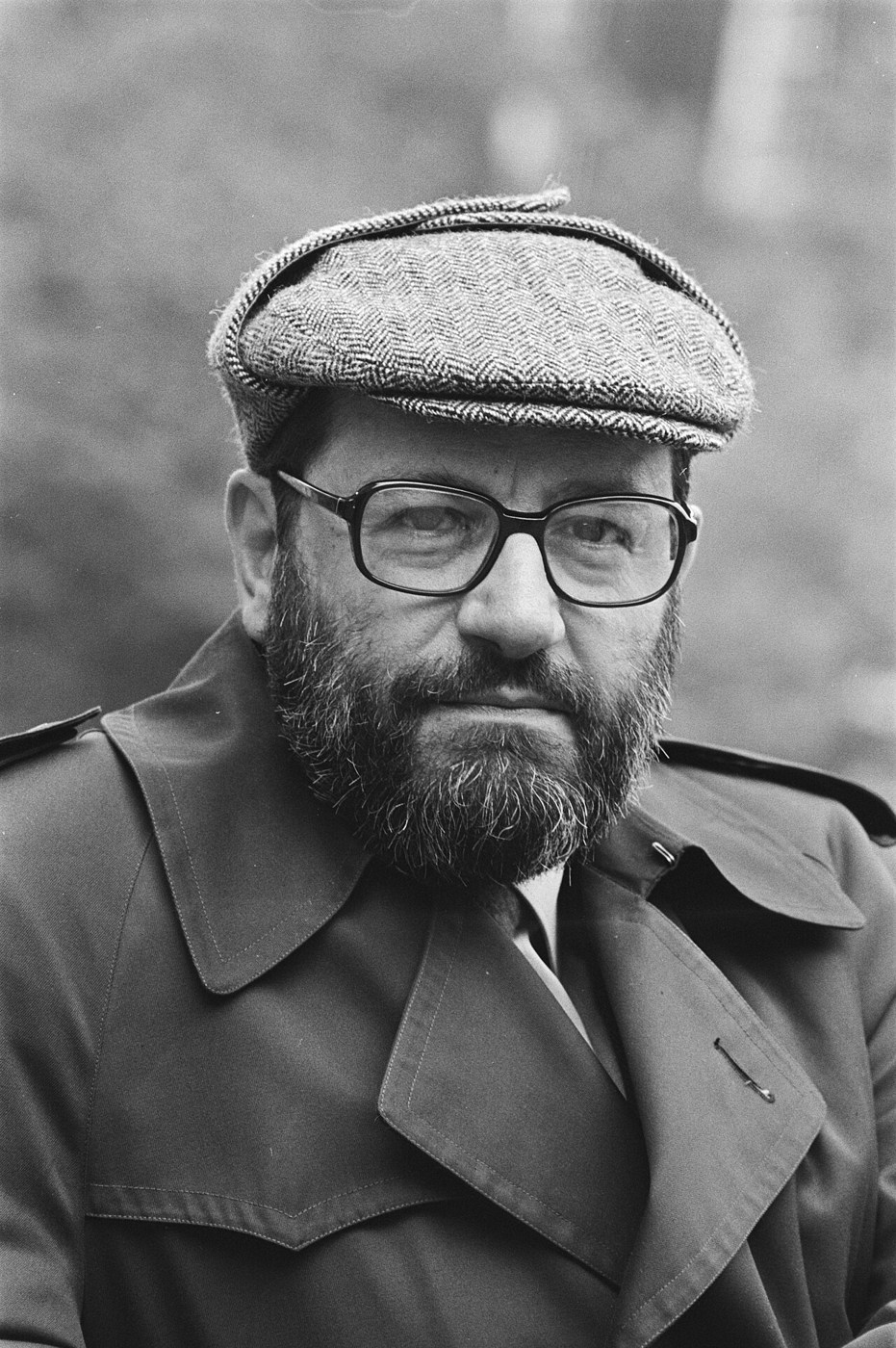
Contents — explore this biography
Medieval study and a public careerOpen works and the activity of readingBologna and the study of communicationThe Name of the RoseConspiracies and later fictionThe intellectual legacyMedieval study and a public career
Eco was born in Alessandria in 1932 and graduated from the University of Turin in 1954 with research on the aesthetics of Thomas Aquinas. His early career included work in Italian broadcasting and publishing as well as university teaching. These settings exposed him to communication in several forms: scholarly argument, commercial culture and mass entertainment. His later novels grew from this broad intellectual activity rather than replacing an unrelated academic career.
Open works and the activity of reading
The Open Work, published in Italian in 1962, investigated how artistic forms invite interpretation while retaining structures that shape a reader’s choices. His later work in semiotics examined how signs acquire meaning within cultural systems. This scholarship makes interpretation an active process, but not an unlimited permission to say anything. The distinction between a possible reading and an unsupported invention remained important across his critical and fictional writing.
Bologna and the study of communication
Eco helped develop innovative approaches to the arts and communication at the University of Bologna and became professor of semiotics there in 1975. His teaching and institution-building linked established scholarly questions to contemporary media. A Theory of Semiotics brought a major account of sign systems to an international audience. His many essays also addressed ordinary cultural objects, treating apparently minor entertainments as material that deserved intelligent analysis.
The Name of the Rose
His first novel appeared in Italian in 1980. Set in a medieval monastery, The Name of the Rose combines a sequence of deaths with debates about knowledge, authority, laughter and the preservation of texts. Its detective structure gives readers a practical experience of interpretation: evidence may be partial, classifications may mislead and the desire for an elegant explanation can exceed what the record actually supports.
Conspiracies and later fiction
Foucault’s Pendulum, published in 1988, explored what happens when learned play with connections becomes a consuming theory of hidden power. Later novels returned to questions of memory, historical fabrication and representation through different settings. Eco’s fiction asks readers to enjoy intricate patterns while noticing the risks of mistaking a convincing arrangement for a justified account. The novels therefore extend, rather than merely popularize, concerns visible in his scholarship.
The intellectual legacy
Eco died in Milan in 2016. His work remains significant for the conversation it creates between specialized research and an extensive reading public. He wrote criticism, journalism and fiction in distinct voices, showing how an idea can change when tested through another form. His legacy is especially useful wherever people interpret abundant information: learning to make connections also requires learning which connections the available evidence can reasonably sustain.
Career timeline
Completes philosophical study with research on medieval aesthetics.
Publishes an influential account of interpretation and artistic form.
Becomes professor of semiotics at the University of Bologna.
Publishes the first novel, combining medieval history and detection.
Explores conspiratorial interpretation through a complex contemporary novel.
Selected works & milestones
The Open Work
Publishes an influential account of interpretation and artistic form.
Semiotics at Bologna
Becomes professor of semiotics at the University of Bologna.
The Name of the Rose
Publishes the first novel, combining medieval history and detection.
Foucault’s Pendulum
Explores conspiratorial interpretation through a complex contemporary novel.
- University of Bologna — institutional biography
- Bompiani — author and publishing bibliography
- Umberto Eco — biographical reference and bibliography
Published 2026-10-31. Sources reviewed for this edition. Independent coverage of public professional activity.