Contents — explore this biography
A Bengali cultural formationPoetry, song and ordinary experienceGitanjali and the Nobel PrizeEducation at SantiniketanPublic conscience and artistic expansionA legacy across forms and bordersA Bengali cultural formation
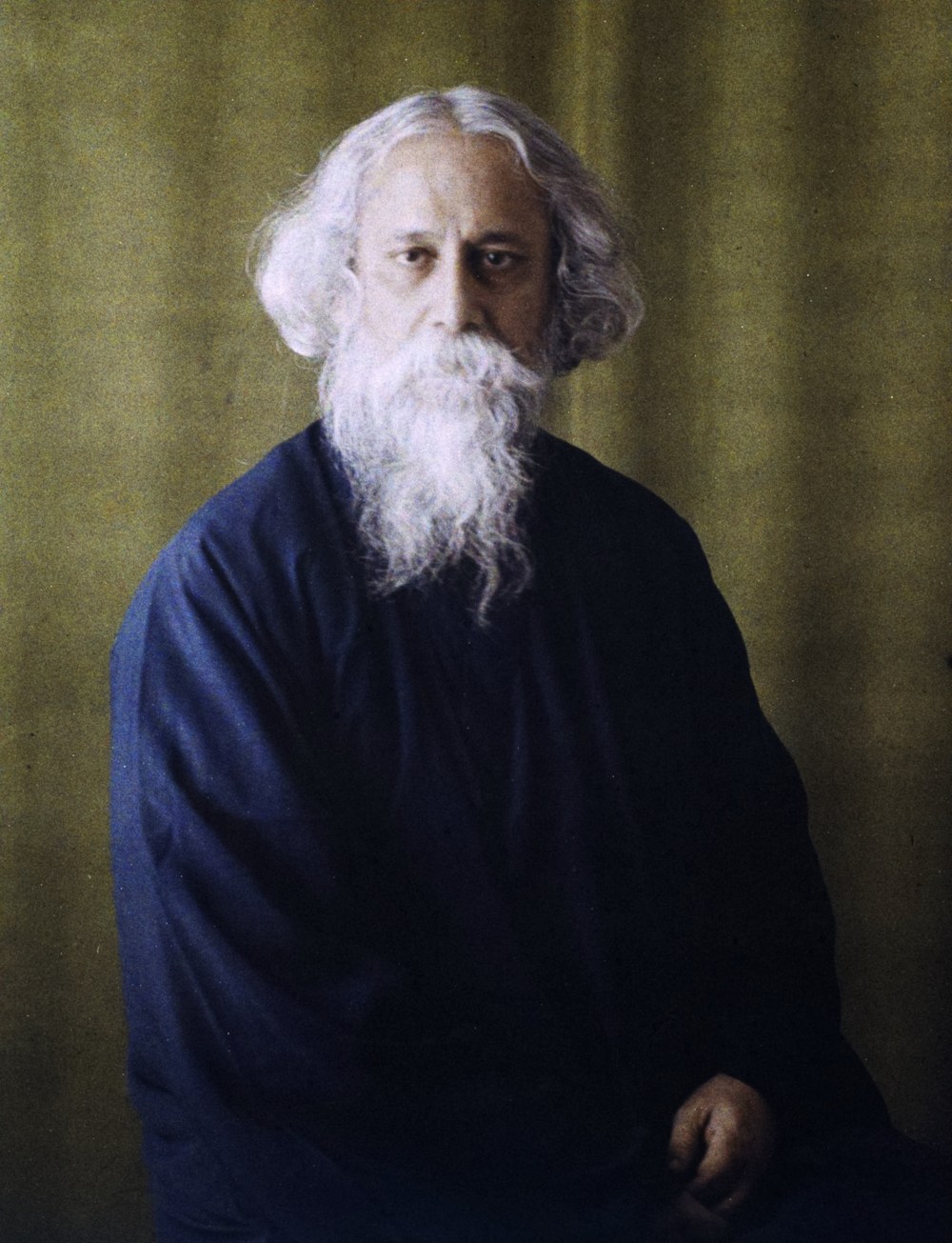
Tagore was born in Calcutta in 1861 into a family involved in literary, artistic and social debate. His writing developed in Bengali across poetry, songs, stories, drama and essays, with experiences of rural Bengal contributing to his imaginative range. English-language fame later made one selection of his poetry internationally familiar. His career, however, cannot be understood adequately through that selection alone or by overlooking the language in which most of his work originated.
Poetry, song and ordinary experience
His poems and songs explored devotion, nature, love and the movement between private feeling and wider human belonging. Short stories brought sustained attention to households, social expectations and people whose lives could appear marginal to public history. His literary experiment included changing registers and forms rather than simply preserving inherited conventions. The relationship between music and words also made his work part of cultural life beyond the experience of reading a printed page.
Gitanjali and the Nobel Prize
The Bengali Gitanjali appeared in 1910. Tagore’s English-language Gitanjali, first issued in 1912, selected and reworked poems from several Bengali collections rather than reproducing that volume exactly. The 1913 Nobel Prize in Literature brought major international recognition to his poetry. Distinguishing the Bengali and English books helps explain both the achievement and the selective way in which readers outside Bengal initially encountered an extensive body of work.
Education at Santiniketan
He established a school at Santiniketan in 1901 and developed the project that became Visva-Bharati in 1921. Education there was connected to creativity, encounters with nature and exchange between cultures. These institutional experiments gave practical form to questions visible in his writing. They sought a setting in which learning could involve relationships and exploration, rather than being organized exclusively around examinations, hierarchy and the reproduction of a fixed curriculum.
Public conscience and artistic expansion
Tagore travelled widely and debated nationalism, colonial rule and the obligations of cultural exchange. He renounced his British knighthood in 1919 after the Jallianwala Bagh massacre. In later life he developed a substantial body of painting, extending his practice into another visual and expressive medium. His commitments could place him at odds with different political camps, making his public thought more complex than a simple designation as a national literary emblem.
A legacy across forms and borders
He died in Calcutta in 1941. His songs became the national anthems of India and Bangladesh, while his educational institutions and writings continued to circulate internationally. That legacy joins local language and experience with a desire for intellectual openness. Reading Tagore across poems, stories, songs and essays reveals a writer attentive to the ways a culture can sustain its particular voice while remaining capable of learning through contact with others.
Career timeline
Establishes an educational setting linked to creativity and direct experience.
Publishes the Bengali poetry collection preceding the distinct English selection.
Receives the Nobel Prize in Literature.
Rejects the British honour after the Jallianwala Bagh massacre.
Develops the institution devoted to learning and international cultural exchange.
Selected works & milestones
Bengali Gitanjali
Publishes the Bengali poetry collection preceding the distinct English selection.
Nobel Prize
Receives the Nobel Prize in Literature.
Renunciation of knighthood
Rejects the British honour after the Jallianwala Bagh massacre.
Visva-Bharati
Develops the institution devoted to learning and international cultural exchange.
- Nobel Prize — award and biographical facts
- Nobel Prize — literary and educational career
- Victoria and Albert Museum — poet and painter
- Rabindranath Tagore — biographical reference and bibliography
Published 2026-10-31. Sources reviewed for this edition. Independent coverage of public professional activity.