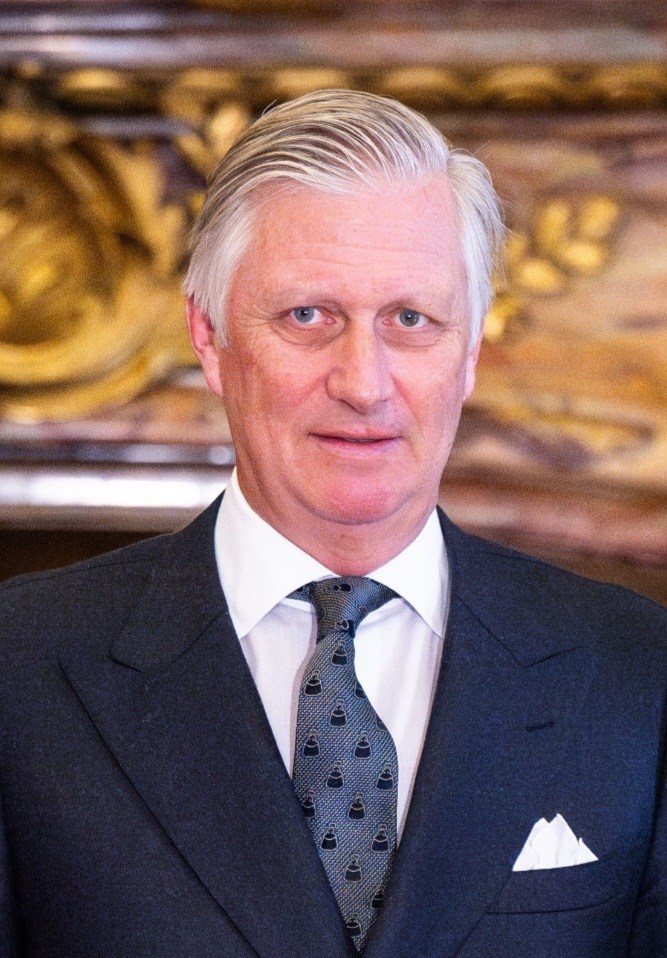
Contents — explore this biography
Family and schoolingMilitary and university educationThe heir’s public programmeMarriage and familyAccession in 2013The constitutional public roleFamily and schooling
Philippe was born in Brussels on 15 April 1960, the eldest son of Albert and Paola. His uncle Baudouin was king at the time. His education followed a bilingual path in Belgium before military and overseas studies. The family sequence matters because Philippe became heir after his father’s accession in 1993, rather than succeeding his uncle directly.
Military and university education
He entered Belgium’s Royal Military Academy in 1978, trained as a fighter pilot and obtained parachutist and commando qualifications. He later studied abroad, including at Oxford and Stanford, completing a master’s in political science. The biography distinguishes the degree-awarding institution from a shorter period of study, rather than treating every educational association as the same qualification.
The heir’s public programme
After Albert II became king in 1993, Philippe’s public duties expanded as heir. He led economic missions and worked with organizations concerned with trade, sustainable development and dialogue among language communities. These activities connected representative royal work with Belgium’s complex social and institutional setting. Commercial outcomes depended on participating organizations and businesses rather than on royal presence alone.
Marriage and family
He married Mathilde d’Udekem d’Acoz in 1999. Their four children are Elisabeth, Gabriel, Emmanuel and Eléonore. Elisabeth became heir when Philippe acceded. The family relationships provide a clear succession context, while Mathilde’s consort role and the children’s positions should not be treated as identical to the sovereign office exercised by Philippe.
Accession in 2013
Albert II abdicated on 21 July 2013, and Philippe took the constitutional oath as King of the Belgians. The official title refers to the people rather than simply naming him King of Belgium. The transition is recorded as abdication and oath, not as a coronation, reflecting the Belgian monarchy’s specific constitutional practice.
The constitutional public role
His work includes audiences, state visits, national representation and duties associated with the operation of government. Belgium is a federal parliamentary state with several levels of political authority. Royal participation in government-formation processes does not mean the king replaces ministers or parliaments. The biography places personal preparation and family continuity within that institutional framework rather than treating monarchy as one uniform system worldwide.
Career timeline
Begins training at the Royal Military Academy.
Returns to Belgium after overseas study.
Becomes heir after Albert II’s accession.
Marries Mathilde d’Udekem d’Acoz.
Takes the oath as King of the Belgians following Albert’s abdication.
Selected works & milestones
Education & early career
Begins training at the Royal Military Academy.
Public responsibilities
Returns to Belgium after overseas study.
A defining milestone
Marries Mathilde d’Udekem d’Acoz.
Royal role & continuity
Takes the oath as King of the Belgians following Albert’s abdication.
- Belgian Monarchy — official biography and public responsibilities
- Belgian Monarchy — official royal-family directory
- Philippe of Belgium — biographical reference and cited sources
Published 2026-10-31. Sources reviewed for this edition. Independent coverage of public professional activity.