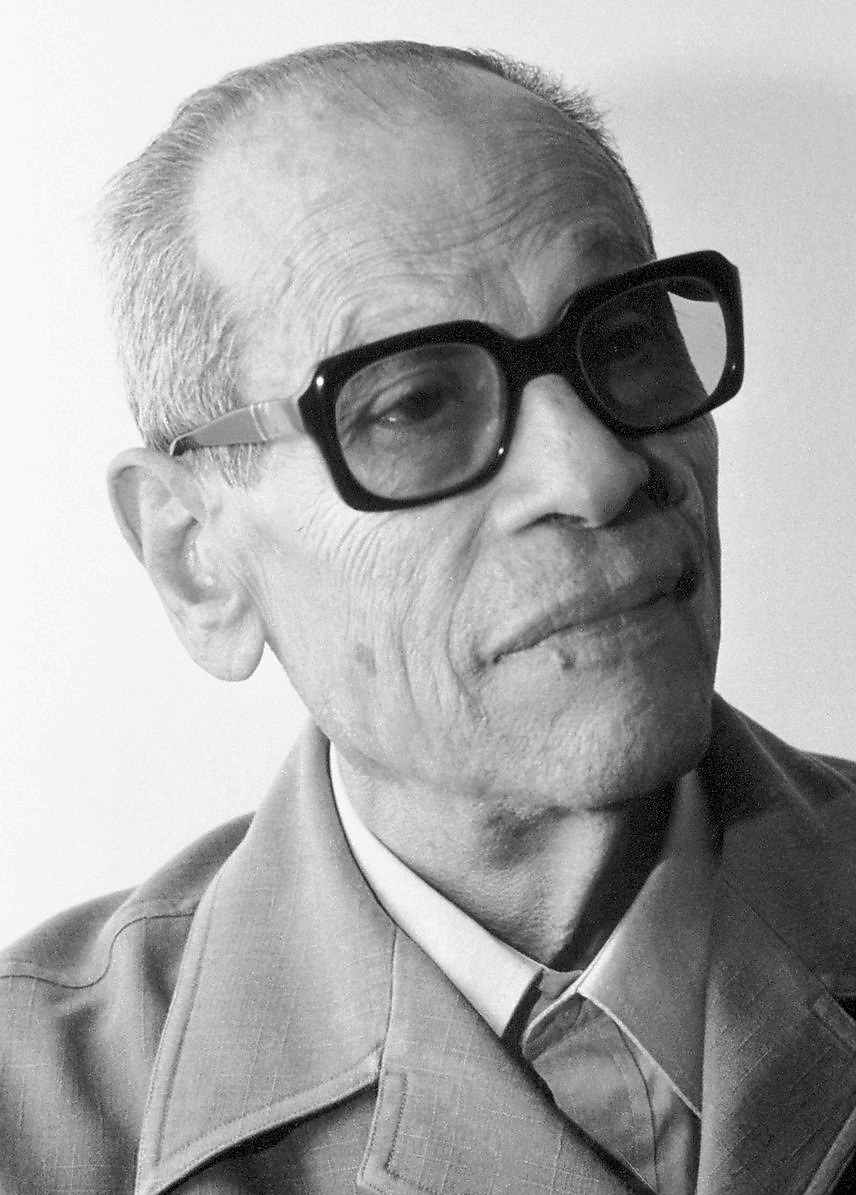
Contents — explore this biography
Cairo as a lived and literary worldFrom historical fiction to urban societyThe Cairo Trilogy and family across generationsExperiment, allegory and public debateNobel recognition and a wider readershipCairo as a lived and literary world
Mahfouz was born in Cairo in 1911 and studied philosophy before developing his literary career alongside public employment. The city’s neighbourhoods supplied much more than scenery. Streets, coffeehouses and domestic spaces became settings through which generations encountered political upheaval, social ambition and the strain between inherited customs and changing expectations.
From historical fiction to urban society
His early novels included works set in ancient Egypt. He subsequently turned towards modern Cairo, with novels such as Midaq Alley examining the lives of people whose opportunities and desires intersect within a tightly observed urban community. The change in setting accompanied an increasingly expansive account of social relationships rather than the abandonment of historical concerns.
The Cairo Trilogy and family across generations
Palace Walk, Palace of Desire and Sugar Street appeared in 1956 and 1957. Together they follow a Cairo family through generational and political change. Domestic authority, education, nationalism and individual desire interact throughout the trilogy. Its achievement lies in connecting the intimate organization of family life with forces that no household can fully control.
Experiment, allegory and public debate
Mahfouz’s later fiction moved beyond straightforward social realism. Children of the Alley, The Thief and the Dogs and Miramar employ different narrative methods to investigate authority, moral responsibility and uncertainty. His work generated major public debates, especially around allegory and religion. These books should be approached in their distinct contexts rather than as interchangeable illustrations of a single message.
Nobel recognition and a wider readership
In 1988 Mahfouz became the first Arabic-language writer awarded the Nobel Prize in Literature. Translation expanded his international readership, although his work was already central to Arabic literary culture. He died in Cairo in 2006. His legacy includes novels, short fiction and screenwriting, with the modern city remaining a powerful meeting point between personal lives and public history.
Career timeline
Born in Cairo.
Published his first novel, set in ancient Egypt.
Published Midaq Alley.
Published the three volumes of the Cairo Trilogy.
Awarded the Nobel Prize in Literature.
Selected works & milestones
Midaq Alley
An urban community observed through interlocking lives.
The Cairo Trilogy
Palace Walk, Palace of Desire and Sugar Street.
The Thief and the Dogs
A novel about betrayal, alienation and moral uncertainty.
Miramar
Multiple narrators examine changing Egyptian society.
- Egypt State Information Service — Naguib Mahfouz
- Nobel Prize — biographical record
- Nobel Prize — award and facts
- Biographical references and further reading
Published 2026-11-02. Sources reviewed for this edition. Independent coverage of public professional activity.