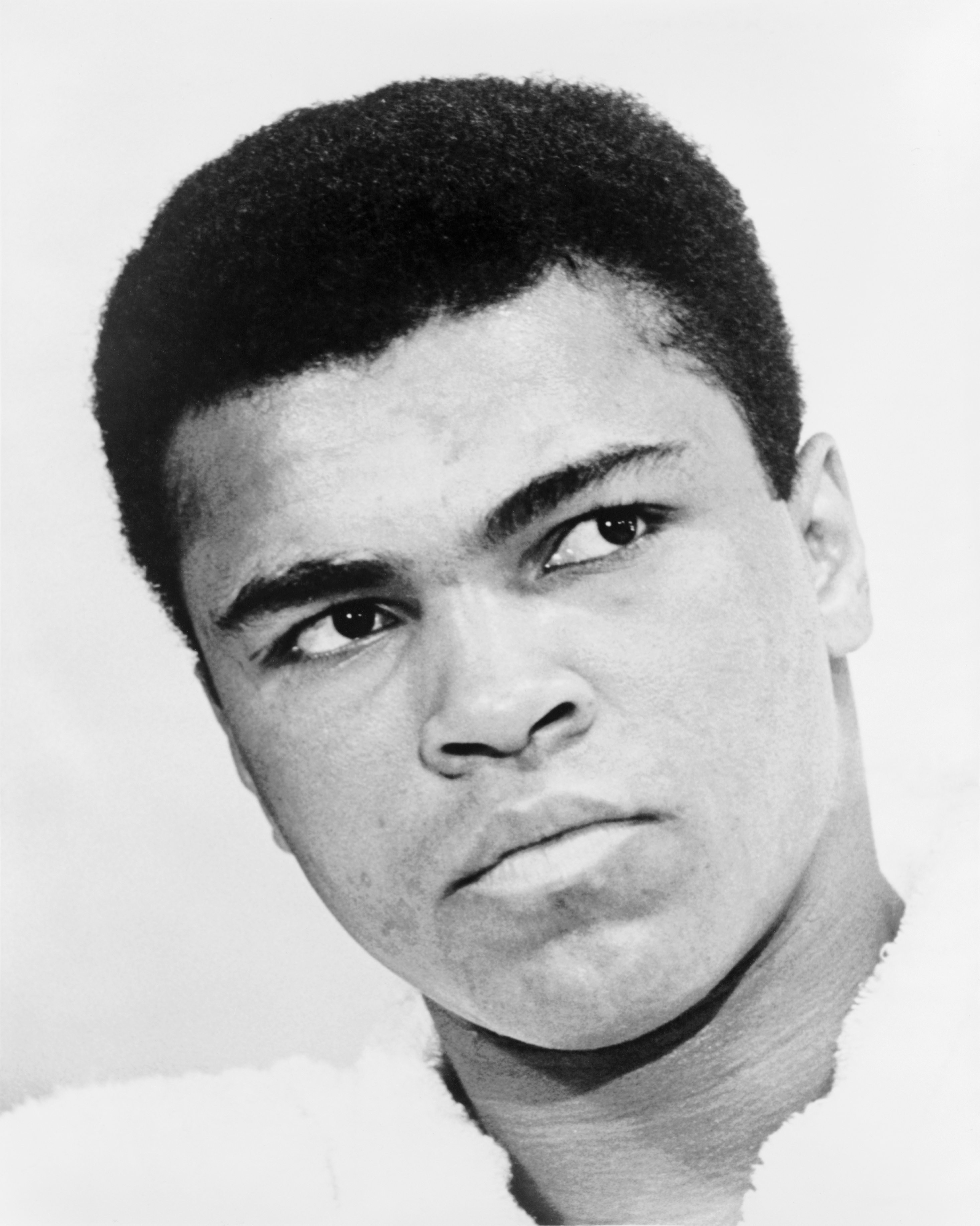
Contents — explore this biography
Louisville and the Olympic breakthroughA heavyweight with a different styleConscience, suspension and returnChampionship rivalries and reinventionHumanitarian work and public memoryLouisville and the Olympic breakthrough
Muhammad Ali was born Cassius Marcellus Clay Jr. in Louisville, Kentucky, in 1942. He developed as an amateur boxer in a city shaped by racial segregation, learning the balance, timing and movement that would distinguish his professional career. At the Rome Olympics in 1960, he won the light-heavyweight gold medal. The achievement established his international reputation before he entered professional boxing. His early development matters because the later public performer rested on years of disciplined technical training rather than confidence or verbal showmanship alone.
A heavyweight with a different style
In February 1964, Clay defeated Sonny Liston to become world heavyweight champion. His quick footwork, accurate jab and ability to strike while moving challenged expectations of how a heavyweight should fight. Soon afterward, he publicly affirmed his Muslim faith and adopted the name Muhammad Ali. His performances were inseparable from a deliberately assertive public identity. Predictions, humour and theatrical confrontation drew attention, but they also expressed a refusal to accept the deferential role often expected of Black athletes in American public life.
Conscience, suspension and return
Ali refused induction into the United States armed forces in 1967, citing his religious convictions and opposition to the Vietnam War. He was convicted of draft evasion and lost access to championship competition during important years of his athletic prime. The Supreme Court overturned the conviction in 1971. His position divided audiences and made his career part of wider arguments about conscience, citizenship and racial equality. The significance of that period lies partly in the professional cost he accepted while contesting the authority of institutions far beyond boxing.
Championship rivalries and reinvention
His return produced defining contests against Joe Frazier, George Foreman and other leading heavyweights. He regained the world title against Foreman in Kinshasa in 1974 and defeated Frazier in their third meeting in Manila in 1975. In 1978 he recovered a heavyweight title from Leon Spinks. These achievements required adaptation as the effortless mobility of his youth diminished. Endurance, tactical adjustment and psychological pressure became increasingly visible. The celebrated victories also belonged to a physically punishing sport, and should not obscure the demands that repeated heavyweight competition placed on its participants.
Humanitarian work and public memory
After retiring, Ali became an internationally recognised humanitarian and a visible figure living with Parkinson’s disease. His lighting of the Olympic cauldron in Atlanta in 1996 became a powerful public moment. The Muhammad Ali Center opened in Louisville in 2005 to connect his life with education and service. He died in 2016. His legacy cannot be reduced to an unbeaten record, which he never held across his entire career. It combines extraordinary competitive achievement with the lasting example of an athlete claiming authority over his name, beliefs and public responsibilities.
Career timeline
Born in Louisville, Kentucky.
Won Olympic light-heavyweight gold in Rome.
Defeated Sonny Liston and adopted the name Muhammad Ali.
Regained the heavyweight championship against George Foreman.
Died after decades of sporting and humanitarian influence.
Selected works & milestones
Olympic champion
Won the light-heavyweight tournament in Rome.
Supreme Court reversal
His draft-evasion conviction was overturned.
Rumble in the Jungle
Defeated George Foreman in Kinshasa.
Muhammad Ali Center
The Louisville institution opened to advance education and service.
- Muhammad Ali Center — life timeline
- National Archives — Muhammad Ali
- U.S. Olympic & Paralympic Museum — Muhammad Ali
Published 2026-11-05. Sources reviewed for this edition. Independent coverage of public professional activity.