Contents — explore this biography
Alabama, Cleveland and early athletic promiseThe record-setting meeting at Ann ArborFour gold medals in BerlinFame did not erase discriminationEducation, remembrance and sporting legacyAlabama, Cleveland and early athletic promise
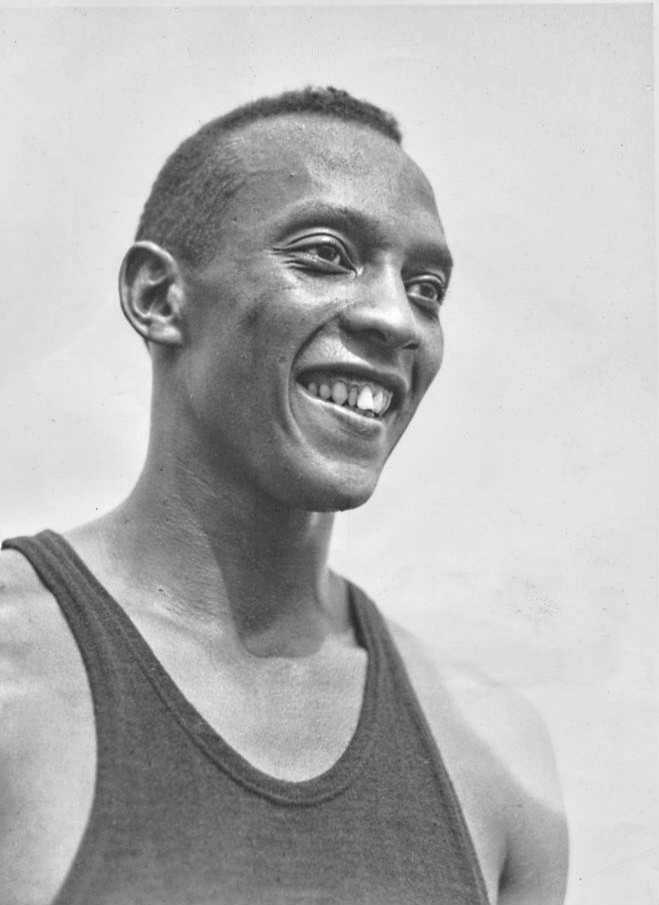
James Cleveland Owens was born in Oakville, Alabama, in 1913. His family later moved to Cleveland, where his athletic ability developed during his school years. Known as Jesse, he excelled in sprinting and jumping before enrolling at Ohio State University in 1933. His progress took place within a segregated society that restricted opportunities for Black Americans. That context is essential to his biography: recognition for athletic talent did not automatically provide equal treatment in accommodation, education or employment, even as newspapers and sporting institutions celebrated his extraordinary performances.
The record-setting meeting at Ann Arbor
At the 1935 Big Ten championships in Ann Arbor, Owens produced one of athletics’ most celebrated sequences of results. He equalled the 100-yard world record and established new marks in the long jump, 220-yard sprint and 220-yard hurdles. The longer sprint and hurdle distances also generated recognition at their metric equivalents. Accounts describe the timing of the sequence differently, but the central achievement is clear: several exceptional performances across distinct events were concentrated into a single afternoon. His long jump of 8.13 metres remained a world record for twenty-five years.
Four gold medals in Berlin
At the 1936 Olympic Games in Berlin, Owens won the 100 metres, 200 metres, long jump and 4 × 100-metre relay. The results made him the most celebrated athlete of an event staged by Nazi Germany to project power and prestige. His victories directly contradicted claims of racial superiority through sporting evidence visible to international audiences. They should also be understood as specific athletic accomplishments. Success across explosive sprinting, technically demanding jumping and a coordinated relay required an unusual combination of speed, preparation, consistency and the ability to manage pressure over several days.
Fame did not erase discrimination
Owens returned from Berlin as an international celebrity, but Olympic achievement did not remove the racial barriers he encountered in the United States. His subsequent career involved public appearances, promotional work and the search for reliable income. The contrast between his reputation and his opportunities complicates the comforting idea that a victory on a world stage necessarily transforms society at home. His story is therefore both a record of personal accomplishment and an illustration of the distance between symbolic recognition and the practical conditions under which a celebrated athlete had to live.
Education, remembrance and sporting legacy
In later life, Owens worked with young people and became a public speaker whose experiences connected sport with perseverance and opportunity. He died in 1980. Museums, universities and sporting organisations continue to preserve his record and explain the historical setting of Berlin. His four-event Olympic achievement was matched by Carl Lewis in 1984, but that comparison does not diminish its distinctive context. Owens remains important because his biography joins precise, measurable athletic excellence with a much wider history of race, public representation and the incomplete promises of national admiration.
Career timeline
Born in Oakville, Alabama.
Enrolled at Ohio State University.
Produced his celebrated record-setting performances at Ann Arbor.
Won four Olympic gold medals in Berlin.
Died in Tucson, Arizona.
Selected works & milestones
Ann Arbor world records
Set sprint, hurdle and long-jump marks in one meeting.
Olympic sprint double
Won both the 100 metres and 200 metres.
Olympic long jump
Won gold in the long jump in Berlin.
Olympic relay gold
Completed his four-gold Games with the 4 × 100-metre team.
- U.S. Olympic & Paralympic Museum — Jesse Owens
- Ohio State University Libraries — a lasting legend
- World Athletics — Hall of Fame profile
- United States Holocaust Memorial Museum — Berlin 1936
Published 2026-11-05. Sources reviewed for this edition. Independent coverage of public professional activity.