Contents — explore this biography
Arkansas, radio and the beginning of a musical vocabularySun Records and a voice built around restraintAlbums, conscience and the prison audienceTelevision, collaboration and a broad public presenceThe American recordings and a late artistic reconsiderationArkansas, radio and the beginning of a musical vocabulary
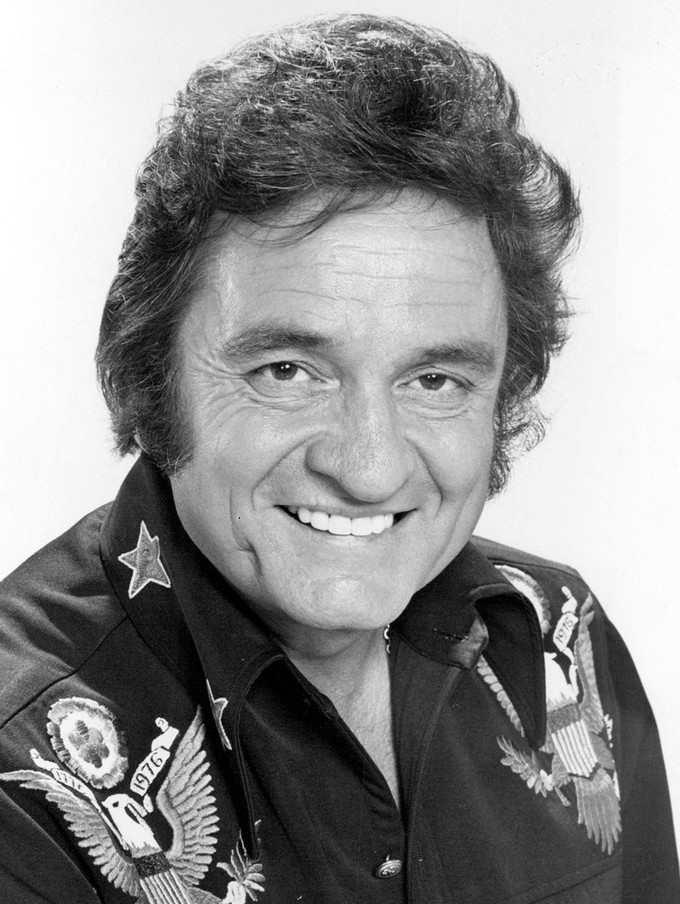
Johnny Cash was born in Kingsland, Arkansas, in 1932 and grew up in Dyess, a farming settlement where family work, church music and radio shaped his early experience. Gospel, country songs and stories of hardship entered the musical language he would later carry into recording studios. Military service in the United States Air Force took him to Germany, where he continued writing and playing. Returning to civilian life, he settled in Memphis in 1954. These experiences preceded the famous public image; they help explain the mixture of ordinary labour, moral questioning and geographic movement that runs through his repertoire.
Sun Records and a voice built around restraint
Cash began recording for Sun Records in 1955 with guitarist Luther Perkins and bassist Marshall Grant. The combination of his low voice and the group’s spare rhythmic accompaniment offered a sound that could be recognized without elaborate production. I Walk the Line became a major success in 1956. Its musical discipline matches the tension of a narrator making a pledge that must be sustained. Cash’s importance did not depend on remaining inside one commercial category. Country audiences, rock-and-roll listeners and later folk enthusiasts could find points of entry into performances whose force often came from measured delivery rather than vocal decoration.
Albums, conscience and the prison audience
After moving to Columbia in 1958, Cash expanded his recording ambitions through concept albums, historical subjects and songs of social concern. The prison albums At Folsom Prison in 1968 and At San Quentin in 1969 became defining works. Their power involves the relationship between performer and audience: laughter, applause and responses from incarcerated listeners are part of the recorded experience. These concerts should not be confused with a fictional biography in which Cash spent years in prison. Instead, they reflect a sustained interest in people living under judgment, and in the distance between an official account of punishment and an individual human story.
Television, collaboration and a broad public presence
The Johnny Cash Show brought music to national television from 1969 to 1971 and placed artists from different traditions on the same platform. His work with June Carter Cash joined domestic partnership with a musical collaboration that retained its own humour and dramatic timing. Later participation in the Highwaymen connected him with Willie Nelson, Waylon Jennings and Kris Kristofferson. The familiar black clothing became a public symbol, but it did not describe every emotional register of the work. His catalogue also contains playful songs, gospel conviction, tender duets and narratives whose speakers are neither uncomplicated heroes nor straightforward villains.
The American recordings and a late artistic reconsideration
Working with producer Rick Rubin, Cash began the American Recordings series in 1994. The arrangements often placed his voice against limited accompaniment, making the age and texture of the instrument part of the interpretation. Songs by other writers could emerge as acts of reflection rather than demonstrations of stylistic imitation. His recording of Hurt became particularly prominent late in his life. Cash died in 2003, having entered both the Country Music and Rock & Roll Halls of Fame. His career shows how a consistent vocal identity can remain productive across changing recording methods, audiences and definitions of musical authenticity.
Career timeline
Born in Kingsland, Arkansas.
Began recording for Sun Records.
Released At Folsom Prison.
Released American Recordings with producer Rick Rubin.
Died in Nashville, Tennessee.
Selected works & milestones
I Walk the Line
A signature early single.
At Folsom Prison
A live album recorded before an incarcerated audience.
At San Quentin
A second major prison concert album.
American Recordings
The opening album of his collaboration with Rick Rubin.
- Country Music Hall of Fame — Johnny Cash
- Johnny Cash — official career timeline
- Rock&Roll Hall of Fame — Johnny Cash
- Grand Ole Opry — Johnny Cash
Published 2026-11-07. Sources reviewed for this edition. Independent coverage of public professional activity.