Contents — explore this biography
Academic training and the study of employmentResearch and the explanation of imperfect marketsMoving between scholarship and public institutionsThe Federal Reserve chairmanshipTreasury leadership and a distinct policy mandateAcademic training and the study of employment
Janet Yellen was born in Brooklyn in 1946. She studied economics at Brown University and completed her doctorate at Yale in 1971. Teaching and research appointments took her to Harvard, the London School of Economics and the University of California, Berkeley. Her scholarship focused particularly on labor markets and macroeconomics. These interests connect the statistical language of economic policy with concrete questions about unemployment, wages and business behavior: why people remain without work, why firms set pay as they do and how aggregate conditions affect individual opportunities.
Research and the explanation of imperfect markets
Yellen’s work included research on efficiency wages, associated with the idea that higher pay can improve productivity, reduce turnover or support employee effort. This line of inquiry challenges the assumption that a firm always benefits by paying the lowest available wage. The research belongs to a broader attempt to explain why markets may not adjust immediately or smoothly to changing conditions. Its significance for her biography is analytical rather than promotional: it provided a framework for examining employment and economic slack, not a universal formula for business decisions.
Moving between scholarship and public institutions
Yellen joined the Federal Reserve’s Board of Governors in 1994 and chaired the White House Council of Economic Advisers from 1997 to 1999. She later became president of the Federal Reserve Bank of San Francisco in 2004 and vice chair of the Federal Reserve Board in 2010. These positions involved different responsibilities, ranging from economic advice to regional banking oversight and national monetary policy. Her career therefore reflects repeated movement between research and institutions where decisions must be made collectively, with incomplete information and substantial consequences.
The Federal Reserve chairmanship
Yellen chaired the Federal Reserve from 2014 to 2018, becoming the first woman to hold that position. Her term followed the financial crisis and the extraordinary monetary-policy measures introduced during its aftermath. The institution had to judge how recovery in employment and changes in inflation should affect the pace of policy normalization. Such decisions were made by the Federal Open Market Committee rather than by the chair alone. Her leadership is best considered through this collective process, including the need to communicate uncertainty and explain choices to the public.
Treasury leadership and a distinct policy mandate
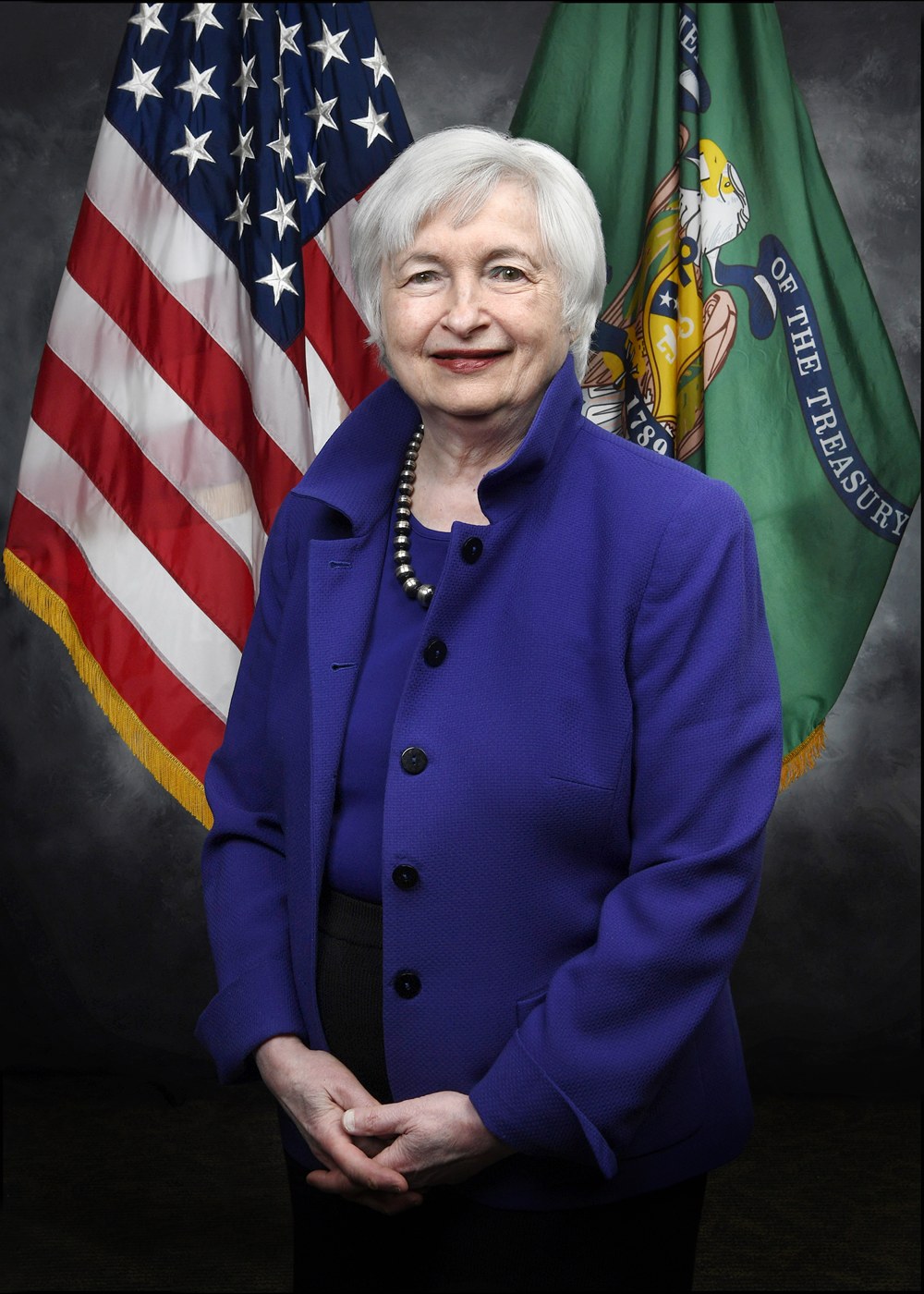
Yellen served as U.S. Treasury secretary from January 2021 to January 2025. This was a different office from Federal Reserve chair: the Treasury operates within the elected administration, while monetary policy is assigned to the central bank. She became the first person to lead the Treasury, Federal Reserve and Council of Economic Advisers. Her career links academic analysis with several forms of public economic leadership. The distinction between those institutional mandates is central to understanding her contribution, and her Treasury service is presented here as a completed tenure rather than a current appointment.
Career timeline
Born in Brooklyn, New York.
Completed her economics doctorate at Yale.
Joined the Federal Reserve Board of Governors.
Became chair of the Federal Reserve, serving until 2018.
Became Treasury secretary, serving until January 2025.
Selected works & milestones
Council of Economic Advisers
Led the council from 1997 to 1999.
Federal Reserve Bank of San Francisco
Served as president until 2010.
Federal Reserve chairmanship
Led the Board of Governors from 2014 to 2018.
U.S. Treasury secretary
Served from 2021 to 2025.
- U.S. Treasury — completed tenure and biography
- Federal Reserve History — career record
- U.S. Treasury — appointment announcement
Published 2026-11-05. Sources reviewed for this edition. Independent coverage of public professional activity.